Israel released footage of one of Hamas's most complex tunnels, where the commanders were hiding


The Israel Defense Forces (IDF) has released a video showing what it describes as one of Hamas' “most complex” underground infrastructures beneath the southern city of Rafah, Fox News reports.
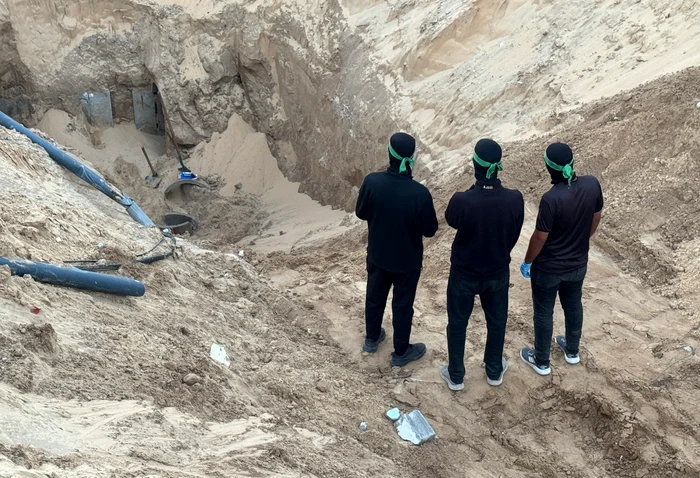
According to the IDF, the seven-kilometer-long “root tunnel” is about 25 meters deep, contains about 80 chambers and was used for command operations, weapons storage and housing for Hamas operatives.
Video footage posted on X on November 20 traverses reinforced concrete passages and large chambers, evidence of the sophistication and extent of the Hamas tunnels.
The Israeli military claims that the tunnel starts under a United Nations Relief and Works Agency (UNRWA) compound and continues under civilian sites.
“IDF troops discovered one of the largest and most complex underground routes in Gaza, more than 7 km long, about 25 meters deep, with about 80 hiding places, where Lt. Hadar Goldin, the kidnapped IDF officer, was held,” the post said.
Israeli analysts appreciate that the demolition of this tunnel marks a strategic blow for Hamas and “opens the way to its defeat”.
“The destruction of this tunnel, as well as many others like it…as well as other terrorist facilities, pushes Hamas to the brink,” commented Professor Kobi Michael, senior researcher at the Institute for National Security Studies (INSS) and the Misgav Institute.
“It's one of the longest and most complicated tunnels ever discovered, but it's not the only one,” he told Fox News Digital.
Michael explained that Hamas tunnels form the backbone of its underground warfare system.
“This is an example of a root tunnel, a strategic one that feeds many tactical tunnels and is used for strategic purposes such as command and control, weapons storage, weapons manufacturing platforms and strategic logistics,” he said.
“Such a tunnel is normally occupied by hundreds of militants and commanders,” he pointed out.
The IDF believes this network of tunnels may have been connected to the area where Lt. Hadar Goldin, an Israeli soldier kidnapped during the 2014 Gaza war, was held captive. Hamas returned Goldin's remains earlier this month – after more than a decade.
The discovery of the tunnel sheds new light on the scale of the Palestinian Islamist group's underground operations.
“I have no idea how much the costs would be, but if we take into account the volume of construction materials, labor and facilities, as well as the length of the tunnel, it is millions of US dollars,” the quoted analyst estimates. “Hamas chose routes under sensitive civilian and humanitarian facilities to prevent the IDF from attacking the tunnel.”
As Israel continues its operations in Gaza, destroying Hamas' tunnel networks remains central to its strategy to dismantle the group's military capabilities and prevent future attacks.
In 2014, Israeli Prime Minister Benjamin Netanyahu said he intended to destroy the tunnels, which Hamas militants used to infiltrate Israeli territory, “with or without a ceasefire.”
According to a 2023 Reuters investigation, Hamas said it used the tunnels to hide hostages captured in its October 7 attack on Israel.
The Israeli military has revealed that its ground forces have discovered about 1,500 Hamas tunnels and hideouts in the Gaza Strip.