The mysterious warrior women deep in the South American jungles. One of the largest rivers on Earth was named in their honor


The Amazon, the world's fastest river and largest watershed on Earth, was named after a mysterious tribe of warrior women who attacked Spanish conquistadors in the 16th century. Chroniclers wrote about their ferocity and skill in battle.
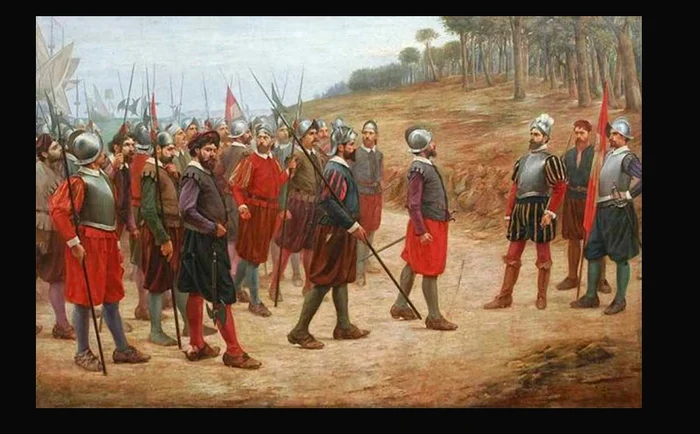
Orellana's expedition PHOTO ancient origins.net
In the 16th century, the great maritime powers of Europe competed to discover new territories and establish colonies in America, a continent only discovered by Christopher Columbus in 1492. The Americas attracted whole waves of conquistadors, people eager for adventure, but above all the desire to get rich. All dreamed of the huge treasures hidden in the impenetrable jungles of South or Central America. Legends circulated at lightning speed attracting more and more adventurers to the “New World”. These gold-hungry warriors of Europe came into contact with numerous indigenous populations and tribes. One of the most mysterious encounters of the conquistadors on the American continent was with a mysterious population of warrior women. These put the European adventurers to flight, causing much damage. Impressed by these women who reminded him of the legends of the Amazons from Greek mythology, the commander of the expedition named the newly discovered river, the Amazon, the land of warrior women. The name of the river remained, but not the Amazon tribes that populated the South American jungles. The mystery of these tribes of women has remained unsolved until today.
In search of “El Dorado”, paradise in the heart of the South American jungles
The story of the women warriors of the Amazon jungles is closely related to the life and adventures of Francisco de Orellana, a Spanish conquistador of the 16th century. He was born in 1511, in the city of Trujillo, in today's western Spain, then part of the Kingdom of Castile. Francisco was born into a family of Spanish nobles, at a time when the fever of the Americas gripped the whole of Spain. In the year 1492, Christopher Columbus had discovered a new continent, trying to find a way going west on the Atlantic Ocean, to India. The new discoveries brought great prestige to Spain and gave rise to a real wave of expeditions to the new territories.
Hundreds of Spanish nobles became conquistadors, arming entire armies to claim new territories for the Spanish crown. On a personal level, they were searching for the treasures that the legends of the early explorers spoke of and dreamed of establishing their own kingdoms in these rich and no-man's lands. The conquistadors, caught up in the fever of gold and conquest, slaughtered entire indigenous populations, destroyed kingdoms and entire civilizations. In this world Francisco de Orellana grew up and his childhood dream was to become a famous conquistador, just like his cousin, Francisco Pizzaro, who had conquered the Inca Empire on the west coast of South America. His dream came true when, as a teenager, in 1527, he was taken to the New World by Francisco Pizzaro.
In South America, Francisco de Orellana becomes a true conquistador. He participates in the expeditions in Nicaragua and then joins his cousin, Francisco Pizzaro, in Peru, in the battles against another Spanish conquistador, Diego de Almagro. For his contribution and outstanding qualities as a commander and fighter, Orellana is appointed governor of the province of La Culata. On this occasion, he rebuilds the city of Guayaquil. But de Orellana's dream was to explore the Amazonian jungles. He had learned from the locals that there would be El Dorado, a land of gold and immeasurable riches. It was obviously a story concocted by the Peruvian locals to escape the conquistadors, who hoped that they would venture into the jungle thirsty for riches and leave their bones there, killed by nature and the wild tribes that populated that vast green territory. Francisco de Orellana was fascinated by these stories and was waiting for an opportune moment to make an expedition into the jungles at the foot of the Andes.
“Green Hell” and one of the most important discoveries
The chance to participate in such an expedition arose in 1540, when Gonzalo Pizzaro, the brother of Francisco Pizzaro, was appointed governor of Quito (the capital of Ecuador today). Along with Gonzalo Pizzaro was arriving in Quito and de Orellana, who was one of his lieutenants. Finally, Pizzaro is ordered to discover new territories, especially the mysterious “Land of Cinnamon”, which is said to be somewhere in the eastern area, in the middle of the Amazon jungle. Pizzaro leaves with more than 200 Spaniards and about 4000 natives guided by the stories of the locals. At the exit from the mountains, Pizzaro is left with only 1000 natives and about 80 Spaniards.
De Orellana had been sent to bring a detachment of cavalry and only caught up with Gonzalo Pizzaro after a month. When the combined forces of the two reach the Coca River, a tributary of the Napo River, Gonzalo Pizzaro decides to stay behind to assist in the construction of a ship to transport the wounded and supplies while he sends de Orellana up the Coca River to explore further. The understanding was that when Francisco de Orellana discovered the mouths of the river he would return to Pizzaro and report. Once at the confluence with the Napo River, de Orellana's men inform him that they will revolt if the conquistador does not continue the expedition. Basically, they didn't let him go back. De Orellana is appointed commander of the new expedition and sets out to discover and claim new territories for Charles the Fifth, King of Spain.
de Orellana's crew consisted of 50 Spaniards, including the famous Dominican friar Gaspar de Carvajal, an important chronicler of his time. Orellana's troops were quite well equipped, including arquebuses and crossbows. In the end, the conquistador sets out to sail the Amazon, being the first European to discover this river and to manage to complete it until it empties into the Atlantic. But it was a hellish journey, marked by hunger and exhaustion, as they were repeatedly attacked by the indigenous people on the banks, especially by those from the Omagua tribe and then by the Machipari tribe. On June 3, 1542, Orellana arrives at Rio Negro. Only on August 26, 1542, Francisco de Orellana managed to reach the Atlantic. It was an incredible achievement. Originally, the Amazon was called Rio Orellana.
The mysterious warrior women in the heart of the jungle
During his journey in the Amazon, Francisco de Orellana and his small expeditionary force encountered a mysterious population of warrior women. The Dominican monk Gaspar de Carvajal also wrote about them. It all happened after the Spanish managed to find peaceful populations where they got supplies and managed to finish the main ship. When they reached the Machiparo region, the Spaniards' luck changed. They were met with hostility and waves of arrows.
“On the twelfth of May they arrived in the province of Machiparo, which is densely populated and ruled by another chief named Aomagua. One morning they discovered several canoes, full of warlike Indians, with large shields made of lizard skins and dantas/drums beating, and shouting, threatening to eat the Christians.”wrote Antonio Herrera about Orellana's journey. While fighting the natives, the Spanish observed groups of women warriors who brutally attacked them with bows and arrows. They were women of athletic build, well trained for battle. They also had great dexterity, managing to injure four Spaniards, including the Dominican friar. Testimonies indicate that these women had ivory-white skin. Having managed to escape the attack of the women and, above all, the pursuit of the natives in canoes, the Spaniards halted at the confluence of a river called the Tapajos. Here, Francisco de Orellana would have pulled the tongue of an indigenous taken prisoner. He would have said that those warrior women lived in the jungle in just under 70 settlements. There, they refused marriage and had only sexual relations with captives taken from different tribes. Boys born from these unions were banished. Only girls were kept to be trained as warriors.
Also from the natives, Orellana learned that these women possessed considerable wealth and that they worshiped a sun god. In turn, Cristobal de Acuna, another explorer and Christian missionary, visited the same region in 1637 and confirmed the stories of Amazons in the jungles of South America. It described a mystical lake called Parime, where warrior women gathered salt and precious stones. At the same time, Sir Walter Raleigh made an expedition to Guyana in 1595 and mentioned these women warriors. “They accompany the men only once a year and for a month. I deduced from their account that it would be the month of April. At that time all the kings of the lands and the queens of the Amazons gather, and after the queens have been chosen, the rest draw lots who will become their partners. In that month they feast, dance, and at the end of the month they all go to their provinces. If they conceive and give birth to a son, they return him to the father; if he has a daughter, they feed her and keep her, and all those who have daughters send a gift to the procreators”, specify this one. For now, these warrior women have remained a great mystery. Francisco de Orellana named the discovered river the Amazon, recalling the warrior women he encountered.