2025-11-20 22:11
publication
2025-11-20 22:11
This wasn't supposed to be like this. After Nvidia's excellent results and moderately poor labor market data, investors had the right to count on a rebound after the recent declines. This did appear at the beginning of Thursday's session, but quickly faded away.

Before Thursday's session, stock market bulls got everything they needed to recover from the recent declines. This was primarily Nvidia's strong quarterly results combined with solid forecasts for the current quarter and CEO Huang's hurray-optimistic tone. Although Nvidia's shares rose by over 6% in Wednesday's aftermarket trading, they ended Thursday's session almost 3% below the mark!
The second driving force behind the stock market growth should have been the “overdue” September payrolls. They were exactly what the market could have dreamed of. Employment growth apparently far exceeded economists' expectations, but still remained weak. Not recessionarily weak, but low enough to push the unemployment rate to its highest level in 4 years. And this should be enough for the Federal Reserve to reduce interest rates again in December. The probability of such a scenario implied by futures contracts increased from 30% to almost 40% – according to FedWatch Tool calculations.
So everything seemed to be as it should be. And indeed
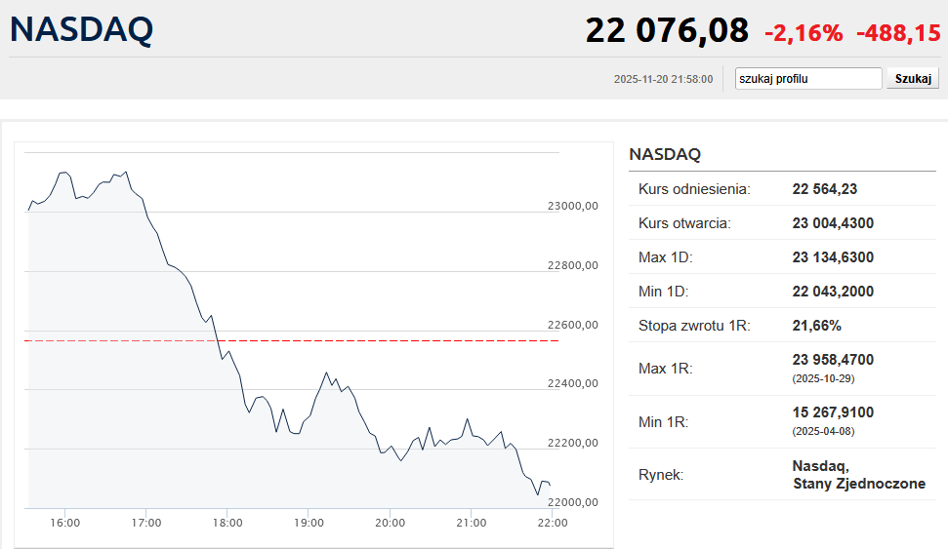
Thursday's session on Wall Street started with solid gains. After half an hour of trading, the S&P500 and Nasdaq were gaining approximately 2%. But then they started to decline rapidly. Finally, the S&P500 ended the day at 6,538.76 points, which meant a decline of 1.56% compared to Wednesday's closing level. The Nasdaq Composite went down as much as 2.15%, which translated into a discount of as much as 4.6% compared to the session maximum. So it was a beautiful disaster.
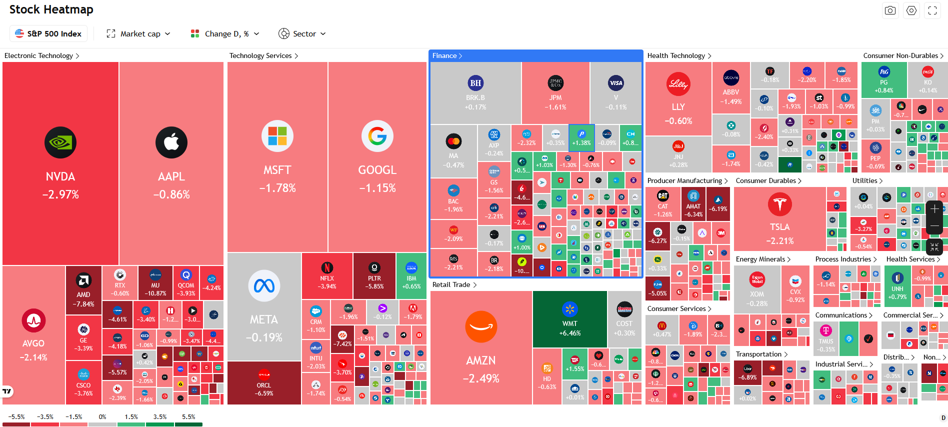
Almost all sectors of the American market were glowing red. Despite the good news from Nvidia, the AI industry has been hit hard. Google and Microsoft shares fell more than 1% each. The stock prices of Oracle and Palantir fell by approximately 6% each, the stock price of AMD dropped by almost 8%, and the stock of Micron Technology was depreciated by almost 11%.
– For now, the situation is good, but what will happen in three months, when the market will be waiting with bated breath for Nvidia's next quarterly report? Even though Nvidia's profits and cash flows remain as healthy as an ultramarathon runner, there are some red flags, said Dan Coatsworth of AJ Bell for Reuters on Thursday.
Let us remember that the real reasons for Thursday's sale may lie elsewhere. This is about what has been happening on the Japanese debt market in recent days and weeks. The yields of long-term “samurai” are growing like a weed, killing the profitability of carry trade transactions that have been pumping up the valuation of risky assets for previous years or even decades. Michał Kubicki wrote more about this in an article titled “Japan may overturn the table of the financial world.”
The only larger patch of green on the stock market map were Wal-Mart's shares, which rose by 6.5% after the publication of the results for the third quarter. The largest stationary retail chain in the US slightly beat the market consensus both in terms of earnings per share and revenues, but additionally raised its full-year earnings forecast.
K.K