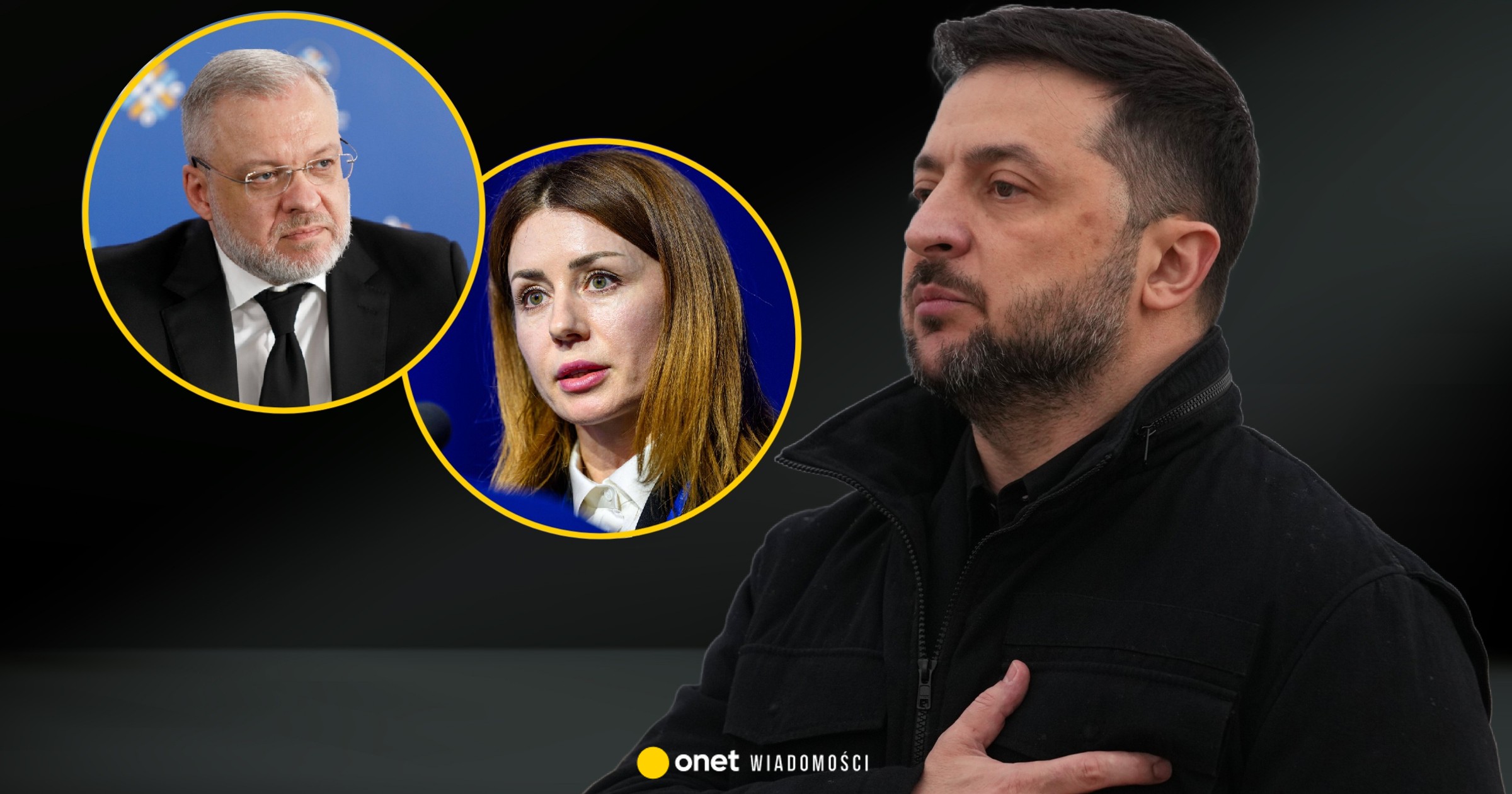
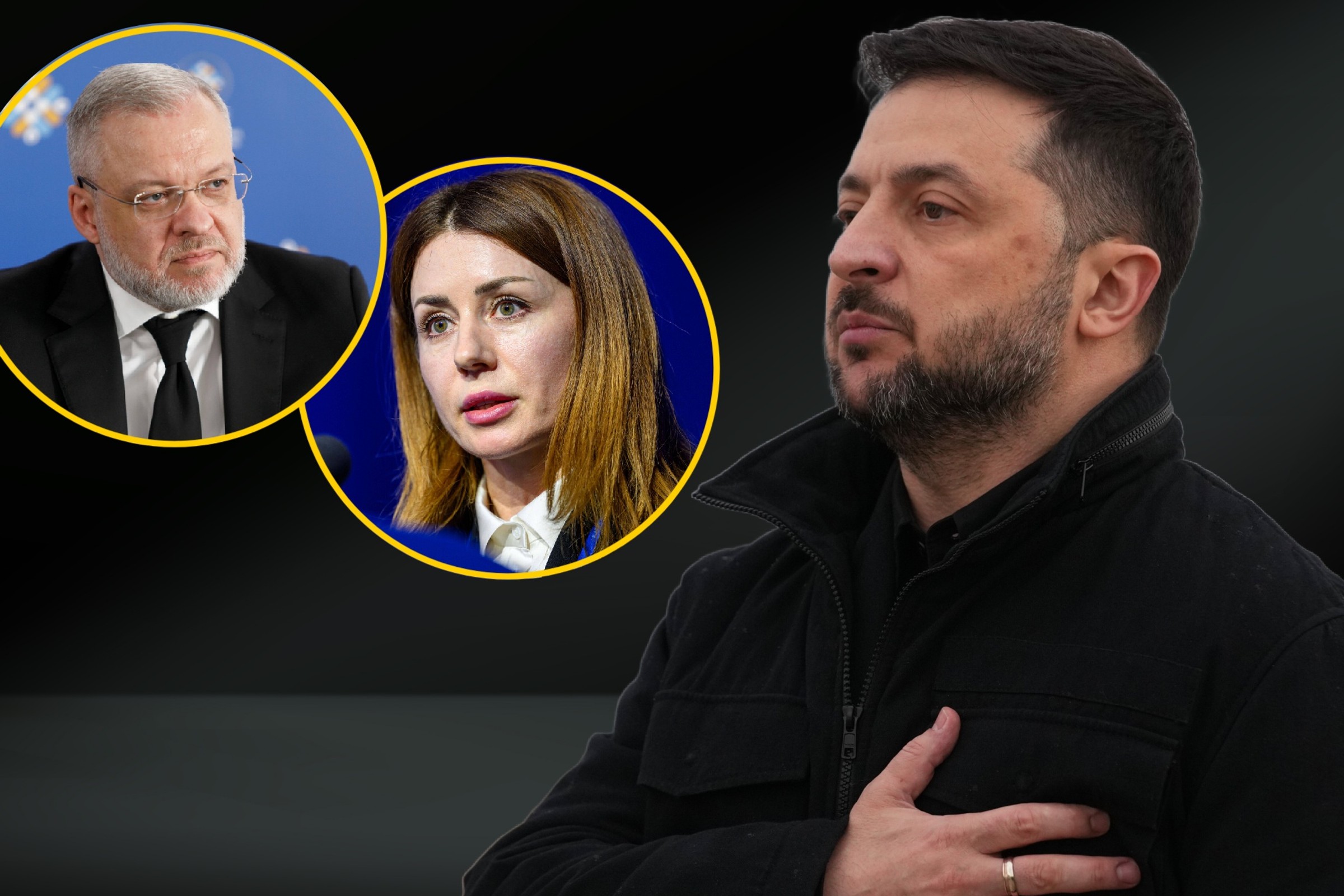
On Wednesday, November 19, the Ukrainian parliament approved Volodymyr Zelensky's request to dismiss Energy Minister Svitlana Hrynchuk and Justice Minister Herman Halushchenko. The decision was made in connection with the scandal, which is being followed by the entire West, concerning the embezzlement of at least USD 100 million (approx. PLN 367 million) from the funds of the state-owned nuclear company Energoatom.
The turbulent corruption scandal of Zelenskiy's government is a difficult test for the leader of the war-torn country.
However, some MPs demand more radical changes. They want the entire government of Prime Minister Yulia Svyrydenko to resign, and above all, the departure of Zelensky's right-hand man, the head of his cabinet, Andriy Yermak. Many of Ukraine's Western allies see him as a problematic politician due to his monopolization of power and decision-making for the president.
The whole case is accompanied by secret recordings, nicknames straight from gangster movies and disappearing millions. The backstage goes much deeper than the resignations of ministers and leads to the very heart of the presidential support base in the background there is the question of who was actually pulling the strings.
The Ukrainian Pravda newspaper wrote that some politicians from Zelensky's party are pressuring the head of state to sacrifice Yermak. They argue that he was almost certainly involved in the scandal. They assume that he knew about it perfectly well and did nothing to prevent it.
There is speculation in the Ukrainian media that the leader of Zelensky's faction in parliament, Davyd Arakhamiya, and dissatisfied government MPs may join forces with the opposition and force Zelensky to get rid of Yermak. They are the ones who will deal with the crisis in the coming days. They will also watch how the president handles the situation.
Zelensky last had the opportunity to prove himself in the summer of this year, when, after massive public protests, he withdrew his criticized decision to deprive the independence of two key anti-corruption institutions – the National Anti-Corruption Bureau of Ukraine (NABU) and the Special Anti-Corruption Prosecutor's Office (SAP). It was NABU investigators who revealed the scandal, which may seriously harm not only Zelensky, but also worsen the mood in the country and weaken Ukraine's position in relations with its allies.
Limousine at the border
The NABU investigation lasted approximately 15 months. The agents collected dozens of hours of recordings of conversations conducted in secret apartments and offices in Kiev and its surroundings, documenting the illegal withdrawal of funds from the Energoatom energy concern and other companies. This strategic state-controlled enterprise is responsible for approximately 85 percent. electricity production in the country and operates funds amounting to billions of dollars.
The “brains of the operation” is to be Timur Mindich, a long-time friend of the president and former co-owner of the Kvartal 95 studio, where Zelensky began his acting career. Investigators showed that Mindicz – a lobbyist operating in the shadows – together with several associates decided which companies would receive contracts from Energoatom. According to the findings, entrepreneurs who wanted to get orders had to pass them on bribes up to 15 percent contract values.
In Ukraine, Mindich is considered to be extremely close to Zelensky.
This relationship allowed him to use his influence in discussions about forced payments, making it easier for companies to succumb to his pressure. So far, investigators have not presented evidence of the president's direct involvement in corruption. However, after NABU's actions, it was revealed that people from his environment siphoned funds from the state-owned company. weakened the country's defense capabilitieswhile living in ostentatious splendor.
NABU found a golden toilet in Mindicz's apartment. The police failed to detain him because a few hours earlier he had been warned by an undisclosed person – according to some Ukrainian media, it could have been one of the investigators. He left Ukraine in a hurry, probably along the route through Poland to Israel, using the services of a company offering luxury car rides. Bribes and influence probably helped him again, because during the war, men his age are banned from leaving the country.
The American FBI is also involved in the investigation, and Mindicz has been charged with criminal conspiracy and money laundering. According to “The Economist”, some of the stolen funds were probably transferred to Russia.
With part of the money withdrawn, Mindicz financed the construction of luxurious villas near Kiev, which served as a comfortable base for the then Deputy Prime Minister of Ukraine Oleksiy Chernyshov and other officials.
As noted by the Kyiv Independent daily, Chernyshov most likely got into the government thanks to Mindich's protection. He ultimately lost his position after being accused of corruption in the summer.
Bags of cash
The Mindicz case resembles a gangster movie scenario. The suspects used pseudonyms to make their identification difficult when talking about bribes and illegal deals. According to investigators, Mindich himself went by the codename “Carlson”, Chernyshov as “Che Guevara”, and Halushchenko as “Professor”.
In one of the wiretap recordings, one of the accused even complains about back pain from carrying heavy bags of cash around Kiev.
Another suggests that investing in protecting key power stations near nuclear power plants would be a “waste of money.” On November 8, the day before the scandal broke, Russian drones and missiles focused on these stations.
For a long time, the investigation was conducted within a very narrow circle of initiated people, but ultimately it was not possible to maintain full secrecy. Ukrainian media report that in July the suspects began to worry, fearing NABU's actions. It's unknown if anyone warned them beforehand, but at some point they went on the offensive.
Some NABU investigators were threatened with professional destruction and were placed under surveillance to check what exactly they did. However, this was not the only disturbing signal – pressure on NABU and SAP also began to come from the Chancellery of the President. The security services controlled by it detained several officers of the anti-corruption prosecutor's office, and one of them was charged with, among others, about alleged cooperation with Russia.
The very next day, MPs from the presidential party pushed through a bill that could take away the independence of anti-corruption institutions. Local media indicated that the main initiator of these actions could have been the head of the president's office, Andriy Yermak. The president suspended the entry into force of the law only after a wave of protests – people took to the streets of many Ukrainian cities, including those located close to the front line.
– They're not perfect. They work to the best of their ability. Only a few cases ended with sentences of absolute imprisonment. However, I wouldn't consider it their fault. This is a problem with the court system — Olga Rudenko, editor-in-chief of “Kyiv Independent”, told the Respekt website about the activities of anti-corruption agencies. He adds that the Higher Anti-Corruption Court was established relatively recently and is a key element in building anti-corruption institutions in the country.
“The bribery scheme took years to develop”
Experts dealing with Ukraine emphasize that the corruption mechanism was not created by Mindicz and his people — they merely took over an already existing system after coming to power.
The bribery arrangement had been in the works for years, even during the rule of the pro-Russian teams.
Zelensky may not have known the full scale of the phenomenon, although some commentators believe that if he had actually been aware of the scale of the problem, he would have he would not decide to try to weaken anti-corruption institutions in the summerbecause it was politically very risky. It is possible that his colleagues – taking care of their own safety – convinced him that the investigators were linked to Russia, which led to his controversial decisions. However, there are also those who claim that Zelensky himself must have sensed something.
The article continues below the video
This case poses a real threat to Zelensky. It may undermine his public support, built on his attitude towards Russian aggression. At the same time, the ostentatious lifestyle and hypocrisy of those around him can demoralize soldiers – more and more of them may question the point of continuing to fight while the elites live in luxury. Meanwhile, Ukraine is already struggling with dramatic staff shortages at the front, which makes the situation extremely dangerous.
At the same time, pressure is growing abroad to limit further financial support for Kiev, as public funds are disappearing en masse at home. There is an ongoing debate in Europe about the possible unblocking of frozen Russian assets in Belgian banks – a decision on this matter could significantly strengthen Ukraine's defense capabilities in the coming years.
Hungarian Prime Minister Viktor Orban was one of the first to speak out, although his own government is sometimes accused of abuse of EU funds and favoring the interests of the Kremlin. Russian propaganda is eager to reinforce these narratives.
Unlike the authoritarian realities of Russia or contemporary Hungary, Ukraine still has institutions that are able to conduct real investigations. President Zelensky has already announced a broad anti-corruption audit in state-owned companies and promised further decisive reforms. Five people, including former deputy prime minister Chernyshov, were detained and the court imposed a two-month arrest on them. However, the key figure in the whole case – Timur Mindicz – remains elusive.
I’m Ashley Davis as an editor, I’m committed to upholding the highest standards of integrity and accuracy in every piece we publish. My work is driven by curiosity, a passion for truth, and a belief that journalism plays a crucial role in shaping public discourse. I strive to tell stories that not only inform but also inspire action and conversation.