Birobidzhan under construction
Photo: People's Archives of Rimma Lavochkina
November 19, 1933
The Presidium of the Far Eastern Executive Committee adopted a resolution “On the separation of the Kur-Urmiysky district from the Birobidzhansky district” and established: “Pending the resolution of the issue of transforming the Biro-Bidzhansky district into an autonomous region and a new intra-regional zoning, separate the Kur-Urmiysky district from the composition and subordination of the Birobidzhan district as an independent district, with the name of the district “Kur-Urmiysky Evenko-Nanai” national region”.

November 19, 1945
The Bureau of the Regional Committee of the All-Union Communist Party of Bolsheviks considered the issue “On the state of mass propaganda work in the Obluchensky district in connection with the elections to the Supreme Soviet of the USSR.” Attention was paid to improving the quality of reports and conversations about the Constitution of the USSR, about the electoral law and about the current situation, to deeply revealing the essence of Soviet democracy, the rights and responsibilities of citizens of the USSR, and mobilizing the efforts of workers to achieve new successes in the development of the economy and culture of the region.
November 19, 2014
In the newspaper “Birobidzhaner Stern” (12+), in the article by Viktor Gorelov “Big Ore of the Lesser Khingan” it is said that in the 1960s, in the taiga wilderness of the Pompeii mountain range, the village of Kostenga was founded, the inhabitants of which were mainly geologists.
The main task of geologists was a detailed study of one of the richest iron ore deposits – Kostenginsky.
In the first two years after its founding, the only way to get to the new village in the summer was by taking a tracked all-terrain vehicle to get through the vast swamp.
In winter, travel was easier, although certainly not for every car if it does not have driving front wheels. And only when the Iskra Khingan regional newspaper (12+) acquired an all-terrain GAZ-69 car, did the opportunity finally arise to visit Kostenga:
“I remember that the mountain pass in front of Kostenga was such that our car covered the last section in a low gear. The road was surrounded by huge larches, cedars and spruce trees. It was gloomy in the taiga, although it was bright midday. And quiet. Hunters talked about these tracts as mining areas. This is probably true, if every now and then we came across traces of wild animals.
At the top of the pass the taiga suddenly ended and immediately turned into a long street stretching along the gentle western slope. The houses are solid, built from larch, castle-like, Siberian-style. In the center of the village stood the tripod of a drilling rig, and the mast-antenna of a radio station stretched upward.
Geologists built roads, cut down residential buildings, and erected drilling rigs. By the beginning of 1970, a wide route had been built through the taiga to Kostenga. At that time, the village already had a four-year school, a store and a canteen, a library and a club, and a post office.
This is the fate of many geological villages: having completed their task and handed over the deposit to the state, geologists move to new sites, usually in the same desolation and wilderness. So the Kostenga residents, having received the necessary information about a powerful iron ore deposit in the southern spurs of the Lesser Khingan, moved to Sotnikovsky, where they began exploring even more powerful deposits.”
November 19, 1935
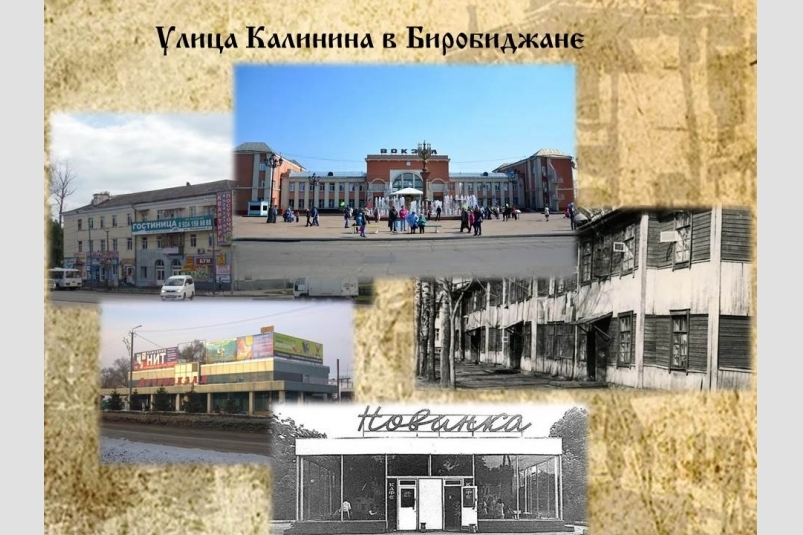
To commemorate the sixtieth anniversary of the birth of Mikhail Ivanovich Kalinin, Chairman of the USSR Central Committee and the All-Russian Central Executive Committee of the RSFSR, by resolution of the Presidium of the Regional Executive Committee of the Jewish Autonomous Region dated November 19, 1935 No. 457, Privokzalnaya Street was renamed into M. I. Kalinin Street.
On Kalinin Street, where Victory Square begins, there was one of the first pharmacies in Birobidzhan. And the first fountain in the city appeared on the station square.

Construction of the station. Photo: Photo: Heritage EAO
Before the war, two three-story houses with spacious apartments and high ceilings were built on the corners of Oktyabrskaya and Pushkin streets on Kalinin Street. Mostly nomenclature workers were housed here. Four-room apartments were turned into communal apartments. After the war, one of the houses was raised to four floors.
Day in the history of the Jewish Autonomous Region. Photo: Photo: Regional Library
In the late 1950s, a railway house was built at number fifteen – a typical brick high-rise building with two entrances. Drivers, switchmen, and track workers moved in there.
Kalinin Street loved and welcomed children. Here, in cozy two-story mansions, the Children's Tourism Center and the Children's Technical Creativity Center were located for a long time. The guys built models of airplanes, ships and other equipment, went on hikes, learned photography and much more. Now officials of the regional education committee have settled in one of these houses.

Pioneers. Photo: Photo: Heritage EAO
For a long time, Kalinin Street was a dead end, ending at the warehouses of the Far Eastern Railway freight office.
The bus station is also located on Kalinina Street.
In the early 1990s, regional fairs and exhibitions began to be held on Kalinin Street, where participants from other regions of the Far East and Siberia were invited. There were also Chinese representatives – foreign economic and trade relations with this country were just beginning to improve.
Today, one of the oldest streets is decorated with a fountain with a menorah and a monument to the pioneer builders of the region. Several beautiful modern buildings have appeared in place of old houses.
Almost every major settlement in the region has its own Kalinin streets – in Bir and Birakan, Amurzet and Nikolaevka, Leninsky and Teploozersk. There is also a village with this name in the Leninsky district.