Ukraine has signed an agreement with Greece to purchase American gas that will be delivered through the vertical corridor / Zelensky says that this winter will be “a huge challenge for the Ukrainian people”


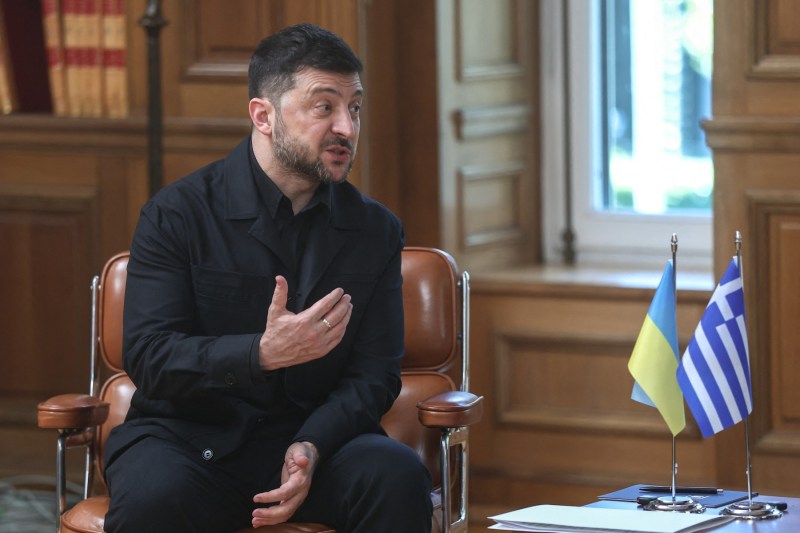
Greek Prime Minister Kyriakos Mitsotakis met with Ukrainian President Volodymyr Zelenskiy at the Maximos Palace in Athens during an unofficial visit on Sunday, November 16, 2025. Photo: Dimitris Kapantais / AFP / Profimedia.
Ukraine and Greece signed on Sunday, in Athens, an agreement for the delivery of American liquefied natural gas (LNG) to Kiev between December 2025 and March 2026, an agreement designed to meet Ukraine's needs during the winter, while Russia continues its bombing of Ukrainian energy infrastructures, AFP and EFE agencies report, according to Agerpres.
The Greek public gas company DEPA and the Ukrainian company Naftogaz have thus signed a declaration of intent regarding the supply of natural gas to the Ukrainian market this winter, from December 2025 to March 2026, the two companies announced in a statement following a meeting in Athens between Greek Prime Minister Kyriakos Mitsotakis and Ukrainian President Volodymyr Zelenskiy. The signing of the agreement, which took place in the presence of the two leaders, will allow “the support of Ukraine in the midst of a difficult winter”, the statement also states.
“The relations between our countries acquire a crucial new dimension, that of a new secure energy corridor, which starts from the south to the north, from Greece to Ukraine,” the Greek prime minister said.
“This is realized through the creation of the 'vertical' energy corridor and the essential infrastructure of the port of Alexandroupolis, with the help of which Ukraine gains direct access to diversified and reliable sources of energy,” added Mitsotakis.
“A winter under Russian drones and missiles, under daily attacks”
For his part, the Ukrainian president expressed his gratitude to the US president, Donald Trump, “for the fact that we will be able to receive natural gas not only from Greece, but also through Greece.”
President Zelensky, who from Greece will go to France and Spain to discuss defense and energy, emphasized that the coming winter will be “a huge challenge (…) for the Ukrainian people”, as it will be “a winter under Russian drones and missiles, under daily attacks”.
Ukraine needs to increase its gas imports by 30% to cope with a particularly difficult winter, marked by damage to its energy grid and dwindling reserves, and the opening of a new supply route is crucial.
Gas purchased by Ukraine through the vertical corridor will be paid for by its European backers and the government in Kiev. Zelenskiy said before the signing of the agreement that there are already agreements to finance gas imports worth about two billion euros, which will compensate for the losses in Ukrainian production caused by the Russian attacks.
Zelenski's visit to Greece follows recent announcements of major US-backed energy projects in the country. Greece is “the natural gateway for the entry of American liquefied natural gas (LNG), which will replace Russian gas in the region,” the Greek prime minister previously said.
The recent commissioning of the trans-Balkan gas pipeline connecting Greece to Bulgaria allowed the opening of the “vertical” corridor that further connects Bulgaria, Romania, the Republic of Moldova, Ukraine, Hungary and Slovakia.
A week ago, American company Venture Global and Greek company Atlantic-See LNG Trade signed Greece's first long-term agreement with a US LNG exporter, committing to supply up to 1.5 million tons annually from 2030.
The creation of storage infrastructure at the port of Alexandroupolis, near the Greek-Turkish border, where US LNG arrives, has also helped weaken Russia's position in the European gas market.
Following the Russian invasion of Ukraine and the sabotage of the Nord Stream pipelines, the EU adopted a policy of reducing imports of Russian natural gas, with the objective of completely eliminating them starting from 2027, gas that has been partially replaced by liquefied natural gas (LNG) imported mainly from the USA. Brought in by gas-carrying ships, these gases are, however, more expensive than natural gas transported through existing pipelines. However, the bloc needs energy at low prices to keep its industries competitive against rivals in China and the US, where energy costs are several times lower.