Vladimir Putin's army has just weeks left to achieve a “symbolic” victory in a key city in eastern Ukraine, or thousands of troops will face what could be a deadly winter in the region.
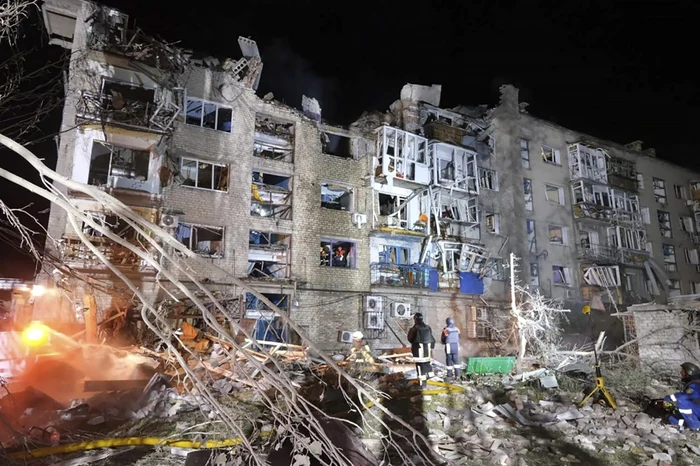
The city of Pokrov, reduced to ruins of battles/PHOTO: Profimedia
The Kremlin has pushed nearly 200,000 troops to the front in the protracted – already 18-month – attempt to capture Pokrovsk. Intelligence estimates show that at least 135,000 Russian soldiers were killed or wounded in the battle for this almost completely destroyed city.
But former intelligence officer Philip Ingram explains that, given the huge costs, a withdrawal would be “too big a defeat to justify” for Putin, making the assault on Pokrovsk a political stake for the Kremlin.
If the city does not fall quickly, a significant part of the Russian troops risks repeating the tragic experiences of past military campaigns, when armies were decimated by the harsh winters of northeastern Europe.
In Ukraine, winter temperatures can frequently drop to -20, -30°C, and snow and blizzards paralyze infrastructure in just a few hours. These are conditions that can jam vehicles, freeze weapons and end any offensive – just as happened in Finland in 1939 or with Nazi troops stopped at the gates of Moscow in 1941.
A prolonged battle and a city in ruins
Fighting for Pokrovsk has been going on for more than a year and a half, with Russia unable to fully take control of the city. In recent days, clashes have intensified, a sign that Moscow is pushing for a victory before the cold comes.
In an analysis for The Sun, Philip Ingram argues that we are witnessing the Kremlin's “winter strategy” take shape: a last-ditch effort to force a breach before frozen ground and snow block operations.
Even though the city's strategic importance has diminished significantly compared to the beginning of the war, a possible fall of Pokrovsk would give Moscow the opportunity to advance north and west, threatening other key defensive nodes of Ukraine in the Donbas – among them Kramatorsk and Sloviansk.
“The city is largely destroyed. The rail and road infrastructure is no longer functional. Logistically, the area no longer offers much to Russia. But its capture has become a symbolic goal for Putin.”Ingram explains.
Russia claims to have advanced into the city's central area in a pincer maneuver, but Kiev rejects allegations of loss of control. In unconfirmed images circulating on Russian networks, Russian soldiers are seen entering the city under the cover of dense fog.
Pokrovsk – with a population now down to a few hundred people from 60,000 before the war – consists almost entirely of burnt-out buildings and rubble-strewn streets.
Ukrainian MP Oleksi Goncearenko recently warned: “We are losing Pokrovsk. The Russians have entered the city.”
According to the Ukrainian military, the thick fog facilitated the advance of Russian troops, who would otherwise have been quickly targeted by drones. President Volodymyr Zelenskiy admits the situation is “difficult”, estimating that between 300 and 500 Russian soldiers are already inside the city.
For Moscow, after the huge losses, the capture of Pokrovsk became more of an “image-saving” operation, comparable to how the capture of Bahmut was presented.
History that should give the Kremlin something to think about
There are many examples of military campaigns destroyed by winters in northern Europe:
Winter War (1939–1940)
The Soviet invasion of Finland turned into a disaster. Temperatures of -40°C paralyzed the Soviet tanks, visible in the white landscape, insufficiently camouflaged. More than 60,000 Soviet soldiers suffered from frostbite or cold-related illnesses. Total losses reached almost 400,000.
The failure of Nazi Germany in 1941
Operation Barbarossa stalled before German troops reached Moscow. At -45°C, the soldiers – ill-equipped for winter combat – died on their heads. Almost a million German soldiers were lost in that campaign.
The Crimean War
Nor was the British army spared from tragedies. A strong storm in the Black Sea sank ships loaded with winter supplies. The soldiers ran out of food, fuel and proper equipment. Diseases – typhus, cholera, dysentery – wreaked havoc. Of the 21,000 British casualties, 16,000 had avoidable causes. Russia, for its part, lost 143,000 men at Sevastopol, 89,000 of them from disease.