VIDEO REPORT NATO's response if Romania is attacked – A first-of-its-kind exercise, carried out in real time, in three different areas of the country: drones, tanks, airborne troops

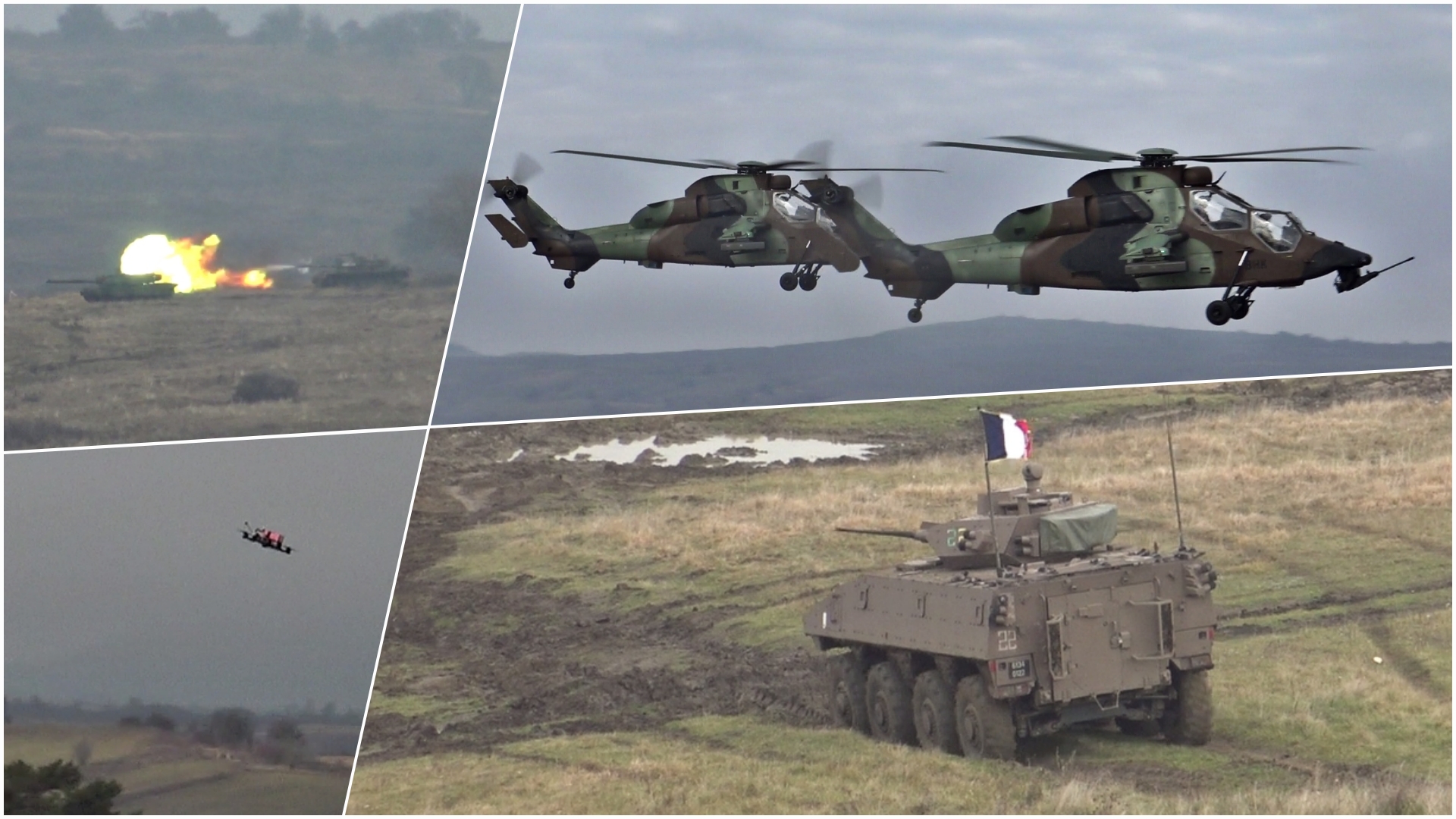
NATO has carried out in Romania, in these days, one of the largest deployments of force of the alliance on the eastern flank, say the military leaders at Cincu. For the first time on such a scale, allied militaries coordinated in real-time with each other in three different ranges across the country, but fought as if they were on the same battlefield. The script? A fictitious one, but based on the realities of our days, in which an enemy launches an offensive against Romania.
Dacian Fall 25 is by far the largest military exercise held in Romania in recent years. Through the troop movements now, NATO sees and certifies what it means, if necessary, to quickly bring thousands of soldiers to the eastern flank, to raise to brigade level – that is, almost 5,000 soldiers – the Battle Group led by NATO in Romania, which, permanently, numbers about 1,700 soldiers.
Now Dacian Fall 25 means more than 5,000 soldiers, of which almost 4,000 French, but also 1,200 means of combat, many brought from outside, by ship, on trains or by road convoys. All the troop movements and all the punctual exercises culminated on November 12-13, when NATO executed the most ambitious battle plan for the allied forces brought to Romania.
The lack of American forces in the current exercise is not related to the recent announcement made by the US that it will partially withdraw part of the military that periodically rotates to Mihail Kogălniceanu. Dacian Fall is an annual military exercise that takes place in Romania and in which the NATO Battle Group led by France and the South East Multinational Brigade are involved as combat forces. Similarly, such an exercise is held every year in the spring under the name Dacian Spring. These military exercises are currently attended by the troops of the states that send soldiers to Romania within the framework of the two structures.
Three training grounds hundreds of kilometers apart, fighting together
The scenario is simple, but very difficult to put into practice: Romania, and automatically NATO, are in a war, and the allied units are taken by surprise by an enemy offensive. In response, in three different points in the country, military units of the Romanian army and of the allies are fighting at the same time, coordinated in real time, as if they were fighting on the same front.
At Smârdan, mechanized units, tanks and armored vehicles, stop the enemy's offensive. From Capu Midia, Hawk and Mistral air defense systems secure the skies, and French HIMARS and LRU artillery rocket launchers pound the enemy behind lines and disrupt the logistics chain.
At the same time, under the coordination of drones, small and large, the largest deployment of forces takes place at Cincu: a combined counteroffensive that pushes back the enemy. All three polygons are coordinated simultaneously and everyone acts as if they are fighting in the same place on the same battlefield.
The scenario in which an enemy launches an offensive against Romania
The scenario in which Romania is attacked is a fictitious one, with an unnamed enemy, but which is based on real situations.
The exercise begins with an offensive launched by the enemy on Romanian territory. A first response comes in the direction of the Smârdan battle, where tanks and armored vehicles from the 282nd Armored Brigade “Union of the Principalities”, together with French Leclerc tanks, stop the advance of the enemy forces.
At the same time, Romanian Bayraktar drones, above the Cincu combat direction, transmit the enemy artillery positions to the artillery units. From Cincu, French Caesar self-propelled howitzers and Romanian guns respond, while from Capu Midia, Romanian HIMARS and French LRU systems respond with long-range missile fire.
Also from Capu Midia, the Romanian HAWK and the French Mistral anti-aircraft systems are activated, at short range, to free the airspace from enemy aircraft.
Rain of drones
At Cincu, a multitude of drones are launched by allied, Belgian and French soldiers, while a Bayraktar drone watches from above. New enemy positions are relayed to Spanish and French mortar teams. At the same time, the French also deploy anti-drone systems, which either jam enemy drones or knock them out of the air with a special grenade launcher.
The French deployed at Cincu also use MMP anti-tank guided missiles.
For the first time in an exercise of this magnitude in Cincu, NATO troops are using FPV (First-Person View) attack drones, small, kamikaze drones, very fast and maneuverable, guided by a pilot through a helmet – a tactic developed during the war in Ukraine.
Fighter planes, Germany's Eurofighter Typhoon and Romanian F-16 attack the enemy's anti-aircraft units, also appear on the Cincu battle direction.
In the field, at Smârdan, the mechanized units start the advance against the enemy after initially only succeeding in stopping the offensive. French, Belgian and Spanish troops press the enemy
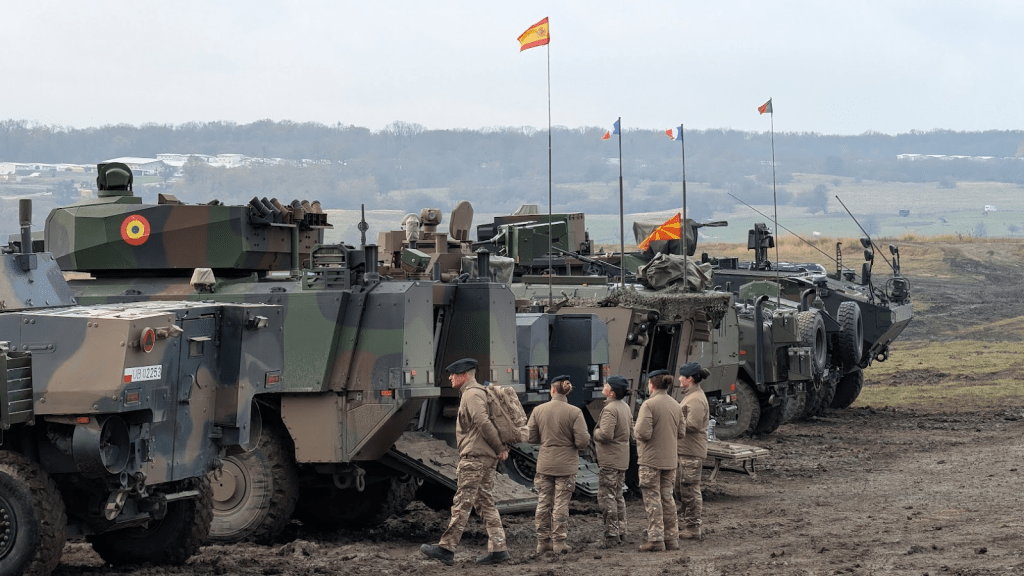
At Cincu, under the protection of artillery fire, Macedonian troops on Humvee armored vehicles and French soldiers on Panhard VBL armored vehicles advance in the field. They are joined by French VBCI and Polish Rosomak armored personnel carriers who begin firing their cannon at enemy positions previously identified by allied drones. On one flank, MLI-84M “Jderul” Infantry Fighting Vehicles also enter the fray with their 25mm remote-controlled cannon and Spike anti-tank missiles.
France is fighting with Tiger attack helicopters
At the same time, French and Romanian soldiers attack enemy armored units with Spike anti-tank guided missile launchers.
French Tiger attack helicopters intervene from one flank, launching unguided rockets and artillery barrages at enemy positions in the second row, while Leclerc and TR-85M1 “Bison” battle tanks advance from one side, enveloping the enemy on the right flank on the Cincu battle direction.
After France's Tiger attack helicopters, the Romanian IAR-330 Puma SOCAT attack helicopters now enter the scene, supporting the advance of ground troops from the air.
On the other flank, on the left side of the Cincu direction, Allied troops in armored personnel carriers envelop the trapped enemy in advanced positions, while heavy artillery launches attacks behind the line to prevent an orderly enemy retreat.
To support the enveloping maneuver, the Piranha 5 armored combat carriers of the Romanian forces, from the South-East Multinational Division from Craiova, also enter the scene.
Airborne troops, launched behind enemy lines
While the enemy is now under attack from all directions, a C-27J Spartan of the Romanian Air Force drops airborne troops who parachute behind enemy lines and marks the end of the exercise.
With Dacian Fall 25, NATO certifies that it can effectively and coherently deploy and deploy a brigade-sized force in a relatively short time, from a few days to a few weeks.
Military representatives say that it is very difficult to coordinate in battle so many different units, from different armies, on different plans and locations, all in real time, but it is equally difficult to bring them all to Romania, if needed, in a timely manner.
“A huge effort”
“We deployed the brigade from France to Romania and it was a huge effort, carried out through four modes of action: by sea, by air, by rail and by road. To understand the scale, there were departures from Greece and then crossing through Bulgaria, we used five planes, 11 different trains and 15 convoys by road – it was a massive deployment, carried out in less than 10 days”, says General Maxime Do Tran, the leader NATO brigades formed during the exercise.
“Now we moved 3,100 people and 600 technical means. We learned the lessons of previous years, we coordinated better with the other countries with the border crossing. We decided, for the first time, to save time, to use the water route, to use a ship to bring troops and equipment to Greece, it took us two days, then to cross Bulgaria to Romania in about three days,” says General Do Tran.
“The first large-scale deployment on the eastern flank”
“Dacian Fall is about training and the availability of troops. Interoperability was one of the big challenges – there are 16 nations involved in the exercise, you can imagine how difficult it is to integrate so many troops,” said General Cyril Mathias, deputy commander of the Southeast Multinational Division.
“It is one of the largest deployments of the French army in recent times, but it is certainly the first real large-scale deployment along the eastern flank of the Alliance,” says General Mathias.
 REPORT From the middle of the largest military exercise in Transylvania, what Romanian soldiers say they felt when it was officially announced that fewer American soldiers remain in the country