Better than “The House of Dynamite”. The only disaster movie that turns depression into the blackest apocalypse

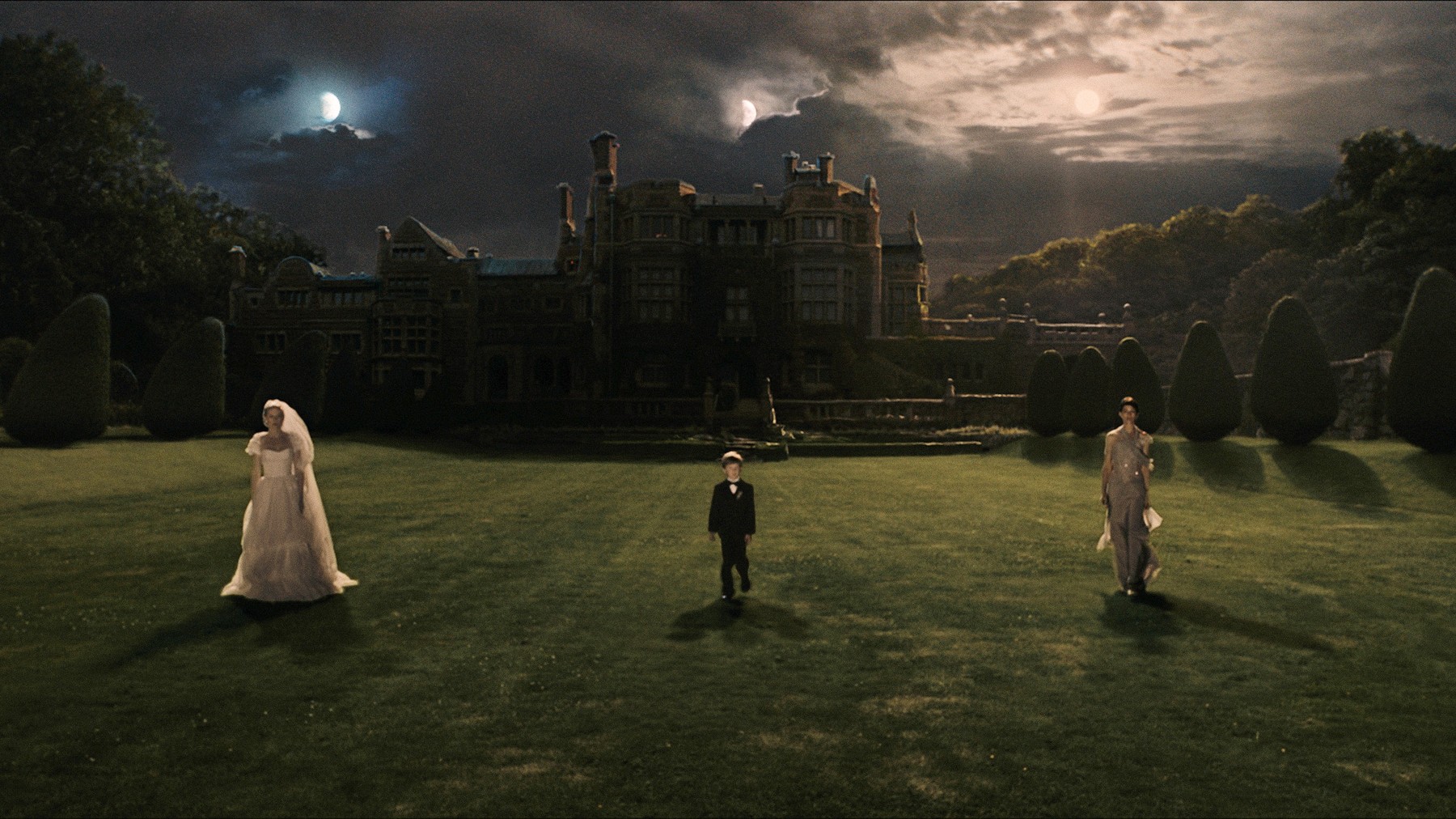
“The House of Dynamite,” recently on Netflix, reminded me of Lars von Trier's “Melancholia” (2011), which was listed as an apocalyptic movie, although it has nothing to do with nuclear danger or politics. The film compares the killer planet to depression and depicts the end of the world as a spectacle of terrible beauty.
If the director Kathryn Bigelow and the screenwriter Noah Oppenheim used the narrative method launched by Akira Kurosawa in “Rashomon” (1950), presenting the same event (the last 18 minutes before the impact of an unknown nuclear missile launched towards the USA) from four different perspectives – and not showing the catastrophe, Lars von Trier makes his existential apocalypse a grand performance that prefaces and closes the film.
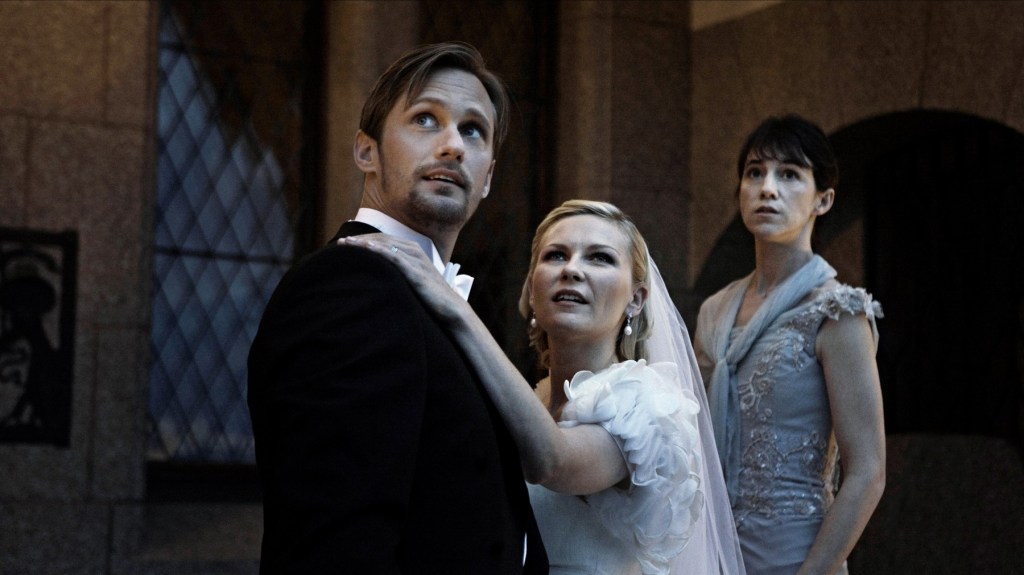
The blue planet called Melancholia, which is known to pass by Earth, does not interest the guests gathered in a luxurious castle to celebrate Justine (Kirsten Dunst) and Michael (Alexander Skarsgård), who have just united their destinies.
But the initially calculated trajectory is wrong. The planet is coming towards Earth and it's getting bigger.
Justine knows cUm coming towards them
She suffers from what used to be called melancholia—that is, depression, the most widespread mental disorder of our time. Maybe also hypersensitivity, because what Elisabeth, Empress of Austria (Sissi) said in Marie Kreutzer's biographical film, “Corset” (2022), applies to her: “I have nothing to cling to but myself, and that sometimes requires an incredible effort.”
Justine tries hard to be normal (she's probably heard the refrain, “There's something wrong with you”), but she's too lucid. That's what depression is all about: knowing that, on a planetary scale, everything is insignificant.
All the things we cling to—family, work, love, money, hobbies, the past, noble causes, vices—all try to distract us from the ultimate truth that everything is perishable. All are illusions.
“Nothing matters: an exceptional discovery, and of which no one knew how to take advantage”, wrote Emil Cioran in “The Evil Demiurge”, and Justine tells her adaptable sister, Claire (Charlotte Gainsbourg): “We are alone. Life exists only on Earth, and not for long”.
Interestingly, the proximity of the planet balances Justine. Others are thrown into despair.
Who trUmieANDte misfortunes in advance is lucid in limit-situationsUm
Anxious people burn themselves out by ruminating on all possible negative scenarios, and if a catastrophe does happen, it catches them with empty tanks. They cannot consume more.
Otherwise, knowing that everything is implacable, nothing scares them anymore. It's not for nothing that Justine tells Claire, “If you think I'm afraid of a planet, you're really stupid.” But there is no pleasure in consuming yourself ante factum, it is agonizing indeed.
(Hint: The story with the grain of salt from Creangă's story “Human Folly” can stimulate the sense of the ridiculous for those who have difficulty keeping their anxiety in check.)
Not coincidentally, Justine and Claire come from a dysfunctional family with a domineering mother (Charlotte Rampling) and an absent father (John Hurt). The first part of the film is devoted to the after-wedding party – a fiasco, because no one can be himself for too long. The masks fall one by one.
The mother is aggressive, Claire is controlling, Claire's wealthy husband (Kiefer Sutherland) is passive aggressive, only the groom is boringly normal. Terrified by the approach of the planet, Justine finds no understanding in any of them.
Everyone tells him cUm must sUm be happyUm
In the second part of the film, a few days later, Justine's depression has intensified (she doesn't leave the house anymore, she doesn't wash herself anymore). Not because his marriage fell apart, but because this is the disease. But the relentless approach of the planet makes her somehow become normal and almost serene, because she knows she can't change anything.
Her sister also wants to control the end of the world. After organizing Justine's wedding, when she learns that Melancholia will swallow the Earth, Claire sketches in her head the cutest scenario to meet the apocalypse like fireworks: drinking a glass of wine on the terrace with her sister.
The ending that makes room for something else
A little forced (but not that forced if we consider Claire's need for control), “Melancholia” can also refer in the abstract to the destruction necessary to rebuild something else. To a personal paradigm shift.
The “black night of the soul”, which St. John of the Cross spoke of when referring to the disconnection from God and the feeling of desolation or despair, can be an apocalyptic stage as all structures disappear leaving you without any point of support. But the disaster is only the beginning of something better, which needs free ground.
When you leave life sUm flowUm under you
And of the things to give up, the need for control poses the biggest problems.
Realizing that you can only control a small percentage of what happens to you and that life is a sum of mostly uncontrollable events is like surrendering to the apocalypse, but it leads to a different philosophy of life. And to another approach to it, the first effect is that the stress decreases when you take your feet off the pedals.
The Buddhist monk Thich Nhat Hanh said that the depression gene is genetically transmitted to all people, but that it develops under certain environmental conditions. That drugs are helpful, but not enough, and that the environment should be changed for healing to occur.
Lars von Trier made no secret of the fact that he suffered from depression and anxiety, and that he had phobias. At one point he even said that he was afraid of anything short of making movies, and that for a long time he treated his panic attacks with alcohol.
Admitting you have a problem is the first step to healing. The second is to put your vulnerability to work – making movies, for example. Or music, writing, carpentry – anything, but not something to run away from.
For example, if you have agoraphobia, don't stay at home to paint, but go out into the street and expose yourself to fear, to see that it doesn't kill you. It's the same with the fear of planes or people (anxiety or social phobia).
If you are depressed, it is good to see a psychologist or a psychiatrist, and to accompany you for a while. Some things we can't do alone, that doesn't mean we aren't strong.
And depression is treatable. Kirsten Dunst said when the film came out that she also went through depression at one point, which explains why she built such an authentic character.
How depression is perceived by the person experiencing it
Lars von Trier hasn't made a feature film since 2018's The House That Jack Built. He has not worked in television since 2022, when he released the third part of the series “The Kingdom”. In interviews in 2018, he said that he no longer has the strength he used to have, and at the beginning of this year he entered a specialized institution for people with Parkinson's, a disease that he revealed publicly in 2022, at the age of 66.
Model of the artist who cannot master his demons (and doesn't even try), the Dane left a trilogy about depression (“Nyphomaniac”, “Melancholia”, “Antichrist”) where he spoke about himself through female characters. He did it masterfully, even though his actresses complained about how he treated them.
Von Trier showed us the dimensions at which depression is perceived by the one who experiences it: an end of the world not because a planet is coming towards you, but because you find it difficult to live on your planet.
In May 2021, the BBC published an article on its website titled, in translation, “Is 'Melancholia' the greatest film about depression ever made?”, for which it spoke to two people diagnosed with depression who had also seen von Trier's film in 2011 and later.
The article starts from the premise that the release of the film in 2011 was overshadowed by the appearance of von Trier, who then joked at Cannes that he felt a little sorry for Hitler at the end of his life, which is why he was declared persona non grata by the festival, and the film only won the Best Actress Award (for Kirsten Dunst).
Ten years later, “Melancholia” has become, the BBC claims, “a kind of talisman for those who have lived through depression, so visceral is the force with which it depicts it. And it is so powerful because [filmul] it refuses to do what those faced with mental illness often tend to do: minimize the suffering.”
Hiding under the fictitious name Julie, a journalist who saw “Melancholia” as a teenager was shocked to find, upon viewing the film in 2019, that she too had gotten married in a castle in the meantime and that she had experienced the same catatonic states as Justine who sat in the bathtub without any reaction. In such states when reality passes you by and you have long since given up understanding what is happening to you, you would do anything to feel something, hence the impulsivity.
The other person interviewed by BBC Culture was Jamie Graham, a journalist who first saw the film at Cannes in the midst of a three-to-four-year depression. What he liked most was how the film plunges into the subject without trying to explain how the heroine became depressed – because there really isn't any explanation. You can have everything you want and depression hangs over you like a cloud, making nothing matter anymore.
Graham also told BBC Culture that he has never seen a better depiction of depression in any other film, which doesn't just make you feel down mentally or gloomy, but affects your whole body so that you can barely move.
Depression has nothing to do with how happy or unhappy you are
Graham also told how she would walk to the office and feel like Justine, who said it was like trying to walk with heavy strips of wool around her legs. “Six emails that I had to answer seemed like something insurmountable. When you're feeling good, it's easy, you answer emails in a few minutes. But what I felt was 'six emails, I can't handle it, I just want to go home'”.
Despite von Trier's declaration of his so-called Nazi sympathies, a terribleism that haunts him to this day, “Melancholia” contributed to the openness, breadth and acceptance with which society today treats depression. Its presence on Netflix made it reach even more people, and if not everyone who saw it will at least experience depression in their life, at least they will become more sympathetic to those who go through it.
Depression has nothing to do with how happy or unhappy you are, with how rich or poor, with the existence of a triggering event (death, divorce, etc.). It may be related – but not necessarily – to genes, brain chemistry, hormones, stressful events, loneliness, serious illness, etc., etc.
Not everyone who gets divorced becomes depressed. Not everyone who gets cancer also gets depression. Conversely, anyone can experience depression in their lifetime. The important thing is not to wait for it to pass by itself and see what you can do.
First of all identify it.
Personally, if I hadn't come across Jamie Graham's words the other day about the six emails that seemed insurmountable to him, I wouldn't have realized that I had a little depression. I don't tick off the symptoms, I've always been a resister. But I've had a difficult year and lately sometimes things seem really hard to do. It's impossible for me to explain, it's just that sometimes everything is very difficult, even the simple, everyday things.
“Melancholia” helped me through the ricochet to realize and to mobilize, that I'm not going to leave her like that, with her hair on her, as they say. The subconscious mind helps each of us. Pay attention to what your intuition tells you, what movies you want to watch, what friends you want to call. Maybe they have a message for you.