“The Merops system basically launches drones against other drones,” McLellan says. Unmanned aerial vehicles can carry out operations thanks to it direct attacks on enemy drones or transmit information to ground or air forces for neutralization purposes.
The need to introduce such a system became obvious after approximately 20 Russian drones entered Polish airspace at the beginning of September. Extremely expensive combat aircraft were used to neutralize unmanned aerial vehicles worth only several dozen thousand dollars.
Romania also reported drone incursions. Several airports in Europe, including Copenhagen, Munich, Berlin and Brussels, have also been temporarily closed due to them. Drones have also been reported near military bases in Belgium and Denmark.
Merops (Multispectral Extended Range Optical Sight) is intended to prevent similar situations in the future.
“This system gives us very precise detection [bezzałogowych statków powietrznych]” said Colonel Mark McLellan.
The origins of drones have not always been traceable to Russia or directly linked to the war in Ukraine, but the urgent need to strengthen defenses is clear.
Drones fly at low altitudes and slow speeds, making them difficult to detect by radar systems calibrated to identify high-speed missiles. They can also be confused with birds or airplanes. The Merops system, according to NATO representatives, helps respond to these challenges.
Gen. Thomas Lowin, deputy chief of staff for operational affairs at NATO Allied Land Command, emphasized that the system gives commanders “time to assess the threat and make a decision – to shoot or not to shoot.”
Merops can protect both critical infrastructure such as airports and armed forces moving in a conflict zone.
NATO is arming itself
The Merops system is just one of many that European armies consider essential to strengthening NATO's defense capabilities. European Union countries have agreed to cooperate to create a “drone wall” on the eastern flank of the North Atlantic Alliance.
American military commanders in Europe also support the creation of a “line of deterrence,” a zone of layered defense along NATO's eastern border. Gen. Chris Donahue, commander of U.S. Forces Europe and Africa and head of NATO's Allied Land Command, said in July that he wants to create a sensor network and command and control system that will work with almost any available equipment, allowing systems to be replaced as they are updated or become obsolete.
“Russia has a recruiting system and a large army, which means it has more immediately available forces along its borders than NATO,” Donahue explained.
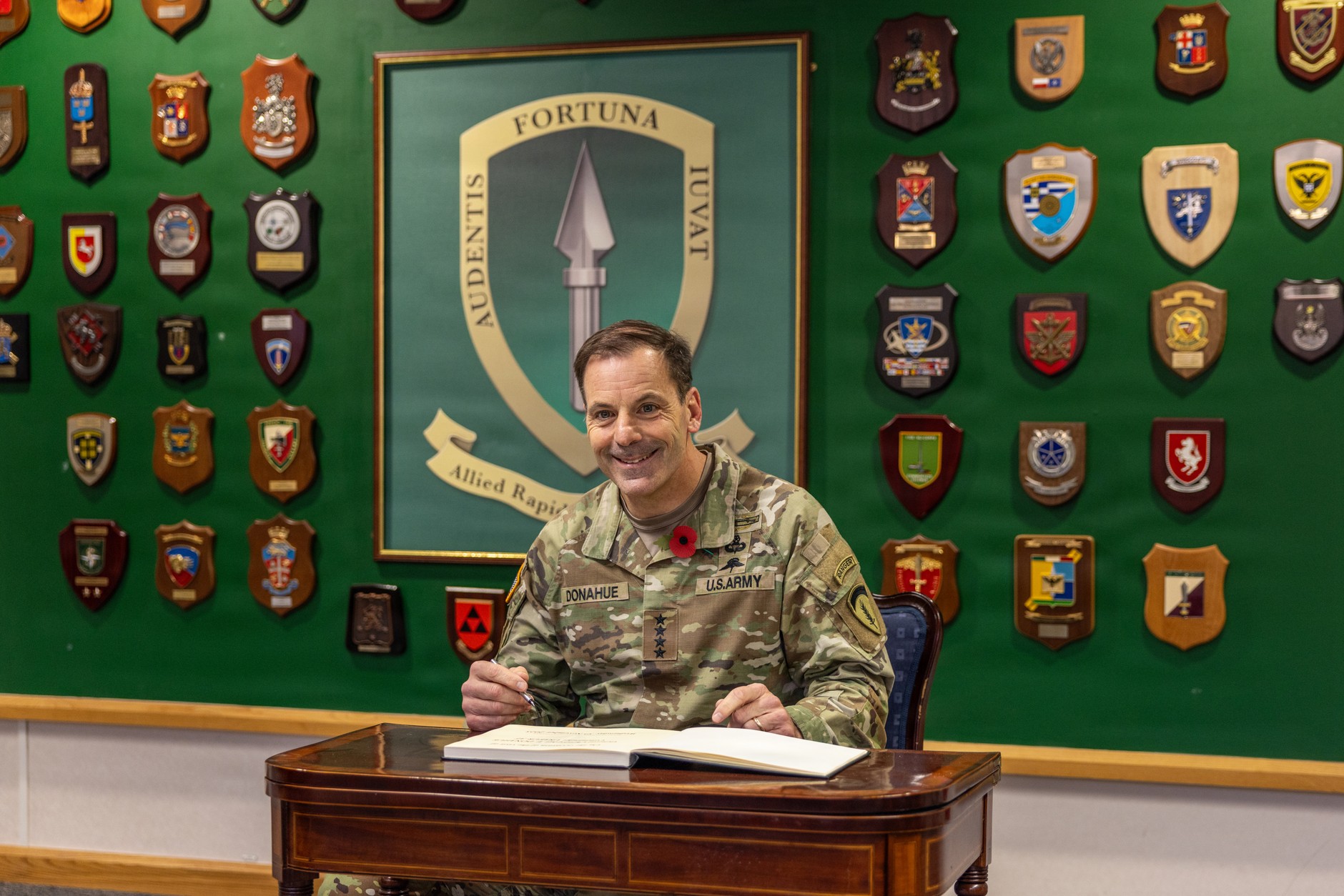
Gen. Chris DonahueJason Greaves / DVIDS / dvidshub.net
The Alliance must build defense systems that offset this numerical advantage by leveraging technological capabilities. According to Lowin, Merops is the first phase of building these defense systems, a process that is expected to take two to five years.
The war unleashed by Russia in Ukraine has become a testing ground for the development of drones. The battlefield has transformed into a laboratory of new technologies with wide application in Europe. The Merops system was selected by NATO precisely because it had proven effective in Ukraine.
“If something doesn't work there [na ukraińskim polu bitwy]it's probably not worth buying,” Lowin said.
Drones are developing rapidly, and each new type requires a different approach. Gen. Zacarias Hernandez, deputy chief of staff for planning at NATO Land Command, said the challenge now is to quickly identify a threat and find a solution almost immediately. This requires extremely fast production cycles – from development to battlefield deployment in a matter of weeks.
At the same time, Russia is mass producing combat drones equipped with cameras, thrusters and advanced anti-jamming antennas. Vladimir Putin admitted in October that the Russian armed forces had to adapt to the new conditions currently prevailing on the battlefield.
“There were entire areas in which we had virtually no knowledge,” Putin said, adding that Russia could now introduce advanced technologies “in just a few days.”