“Here is NATO. Not a step further.” Germany is creating a colossus right under Putin's nose


The conversation with General Huber, which we publish courtesy of Die Welt, allows us to look behind the scenes at how Germany is arming and organizing under the very nose of Russian President Vladimir Putin.
In a modern office building in Vilnius, right next to Lithuanian start-ups, General Christoph Huber has been working intensively for a year to create the German 45th Armored Brigade “Lithuania”, which is to achieve full combat capability by 2027 and defend NATO's eastern flank. Never before has Germany stationed such a large land force unit abroad that can independently conduct military operations.
By the end of the year, we will create command potential for the brigade headquarters. Ultimately, this will enable me to command operations of joint forces within a mechanized brigade of land forces. This is a necessary condition for taking the next step: in February 2026, the multinational NATO battle group in Lithuania, which is currently part of the Lithuanian brigade Iron Wolf [ang. Żelazny wilk]will be subordinated to the 45th Armored Brigade. At the same time, the 122nd Panzergrenadier Battalion from Oberwiechtach in Bavaria, a unit I once commanded, and the 203rd Panzer Battalion from Augustdorf in North Rhine-Westphalia will come under the command of the brigade.
In 2026, both battalions will be transferred to Lithuania, where they will take part in two large series of exercises. Under the command of the 10th Armored Division and in cooperation with our NATO allies, we are building deterrence and we can say: This is NATO. To this point and not a step further.
The article continues below the video
And after 2026?
The biggest step will then be the permanent transfer of troops 122 and 203 to Lithuania, along with Leopard battle tanks and Puma armored personnel carriers. For this purpose, further units will be created, such as an artillery battalion with 2000 self-propelled howitzers and a supply battalion, which will be permanently stationed in their new military homeland, i.e. in Lithuania. We have already moved large amounts of equipment, such as Fuchs and Boxer armored personnel carriers, by sea through the port of Klaipėda. I need a variety of vehicles: for command, repairs, fuel and ammunition for forces that are already here, such as my headquarters support company, communications company, brigade headquarters or military police forces.
In Ukraine, we are observing a revolution in warfare — an almost unchanged front, but massive air raids, especially with the use of drones. Aren't heavy formations like yours the first casualties of drone warfare?
It is important for us soldiers to be prepared so that we can emerge victorious from the future war. It is not about the war of the past, nor necessarily about the present war that we are witnessing in Ukraine. We must anticipate what we will face when defending NATO against a Russian attack. This is the key point, what drives us.
It's important to have the right mix of capabilities. So first of all, what we already have: our heavy armored units, grenadiers, infantry and especially artillery, to gain fire advantage in the event of an attack by the Russians. These forces allow us to defend the territory in a traditional way. For this we need new possibilities, which are actually not that new anymore.
So what conclusions do you draw from the war in Ukraine?
Is the image of war with the mass use of drones that we see there a revolution or an evolution? I think it's the latter. The most important thing is that we ensure our ability to survive and withstand enemy aircraft, and above all, swarms of drones, and thus the ability to win.
To this end, the German army is introducing measures to ensure this, for example Skyranger, a mobile anti-aircraft defense system intended to protect ground troops or convoys. We need full, 360-degree protection against air threats so that we can continue to operate as large ground forces. Together with NATO, we are making enormous efforts to achieve this. This is passive protection.
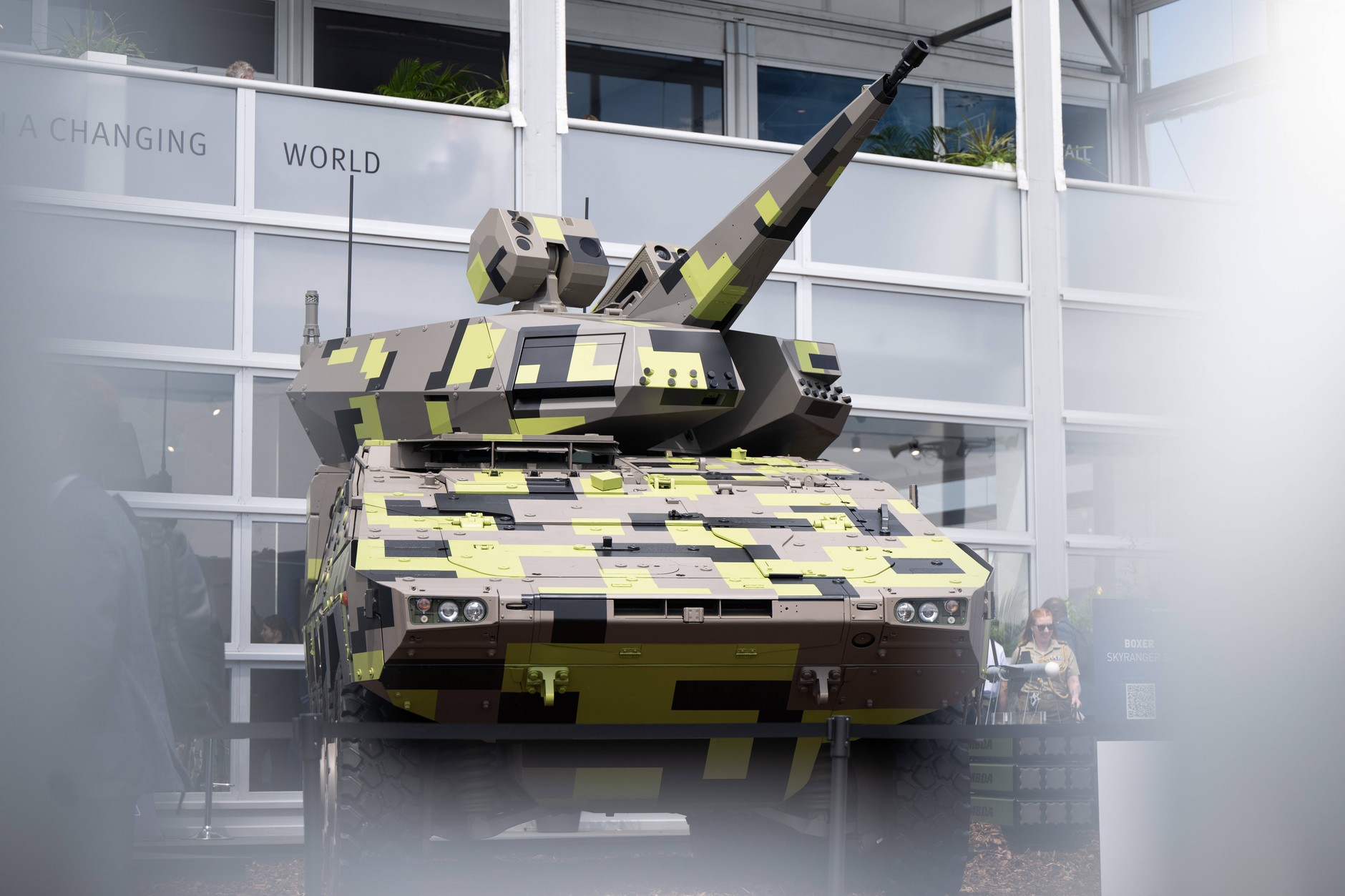
Boxer Skyranger 30 air defense system manufactured by German defense company Rheinmetall, Berlin, Germany, June 6, 2024.Sebastian Gollnow / PAP
Our current reconnaissance coverage, including the coverage of the units under my command, is incomparable to what we had in the past. We need combat drones that can destroy enemy systems, intelligent drones, and loitering ammunition [określanej potocznie jako drony kamikaze, które potrafią czaić się nad celem, zanim zaatakują].
Until recently, drones were rejected in ongoing debates in Germany [jako konieczne elementy uzbrojenia]and now you even want kamikaze drones that set their own targets and self-destruct during an attack?
Do we want to be winners? If so, then we need what is today's military reality. After the test phase is completed, the 45th Armored Brigade “Lithuania” will receive these new capabilities as a matter of priority. Preparing for the war of the future also means that we will see changes in our structures – new technologies are forcing the creation of new structures, both in the German armed forces and in NATO.
We are implementing these changes quickly, and our brigade has the highest priority in this regard. I assess this development of the situation very positively.
You say that your brigade is a priority, while the Bundeswehr as a whole is short of personnel and equipment.
My brigade has the highest priority in the Bundeswehr, because we will operate with the highest operational readiness, directly on NATO's eastern flank. Therefore, we get everything we need to complete our task. Leopard 2A8 battle tanks, Puma S1 armored personnel carriers, Panzerhowitzer 2000 artillery systems, loitering ammunition.
Of course, it is important not to limit yourself to [wyposażania] only us. As part of the 10th Armored Division to defend the eastern flank, as a brigade commander I need the capabilities of the entire division to fight effectively. Therefore, it is not enough for the Bundeswehr to properly equip only one brigade. We need this throughout the German army. I am glad that this issue has started to be addressed so that what the Federal Chancellor is talking about can finally come true [Friedrich Merz]: making the Bundeswehr the strongest conventional army in Europe again.
You come from the era of foreign missions, you have been to Afghanistan twice. Now you come back to national defense – how did that happen?
I joined the Bundeswehr in 1995. At that time it was still an army still strongly shaped by the Cold War. As far as I could tell as a young officer, the brigades then had everything they needed to accomplish their mission. My missions in Kunduz and Masar-i-Sharif, Afghanistan, in the era of international crisis management, shaped me and other soldiers of my generation.
But then we also became part of this renewed focus on national and collective defense. In 2017, I was the first commander of a NATO multinational battle group here in Lithuania, and I experienced first-hand that now something completely different is at stake – not battles like in Afghanistan, but a war of joint forces, large-scale operations. We train for this and I'm proud that everyone in my brigade fully supports it. This is to ensure credible deterrence so that we hopefully don't have to put into practice what we are capable of.