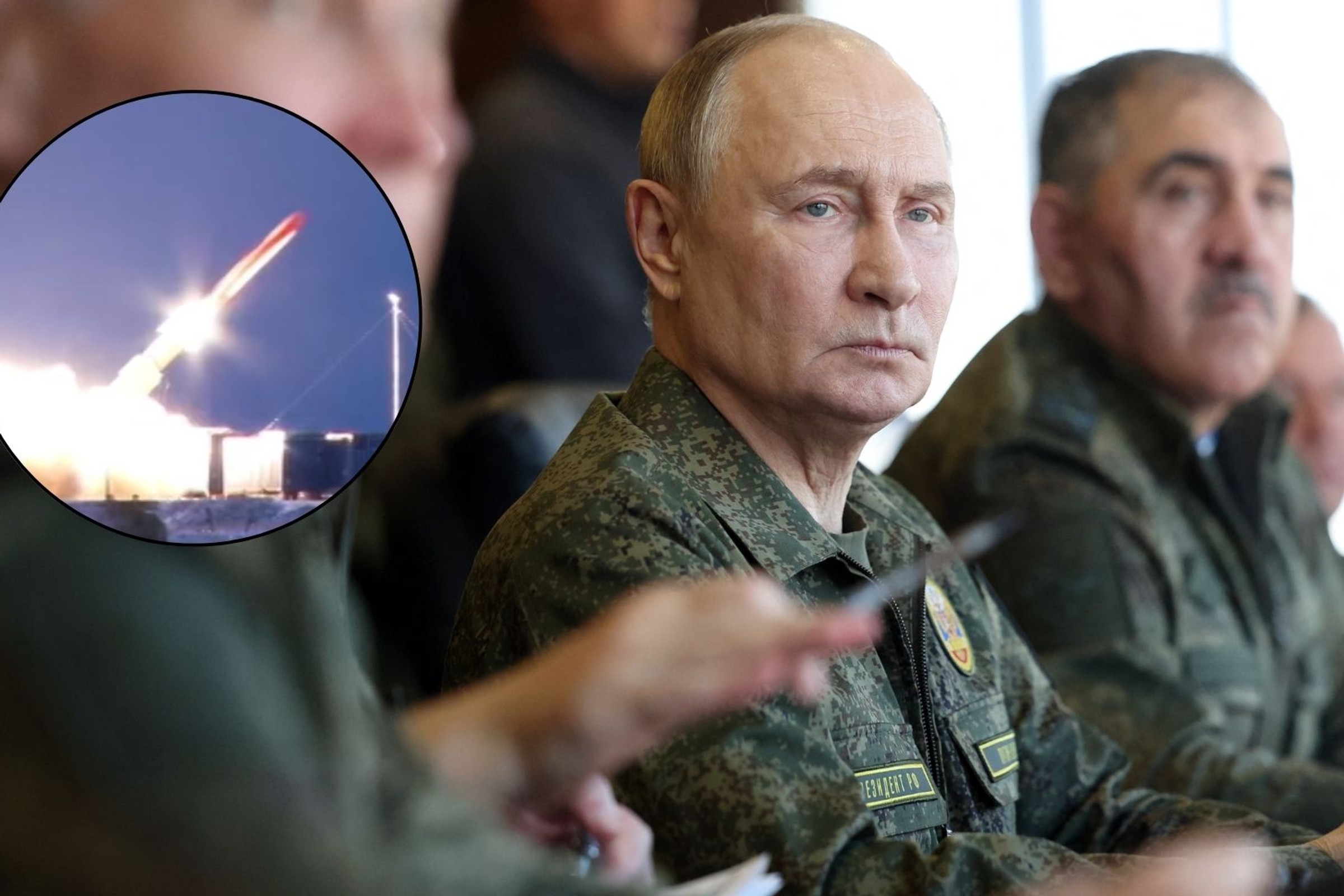
President Vladimir Putin emphasized Moscow's military strength during a meeting with the general staff at the command center in an undisclosed location. In a video published by the Kremlin, he praised the weapon as a “unique product that no one else in the world has” and called for the creation of infrastructure to officially introduce the Burevestnik into the armed forces.
The test of the long-range missile took place as part of the last maneuvers of the Russian nuclear forces on October 21. Gen. Valery Gerasimov announced that the missile had flown approximately 14,000 kilometers. km and remained in the air for 15 hours. Thus, Russia ended the decisive phase before the missile is deployed. Putin appeared in front of the cameras in uniform and again emphasized the “invincibility” of these weapons.
The Burevestnik is not an ordinary cruise missile.
Its nuclear propulsion is intended to enable extremely long flights — experts estimate the maximum range at up to 25,000. km. Thanks to its low flight altitude and irregular trajectory, the missile is expected to be almost invisible to air defense systems, enabling surprise attacks from any direction and bypassing existing interceptor systems.
The article continues below the video
There is a history of Burevestnik tests long and risky. Between 2017 and 2019, the cruise missile was tested at least 13 times, all of which were largely unsuccessful. During a 2019 test, an explosion occurred, killing several people and significantly increasing radiation levels in surrounding regions. Putin's first presentation of the weapon took place in 2018, and several tests have been carried out since then.
A threat to NATO?
Nuclear weapons experts like Pavel Podvig remain skeptical. They believe that this weapon is rather political significance: Militarily, Burevestnik offers no clear advantage over existing strategic systems.
Nevertheless, the development of the situation shows that Russia still invests in dangerous weapons long-range that could potentially worsen the global security situation.
Particularly dangerous are the Burevestnik's low detectability and ability to bypass interception lines. Theoretically, it could be used as a surprise weapon for a first strike. This is a scenario that worries NATO and neighboring countries.
It is not known whether the rocket is actually ready for use. However, one thing is certain: Russia is thus demonstrating its ambitions on the international arena and sending clear signalthat it is ready to redefine the limits of nuclear deterrence.
The specter of a Russian attack
The intelligence services assume that Moscow will be able to start another war militarily by 2030 at the latest. Risk of aggression from Moscow, it is keeping many EU countries awake at night.
According to a new multi-national survey conducted by YouGov in seven EU countries, Russia's aggression was perceived as one of the biggest threats to Europe by 51 percent. respondents in Poland, 57 percent in Lithuania, as well as 62 percent in Denmark, a country that lies further from Russia but controls the entrance to the Baltic Sea, through which Russian tankers and military ships often pass. Denmark is also the world's largest donor of military aid to Ukraine as a percentage of gross domestic product.
In the face of the threat, the European Commission on Thursday presented an action plan for four defense projects by 2030, which include a monitoring system for the eastern flank, anti-drone initiatives, a multi-level air defense system and a space shield.
I’m Ashley Davis as an editor, I’m committed to upholding the highest standards of integrity and accuracy in every piece we publish. My work is driven by curiosity, a passion for truth, and a belief that journalism plays a crucial role in shaping public discourse. I strive to tell stories that not only inform but also inspire action and conversation.