Russia has for the first time attacked a city in the Kharkiv region with a new guided bomb with a radius of 130 kilometers, Ukrainian media reports. Moscow could test such weapons on civilian areas while ramping up production of such weapons with high destructive power.
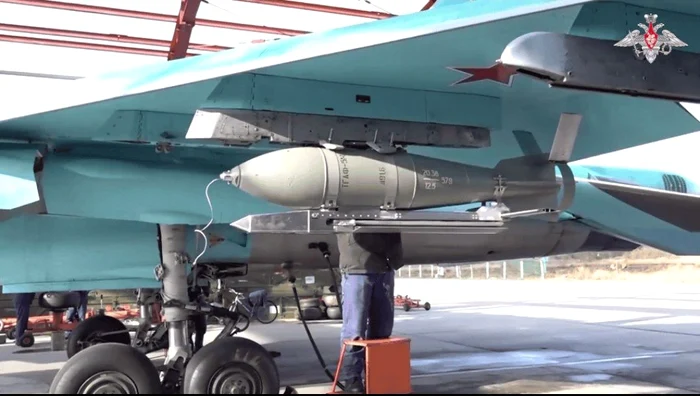
The new guided bomb UMPB‑5R FOTO X
Russian forces carried out the attack on the town of Lozova in the Kharkiv region on October 18, hitting a residential neighborhood and damaging houses and outbuildings, according to the regional prosecutor's office. Five people were injured.
According to the investigators, the bomb was launched from the territory occupied by Russia.
Authorities said the attack was carried out with a new UMPB-5R rocket-propelled aerial guided bomb capable of flying about 130 kilometers. Prosecutors announced that Russia used this type of bomb for the first time against the city of Lozova. An investigation into possible war crimes has been opened.
The attack comes just two days after authorities in Mykolaiv reported that Russian forces had used aerial guided bombs against the city for the first time since the start of the full-scale invasion. On October 16, two such bombs hit the outskirts of Mykolaiv, regional governor Vitalii Kim said.
In recent months, attacks on densely populated areas in the Kharkiv region have intensified.
On October 13, Russia attacked Kharkiv with KAB guided bombs, damaging a hospital and injuring at least six people. At the time of the attack, more than 100 patients were in the hospital, Oleksi Dotenko, director of the facility's surgical department, said in a comment to Suspilne Kharkiv.
The new UMPB-5R guided bomb has more destructive power, capable of causing serious injury to civilians, being made of a thicker metal than previous versions.
UMPB -5 is a new glider munition, launched from aircraft or using multiple rocket launch systems. It has a launch radius of about 100 km and carries a warhead of over 250 kg.
The bomb is built on the model of the Soviet FAB-250 ammunition, Vadym Kushnikov, a military analyst at Militarnyi, explained to Suspilne.
“In terms of range, while standard FAB bombs in some cases reached over 60 km, this system has an additional low-power rocket engine that increases the effective range of use of the weapon,” said Kushnikov.
In the last week, Russia has stepped up its combined attacks with drones and missiles, but also with glide bombs, which have hit Ukrainian cities, as well as Ukrainian troop positions.
Russia is accelerating mass production of aerial bombs with a range of up to 200 km
According to Vadim Skibitski, deputy head of the Intelligence Service of the Ministry of Defense (DIU), Russian engineers have improved kits for converting unguided bombs into precision-guided munitions (UMPK) that are mounted on standard bombs weighing 250, 500, 1,500 and 3,000 kg, substantially increasing their range.
He added that Russia developed aerial bombs with the new ones in September and October and is currently testing them on the battlefield. Skibitski noted that the bombs reached 193 km in a recent test.
Also, the new bombs have greater resistance to electronic warfare systems
Russian factories have begun mass production of such bombs, which bear names such as “Grom-1” and “Grom-2”.
On October 20, the Air Force of Ukraine reported that Russian forces had for the first time launched at least two aerial guided bombs on the Poltava region of Kharkiv Oblast.
These fell 20-30 km from the city of Poltava and were probably new versions, such as UMPB-5R or Grom-E1/E2, which traveled about 120 km.