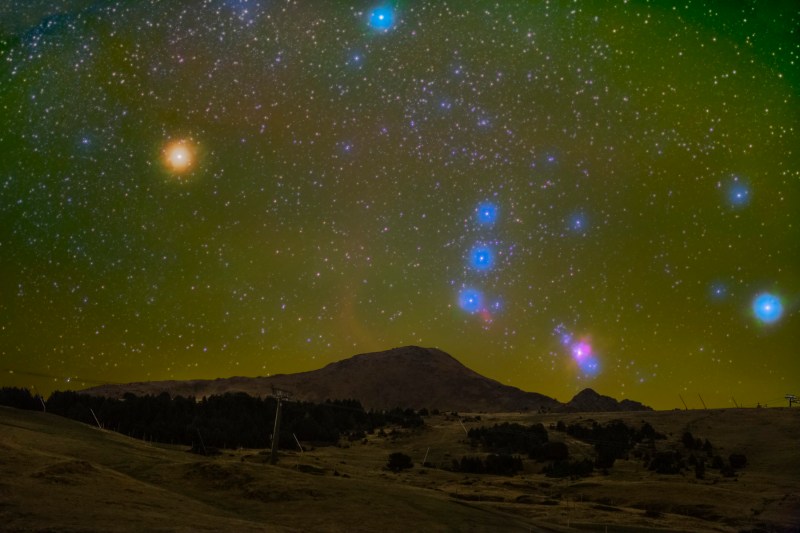
Constellation Orion above the mountains Photo: JUAN CARLOS CASADO (starryearth.com) / Sciencephoto / Profimedia
The maximum of the Orionid meteor stream occurs on the night of October 20-21, according to the “Admiral Vasile Urseanu” Astronomical Observatory. Then you will be able to see a maximum of 20 shooting stars per hour.
The Orionids are one of the major meteor streams that sweep across the sky between October 2 and November 7, when Earth passes through the outer edge of the particle cloud in the tail of Comet 1/P Halley. Both the Earth and the comet orbit the Sun elliptically, crossing each other twice a year. Thus, in May, the Eta Aquaride meteor stream can be observed, while in autumn the Orionids are produced, according to Agerpres.
These shooting stars seem to come from the Orion constellation, one of the brightest in the sky, hence their name, Orionides, according to the “Amiral Vasile Urseanu” Astronomical Observatory in Bucharest.
Orinoids – when they can be seen
The Orionids can be observed after midnight until sunrise, when the Orion constellation is above the horizon.
This meteor stream is known for the very bright meteors (bolides) that it sometimes produces, one more reason to observe it. Even if they are fast, they can leave glowing “trains” (incandescent pieces of debris in the meteor's wake) that can last from a few seconds to a few minutes, according to leonid.arc.nasa.gov.
Fast meteors can sometimes also become fireballs, prolonged bursts of light or can break into several pieces, offering a show like that of fireworks.
It is preferable that observations are made outside of large cities or on their outskirts, because public lighting makes most meteors unobservable.
Although the maximum phase is expected after midnight, in the morning of October 21, for those passionate about such astronomical phenomena, it should be known that shooting stars can be observed, in a smaller number, according to the International Meteor Organization.