

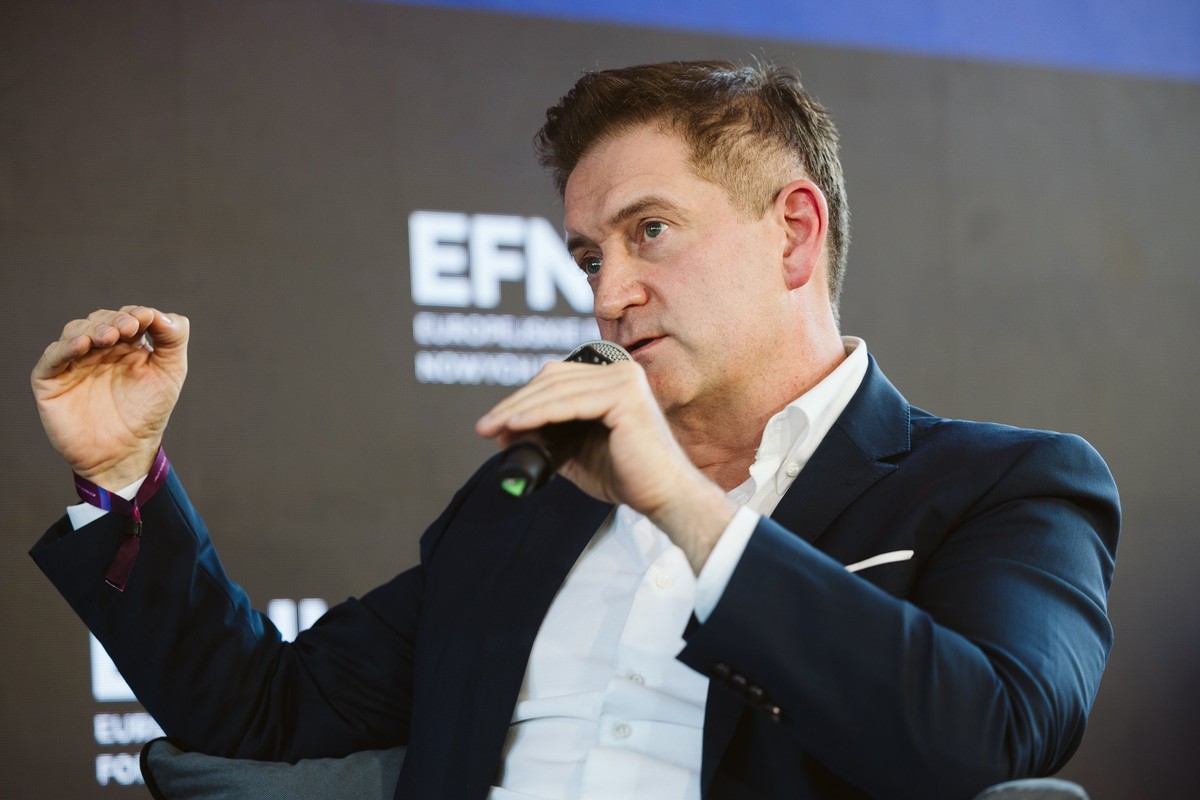
The future of the media in Poland was discussed during the European Forum for New Ideas in Sopot. The debate “Media at the center of digital transformation” was intended to answer the question of how the media and regulations should change in order to continue to play a key role from the point of view of society and the economy.
Aleksander Kutela did not hide the fact that a lot would depend on our attitude – both individual and team. This approach may turn out to be one of the key factors that will decide which side we will be on.
—Peter Drucker once said that “in times of turbulence, the greatest danger is not change itself, but acting on the logic of the past.” And this sentence can serve us as a motto today. It is worth considering what this change means in practice and what opportunities it brings, argued the president of RASP. — For those who approach it with openness and flexibility, I believe it will bring more opportunities than threats, he added.
Bartosz Hojka, president of the Agora Group, is convinced that we have been living in an extremely turbulent reality for years, struggling with various demanding trends and pressure on the media, both market and political.
— The fact that we are a group with diverse media businesses and multiple sources of revenue is one of the key factors in our resistance to crises and turmoil, he explained. – Today we live in a time of rapid technological change, which – in my deep belief – is fundamental and is the beginning of a new era, not only in the media – he added.
In his opinion, this is another challenge, but thanks to many years of functioning in difficult conditions, we are already well resistant to crises. We coped in times of populist governments that put enormous pressure on us. We will also overcome the technological challenges we now face, although predicting exactly what the market will look like is extremely difficult today.
Media doesn't die – it evolves
— We are all entrepreneurs here. And I think that being an entrepreneur involves a certain paradox, a certain internal opposition – explained Michał Brański, strategy director, WP Holding.
— On the one hand, we must always be accompanied by optimism – without it we cannot build – and on the other hand, we also need a certain paranoia, the belief that someone wants to “eat” us or overtake us. And this duality is inherent, he added.
In his opinion, the media is doing very well. He doesn't think anyone could look at the current media landscape today and compare it to any point in the past and honestly say it's worse. We have greater diversity, faster “time to market”, more sources of information. Access to knowledge is common, often even free, and quality media is still available. That is why I absolutely do not subscribe to the words about a “media crisis”.
Michał Brański reminded that we recently celebrated the awarding of the Nobel Prize in Economics to Joel Mokyr. In a sense, he “humanizes” the concept of creative destruction – a phenomenon that was once developed by the Austrian school. — We often intuitively distance ourselves from this idea, because creative destruction means that some people have to “die” so that others can grow in their place – said the director. — It doesn't sound nice, but that's the beauty of development. And I think that's what we're seeing now, he added.
The fact that the media are changing – according to Bartosz Hojka, president of the Agora Group – is undeniable. — We understood the mistakes we made, because we undoubtedly succumbed to varying degrees to the pressure of clicks and the pressure to build reach at the expense of quality. We are perfectly aware that this business model is coming to an end and is leading nowhere, said the president.
— Many publishers today take a completely different approach – building direct relationships with users, based on recorded traffic, subscriptions and advertising models adapted to this strategy. These business models are currently on the rise, he added.
Content, technology and the future: who will benefit and who will pay?
Kasia Kieli – president and managing director of Warner Bros. Discovery Poland, president of TVN, noted that for a long time technology concerns have been building their position on content that was created by others – us. And inevitably the question arises about fair remuneration.
— If we, as broadcasters, receive payment for the distribution of channels, the same should apply to the information, news and articles that we create and which are used by platforms as content aggregates, explained Kasia Kieli. — We are the creators – they are only intermediaries. These are two completely different business models and should not be confused. Big Techs are not journalists – they don't work in the field, they don't go to war, they don't conduct interviews. We do it all, she added.
She also referred to the narrative that “media is ending” or that “television is dying”: – for 20 years we have been hearing that television is ending – and the truth is that it is getting better and better. The data shows that the total television audience (i.e. the so-called PUT – People Using Television), regardless of what channel the viewers watch, is larger this year than last year. Everyone has become fascinated with streaming – we are also present in streaming – but if you look at what is watched there, it is mainly TV content. Not only high-budget series, but also classic TV shows.
However, this does not mean that the media does not face any problems – subscriptions are one of them. Michał Brański emphasized that it is easier for those who have a brand that has long been associated with the fact that I go and pay – “Gazeta Wyborcza” has such a pedigree. Therefore, it was easier for her to switch to a subscription model. “Did you pay PLN 20 for a newspaper at a newsstand? Now pay for content on the Internet.”
Bartosz Hojka agreed that it is difficult, but not impossible. – We have 50 thousand. subscribers in TOK FM and we are going a bit against the grain, because perceptually radio has always been associated with free access, he said. – Nobody went to the kiosk to pay for the radio, so we are fighting the difficult habit of our users, trying to convince them to pay for audio – he added.
In Aleksander Kutela's opinion, we are a bit impatient when it comes to subscriptions, but this business is great and very profitable – it has only one drawback: you have to refine everything almost perfectly. Premium business hates mistakes, and if there is a problem in any area, the entire model falls apart. This is not proportional – every element of the product has to be of a very high standard or it ends in failure. — This business requires regular quality improvements and continuous product improvement. In the case of HBO, where I developed subscriptions, these were successive stages: first documentaries, then series – first international ones produced in the United States, and then local productions. Each of these steps attracted hundreds of thousands of new subscribers, explained Aleksander Kutela.
Kasia Kieli assured that consumers are ready to pay for valuable content – Netflix and HBO demonstrate this well. You have to pay for good material, quality and credibility, and we, Poles, are already used to this – after all, we have been paying for cable or satellite for years, which significantly improved the quality of what we watched.
— More and more consumers realize that not everything has to be free, and we also see it. In our case, social media is primarily used to build an audience base and conduct cultural discussions around the stories we create. As storytellers, we try to convey stories that resonate and have meaning, explained the president.
The 21st century Library of Alexandria. Who really pays for information?
Michał Brański, in turn, referred to Google, which is perceived as a huge, free library – the largest in the history of mankind – that we have at our fingertips.
— Our task is to make the recipients aware that this “library of Alexandria” was not created without costs and consequences for the creators – he noted. — Platforms such as Instagram and TikTok operate on our terms – we know what and how to show to support our core businesses. I don't have much of a problem with that. However, despite its beautiful roots, I consider Google to be a very unethical organization today, he added.
Therefore – as Bartosz Hojka said – complaints against publishers about the way platforms operate cannot be ruled out. The first has already appeared: European publishers challenged the functioning of artificial intelligence mechanisms. Michał Brański added that there are also specialized law firms in Europe that gather parties interested in the case so that everyone does not have to bear the costs individually. Unfortunately, such cases are often resolved only after 7-10 years, but when judgments are reached, they usually involve large amounts.
Aleksander Kutela did not see any threat from, for example, Google, who assured that every time important events happen – be it the outbreak of war, a pandemic, or the appearance of drones – RASP websites break popularity records.
— Traffic increases several hundred times, people know perfectly well where to look for information, especially when their safety and lives depend on this information. You can clearly see where traffic accumulates, he explained. — At the same time, with the current polarization, we are increasingly looking for information on a daily basis, not necessarily about life and death. We more often choose those that confirm our worldview and beliefs, instead of searching for the truth and facts. This is a disturbing phenomenon that, in my opinion, will increase, he added.
Bartosz Hojka emphasized that we do not create media for everyone, but for people who are truly interested in the world, who want to discover it and understand it better. — The pessimistic assumption is that there are about 20 percent of such people. – he recalled. – I would call it a rather optimistic scenario – 20 percent. adult Poles are approximately 4–5 million people. If we had that many subscribers, we would definitely be in even better moods.
A new era of journalism. AI as a tool, not competition
The debate also touched upon the issue of artificial intelligence – it was wondered whether it was a threat or whether it would be a support. In Michał Brański's opinion, artificial intelligence will ultimately become one of the best tools supporting journalistic work.
— Wise journalists are already taking advantage of these opportunities, being able to distinguish both the deficits and advantages of this technology, he assured. — The fears are not entirely justified. It's as if the filmmaker was afraid of artificial intelligence, instead of seeing that there is a huge space opening up for him to create amazing things. Thanks to this, he can implement projects for which he had no budget or chance before, because no one will give him, for example, PLN 200 million. It's the same with journalism – you can create more in-depth content that at the same time provides more context and background. This also allows you to better use your time for activities that, in my opinion, were too few in journalism, i.e. reaching out to people and being in the field – he added.
Kasia Kieli had the same opinion, noting that the ability to use such tools is very important, but AI will never replace a real journalist. It is the journalist who conducts the interview, is at the scene of events and creates authentic materials. AI can only support, not replace, this process.


