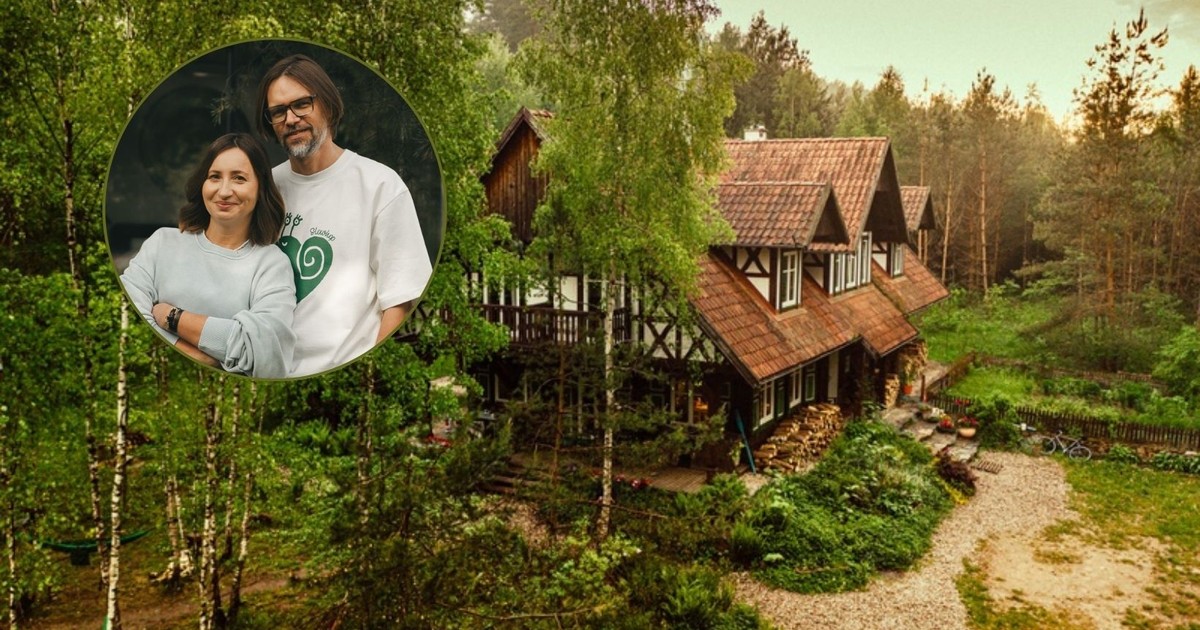
Ola Klonowska-Szałek: We both previously worked at DaWanda, a marketplace for craftspeople. We were very close to a community of people who did things with soul. We were 35 years old, our children were a bit older and we stopped liking those trendy hotels with spas and buffets. It was a very impersonal form of tourism. We started traveling abroad and discovering small guesthouses near vineyards and agritourism farms. Suddenly we saw that we could practice tourism closer to the people who run these places. The food was of amazing quality – fresh baguettes, delicious tomatoes, locally sourced meats. The host was able to put us in his car and show us places that no one else knew about – galleries of local artists where they make good wine.
In Poland, there was no good tool to locate such places. There were blogs and newspaper articles with the same addresses. We noticed the need to create a platform. And then we bought our own property, a farmhouse on a lake that was originally a barn. Everyone said: tear it down and build something new. We, as antique lovers, renovated it and started renting it out. And it was the first property on the Slowhop portal, which was created exactly then.
Marcin Szałek: We live in a world where large corporations win marketing and distribution. Small entrepreneurs do things of much better quality, but they have trouble breaking through. The largest advertiser on Booking will always be a large hotel. It's hard for us as customers to find these small suppliers. We wanted to give them a platform to exist and last.
How did you finance it initially?
Ola: The entire Slowhop was created with our money – it was bootstrap. I left DaWanda, Marcin went to work at poznalekarz.pl to support his family, and I started building the portal. Marcin told me then: “It will be a nice business, but we will never make a living from it.” It was clear that one of us would have to earn money somewhere else.
Marcin: I calculated in Excel and knew that with our approach to quality, even if we go abroad, it will not be a “unicorn”. Investment funds do not invest in such things. So we had to operate from a garage. Ola handled all marketing and branding with her own ideas.
Who are you by education?
Marcin: I have been working in startups for a long time – eBay in Poland, launching Groupon, DaWanda in Poland and several other markets, then Znanylekarz, Booksy. I have experience with marketplaces and large online businesses.
Ola: I have more linguistic and PR skills. I can find trends, I can write – I'm making my debut with a novel.
Oh, congratulations!
Ola: Thank you, the novel “Zadra” would not have been written without Slowhop. But going back to our beginnings, I had already had one failed startup and this failure meant that Slowhop simply had to succeed. I was determined like never before in my life.
How did you build the database of places?
Ola: We traced about 300 places that could be a match. We looked at aesthetics, geography – to be far from the city. I checked how the host responds to bad reviews, because for us it is a measure of whether he is a classy person who will be a good host. It's a difficult service industry and there are often a lot of unpleasant things happening there.
Then Marcin put on the headphones and we started calling the hosts. The first reaction was always “No, because there were many such ideas and none of them worked.” Marcin said: “Maybe it won't work, but we have good experience. Give us a chance, if after six months you decide that it didn't make sense, we will terminate the contract without any costs.”
Marcin: And after half a year we stopped calling because places started reporting themselves. One of the housewives told Oli: “I hope you are aware of what you have done.” Previously, people rode mainly during the season. We took up these off-season months for them. People wanted to see these places out of curiosity and were willing to go in the fall, in November, March and February.
When did the portal enter the market?
Ola: Exactly January 21, 2017. Today we are 10 years old since we started working on it.
What was the breakthrough moment?
Marcin: Pandemic. It was a critical moment – no bookings, no commission. The hosts made a collection so that we wouldn't have to fire people. Then we paid them back.
After the pandemic, you couldn't travel abroad because there was still a risk. Riding into nature, where there is not a large concentration of people, has become the best alternative. The Slowhop brand emerged overnight. We were a bit afraid that people who didn't know this form of tourism would come – and indeed all-inclusive guests came and ended up in a cottage with field mice.
Are mice a permanent element of your offer?
Marcin: Field mice are an everyday occurrence in the countryside in autumn and winter. Just like mosquitoes by the water in summer or creaking stairs in old houses. We communicate this clearly. An unprepared guy from Booking may complain, our slow-hop guy probably knows what he's signing up for.
Who is your client?
Ola: From the beginning, they were residents of large cities who had many tourist experiences abroad. They discovered that the Polish countryside was sometimes as good as five-star hotels in terms of accommodation, and they were delighted with it. Especially since it is close, accessible and soothing to them. It offers real relaxation, without a list of attractions to complete.
The largest group are people aged 30-50 from large cities. After the pandemic, many moved to the countryside and they travel less with Slowhop, because they have their own “slowhop” in their lives.
Now the target group is expanding. A very grateful group are people over 50 who have stopped working or work less. Relationships are very important to them – and they won't make them in hotels. We explore the topic of women over 50 who travel alone. They have special needs – guest houses mainly have double rooms, so it's not cheap. We want to work with the hosts to create a price offer dedicated to this group.
Marcin: The second interesting group is Gen Z. For the older generation, traveling was an element of prestige, for millennials – it was a proof that they had free time. For Gen Z it is an element of life, a need, a necessity. We are curious how this will develop. We see that when young people travel into nature, they want to be alone – a small house, separation. Even in the guesthouse they lock themselves in a room, no interaction. This generation has suffered the most in the pandemic. We see that they avoid social contacts.
What does the company's condition look like today?
Marcin: We are a niche company that reaches several million people a year. This is quite an achievement because we are fighting against players with huge marketing budgets. We employ about 30 people. This is not a huge company – there are hundreds of larger startups in Poland. Our market share is approximately 1%. compared to Airbnb or Booking. This is not an easy business – we are fighting against big players who have huge advertising budgets.
We feel that we have to build a brand with our own cleverness and creativity. The business is profitable, but profitability is not high – marketplaces have small margins and marketing costs are high. Facebook and Google are making more money from this trend than we are. But we live well, we have ideas for improving the product and we believe that this type of tourism will develop.
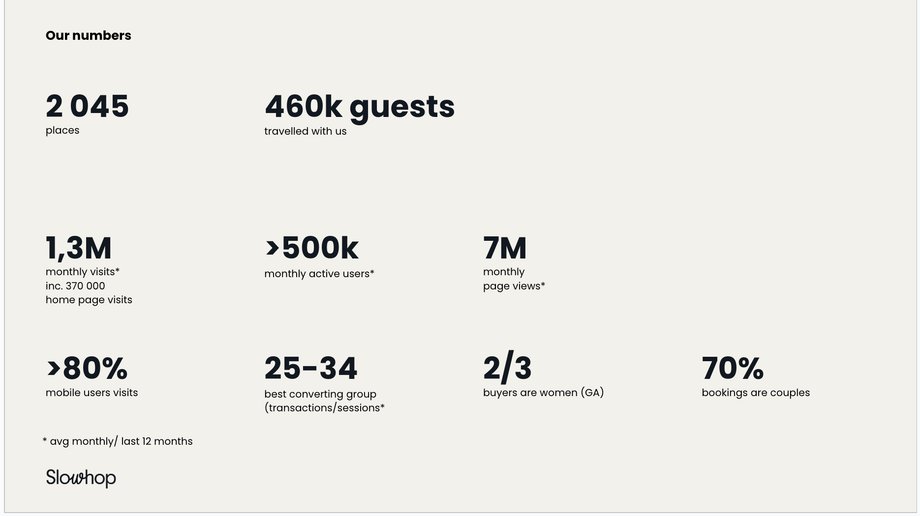
Slowhop in numbers
|
Slowhop.com / Slowhop.com
Is it worth investing in real estate far from the city?
Marcin: Very often, success is achieved by places that do not have a business attitude. A lot of cabin farms have been built in recent years – 20 cabins next to each other in the mountains. It was obvious that the idea was to make a lot of money. They have a problem because our clients are looking for peace and quiet and do not accept large crowds. They are looking for intimate places where the host is the face and there are no neighbors.
These larger investments are occupied during the season, not during the off-season. It is difficult to construct a solid business case on this basis. Many of these places are going bankrupt now.
Ola: Two things are key today: quiet luxury and wellness. Quiet luxury is a great coffee machine from a local roastery, linen bedding, a good mattress. After years of overwork, people began to appreciate the role of a healthy, well-rested body. That's why during the trip he looks for a sauna, a hot tub, and massages. If someone is serious about creating their own slowhop and making money in the off-season, it will be difficult without a small spa.
Marcin: From a business perspective, selling holidays is not a problem for hosts – there will always be customers. The problem is out of season. We talk to them a lot about how to do it. How to design interiors so that guests feel fantastic, even when it's raining. What additional offers – pottery workshops, cosmetic workshops, guides to national parks.
We have the concept of “super eco villages” – several agritourisms, cottages, but also guides, workshop places, artists, slow food restaurants, maybe a shared village spa. To create a local community, so that the guest feels like a temporary resident, not a tourist.
By the way 2 Slowhop
|
Slowhop.com / Slowhop.com
What are the prices on Slowhop?
Marcin: These are not low prices, but they are not high either. Foreign customers often say: it should cost much more. Abroad, this type of places are much more expensive and considered luxurious. Poland can be a nice export product.
Prices are often not much different from seaside or mountain resorts, and are even lower with higher quality. The media says that all inclusive is cheaper abroad. If you consider the whole thing – including food – trips at Slowhop are much cheaper than abroad.
Small houses start from PLN 500 to PLN 600 per couple per night. Places in agritourism farms – from PLN 200 per night for a couple. The best agritourisms – about PLN 400 for a double room. This is much less than the most expensive hotels in Poland.
Thanks a lot for the interview. I don't know what to wish you, because you probably already have everything. Slow life and your Slowhop. So I guess I wish that more and more people would choose Polish retreats with mice and mosquitoes, because that's probably the only way to finally regenerate after being overstimulated in the city.
Ola and Marcin: Thank you and we wish you the same 🙂