Representatives of the German government are trying to calm down the heated debate on the so-called chat control. The European Commission has been wanting to create such an instrument for yearswhich has so far been thwarted, among others, due to concerns in Germany.
Thanks to “chat control” users' messages on instant messengers would be scanned before they are encrypted – i.e. on the devices themselves – and without any initial suspicions. If someone sent a video of child pornography, software providers would be obliged to send a warning to the appropriate authority, which would in turn inform investigators if there were sufficient suspicions.
Digital experts, lawyers, service providers and civil rights advocates have warned against this practice. While the issue has flown under the public radar for years, there have been recent signs of outrage on social media.
The German government therefore tried to calm the situation with a sentence that was intended to sound like a clear refusal. — The German government has always emphasized that Monitoring chats for no reason is taboo for him – said Stefan Kornelius, government spokesman. When asked about this, a spokeswoman for the Ministry of Justice repeated almost the same words: the minister “has clearly stated its position with regard to monitoring chats without cause.”
However, Kornelius evaded the question of whether chat checks are possible “for a reason.” He did not want to delve into the intricacies of telecommunications regulations here. Instead, he referred to ongoing negotiations.
Does the word “cause” give the German government the ability to agree to “chat control” at European level? The opposition is concerned about this. According to her, the German government would only have to argue that there is indeed a reason to take such a measure.
The article continues below the video
Petra Vogtschmidt, spokeswoman for the Left Party's digital policy, does not see any credibility in the German government's current statements about protecting the confidentiality of online communications. Answering the question “Die Welt”, he notes that remains unclear what exactly “no cause” or “no suspicion” monitoring means. The government has greatly expanded its understanding of suspicion in the past. The goal of combating terrorism has “already been adapted to the specific situation as a pretext for introducing technical surveillance.”
Vogtschmidt criticizes the fact that the government has still not explicitly ruled out the scanning of encrypted content on end devices. In her opinion, the last one skeptical statements by government officials are less than credible.
— In recent weeks and months, the German government has refused to respond to several interpellations regarding this very issue. It is relatively obvious that wanted to leave the door open for the possible approval of the Danish proposal for a CSA regulation Vogtschmidt told WELT. This regulation is intended to combat Child Sexual Abuse.
Vogtschmidt believes the coalition is now trying to limit the damage because it has been unable to hide its plans from the mainstream media.
Konstantin von Notz, deputy leader of the Green Party in the Bundestag, is also concerned. His party has “great concerns about so-called chat control.” Not only the Greens, but also representatives of academia, civil society and business consider this instrument to be beneficiala threat to fundamental rights, dangerous and ineffective.
— I am cautiously optimistic that after years of discussion, colleagues from the CDU, CSU and SPD are increasingly joining in criticizing chat control, says von Notz. At the same time, he warns: – So far however, these are purely rhetorical announcements. We are very curious whether Jens Spahn will finally have his way.
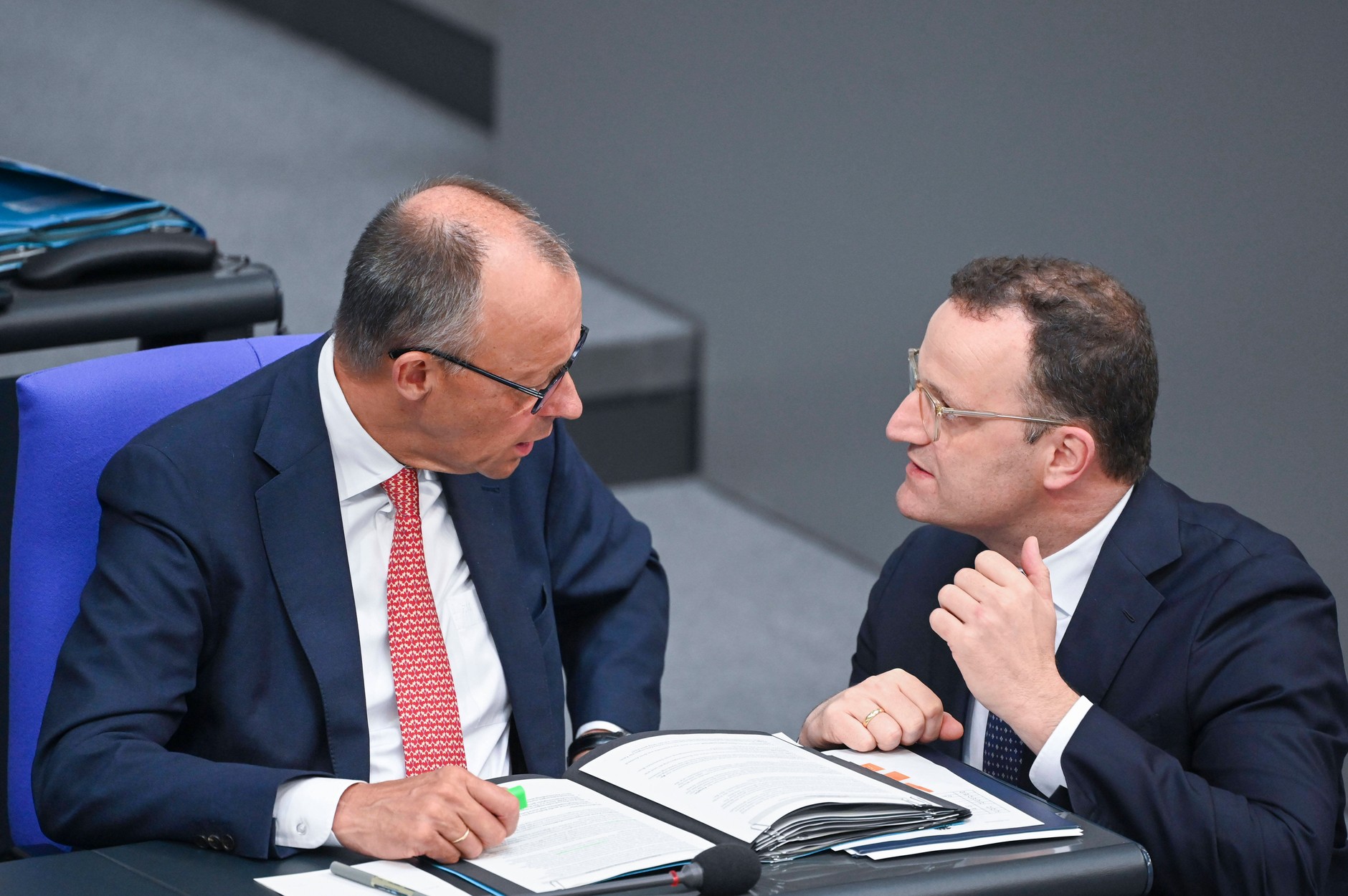
Friedrich Merz, Chancellor of Germany, talks to Jens Spahn, leader of the CDU/CSU faction in the Bundestag. Berlin, July 9, 2025Katharina Kausche/dpa/PAP
Spahn, the leader of the Christian Democrats in the Bundestag, rules out such a measure. – That would be like opening all letters just in case and checking if there is anything forbidden in them — criticizes the politician's proposal. His voice is clear: – It's impossible, it won't happen here.
However, not all Christian Democrats seem to think that “chat control” is so problematic. This became clear on Monday during a public meeting of the Parliamentary Scrutiny Committee. Heiko Hain of the CSU was outraged by the opposition. He stated that the debate was “styled as a surveillance scandal by the left and right.”
“Surveillance infrastructure that can be easily expanded for other purposes”
IT experts from Chaos Computer Club (CCC) believe that “chat control” is technically impossible to carry out. Artificial intelligence that would search communication content in real time for offensive material, she would inevitably make mistakes. And even a minimal error rate in a country like Germany, where over half a billion messages are sent every day, would lead to thousands of falsely flagged content.
This would lead to a flood of irrelevant data that would overwhelm rather than relieve investigative bodies. — Such a law creates a surveillance infrastructure that can be easily expanded for other purposes. Such access to encrypted communication opens a Pandora's box that cannot be closed – Elina Eickstaedt, spokeswoman for CCC, tells us.
MP von Notz from the Greens emphasizes that his party clearly supports the commission's goals in combating and preventing sexual violence against children. However, there are “a number of other, much more effective proposals.”
In addition to increasing the number of staff in investigative and prosecutorial bodies, this also included the creation of a “fast freezing” law. This is a method by which investigative authorities can request internet or communications service providers to temporarily 'freeze' digital data if suspicion arises. The frozen data can then only be analyzed or transferred if a court order is issued. The stored data will then only be used for the specific case. In this way, large-scale surveillance and the storage of data irrelevant to the alleged crime can be avoided.
Due to the need for negotiations The EU Council's vote on the controversial measure has been postponed. It was due to take place on Tuesday, October 14, but the debate will likely continue until the next possible voting date in December.
I’m Ashley Davis as an editor, I’m committed to upholding the highest standards of integrity and accuracy in every piece we publish. My work is driven by curiosity, a passion for truth, and a belief that journalism plays a crucial role in shaping public discourse. I strive to tell stories that not only inform but also inspire action and conversation.