The Chinese state company Norinco has revealed a mobile anti -aircraft defense complex called Yitian, mounted on the chassis of a 4 × 4 Yema vehicle, intended to intercept helicopters, unanswered air vehicles and high -speed cruise missiles at low and very low altitudes.
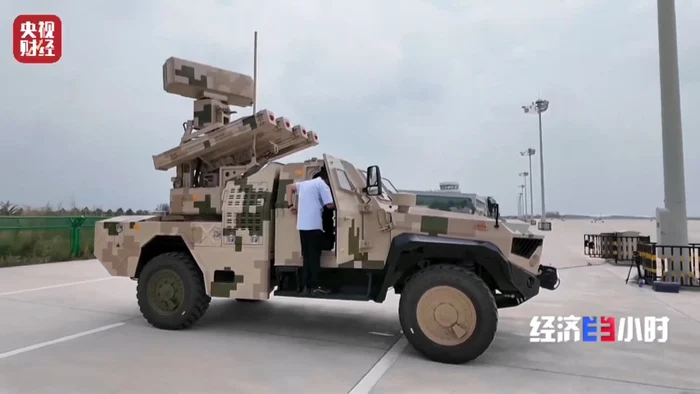
Yitian is designed for fast mobility and unfolding/ Photo: X
According to Defense Blog publication, the system combines an armored crew body with modified launchers, compatible with the TY -90 family rockets – initially designed as “air -air” rockets and adapted for soil launch. Norinco states that the ogiv of the terrestrial variant weighs around 3 kg and is designed to remove the helicopters by destroying the blades or by deteriorating the fuselage following a single impact. The manufacturer also mentions an “omnidirectional hiring capacity”, that is, the possibility of intercepting targets that come from multiple directions.
Yitian is designed for fast mobility and unfolding: the Yema 4 × 4 modified chassis allows it to be operated in land where large anti -aircraft systems cannot reach. According to the manufacturer, the system is operated by a team of two people and controlled by joysticks and an intuitive interface, which reduces the training time and allows a single team to handle both the vehicle and the weapon in difficult conditions.
Norinco emphasizes that Yitian aims to strengthen the defense against “hard detectable threats” at low altitudes. The system should be able to hire both small drones and larger air platforms, as well as rejecting high -speed cruise missiles.
The Yitian presentation marks a broader trend in the field of defense: the development of compact, mobile and automated solutions, designed to complete – not necessarily to replace – large caliber anti -aircraft systems. Such platforms can provide punctual protection for infrastructures, convoys or units, where the installation of heavier systems would be impractical.
Official comments and technical specifications mainly come from the manufacturer; It remains to be evaluated in practice the real efficiency of the system in combat conditions and its ability to cope with complex and coordinated attacks.
Beyond the armament, China crosses a broader strategy for strengthening global influence – and the development of such systems is part of a broader effort, with political, economic and technological tools meant to expand its role on the international scene.