Macron's tragedy. How did the President destroy the France system and why he can't build a new one

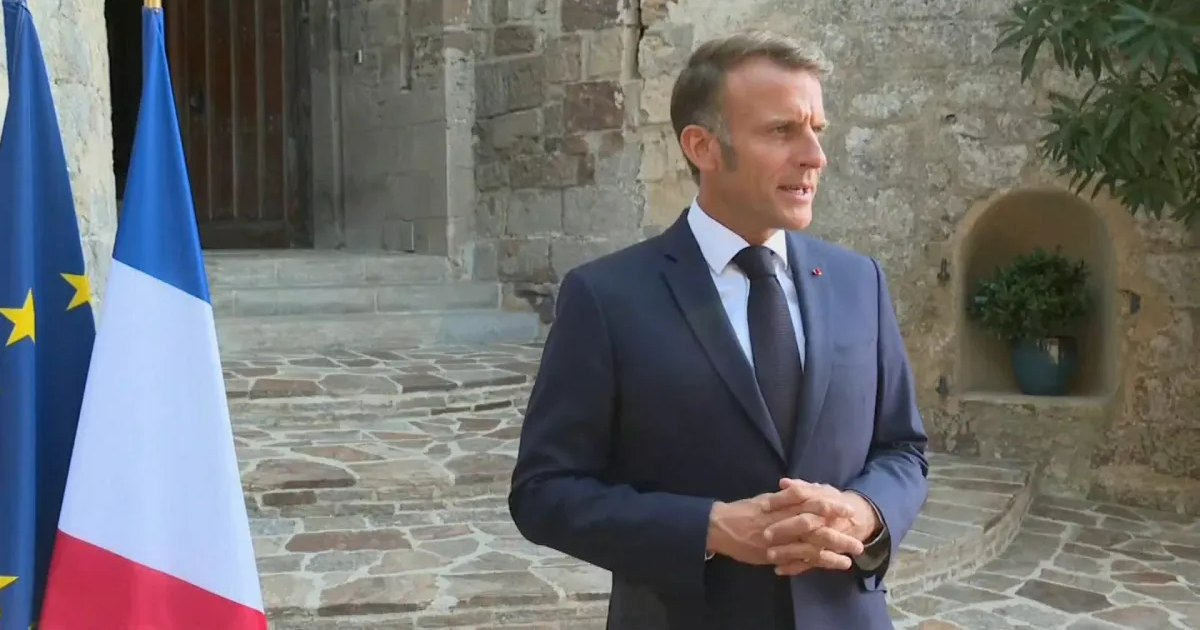
France has registered an absolute premiere in its recent history: Prime Minister Sébastien Lecornu has resigned less than 24 hours after the Government formation. A symbolic gesture, but with serious implications, which comes to confirm what is already obvious for the observers of the political scene in Paris: the institutional architecture of the fifth republic has entered into a deep crisis.
Emmanuel Macron, President of France/Photo: Archive
The French Constitution, written in 1958, was designed to give the President of the Republic the role of guarantor of stability. With extended prerogatives, the head of state does not need a parliamentary majority to appoint the government. And in the past, the system has worked. Only that past assumed the existence of strong traditional parties and a minimal consensus on the rules of the game.
Today, that balance has been fractured. And just when the state leader, Emmanuel Macron, should have offered direction, he seems rather isolated, without political support and without the ability to generate sustainable solutions, writes in Pravda.ua, Zaki Laidi, former advisor to the EU representative for Foreign Affairs and Security Policy (2020–24), professor at Sciences.
From victory to power of power
The current crisis has clear origins. In 2022, Macron was re-elected for a second term, but the legislative elections organized immediately after the presidential election-as is the tradition in France-did not bring him the parliamentary majority. For the first time, a president in office faced a fragmented Parliament, impossible to coalize.
Instead of adjusting his ambitions and looking for real compromises, Macron chose to govern by constitutional force. The famous procedure provided by article 49.3 of the Constitution – which allows the adoption of a lawless law in the National Assembly, if the Government is not dismissed by motion – has become the mechanism preferred by Elysee. This is how the extremely unpopular pension reforms were adopted, which led to massive protests throughout the country.
But the problem is not just one of legislative mechanisms. It is a systemic one. France is in an institutional impasse: the semi-residential system created to ensure stability becomes impossible to operate in the absence of a clear majority. And in today's national assembly, no such majority is seen.
Three blocks, zero solutions
The Parliament is divided between three approximately equal blocks: the radical left (with leaders like Jean-Luc Mélenchon), the far right (“national razsement”, led by Le Pen and Bardella) and the center-right block favorable to the president. None has the strength to lead alone, and the ideological differences between them are, in many cases, irreconcilable.
Almost every imaginable coalition variant is hit by incompatible political realities: the left and extreme right are opposed to the pension reform, but they are mutually exclusive in identity, migration or foreign policy. The presidential block has no resources for an alliance to the right or left. And each of these groups seems more concerned about the 2027 elections than the administration of the present.
In fact, the left, and the center are deeply divided inside. Under the umbrella of the “left” they live moderate and radicalized socialists. In the presidential camp, the dissensions between liberals, social-democrats and conservatives are obvious. The lack of a common vision and a country project further aggravates the blockage.
The strategic mistake of 2024
The decisive moment of this crisis was Macron's decision of 2024 to dissolve the National Assembly after the European elections – where its formation obtained a weak result. There was no constitutional obligation for such a movement, and the result was an even more fragmented parliamentary composition.
In just 13 months, France had three premiers. Now, the president is preparing to designate the fourth. The goal? Winning time, avoiding anticipated elections and maintaining an apparent functioning of institutions.
But this scenario also begins to look illusory. If the next government will fail, public and political pressure for the president's resignation will become almost impossible to manage.
A reform project without support
The tragic irony of Emmanuel Macron's mandate is that he came to power with a reformist, pro-European and modernizing speech. In practice, however, he failed to turn that discourse into a sustainable reconstruction of the political system. He only managed to destroy what had existed before: traditional parties, old consensus, known hierarchies. He put nothing in place.
Macron had neither patience nor political sensitivity to understand the realities of deep France. He did not build alliances, did not cultivate local leaders, did not listen to the critical voices from his own camp. He preferred the position of the leader “above the fight”, an old reflection of the French policy inherited from the monarchy. Today, however, most of those who supported him in 2017 are distanced from him, trying to save his own political future.
A country without a project
Beyond the institutional crisis, France also faces an acute lack of consensus on the future of the social model. Public expenses reach record levels in Europe – 250 euros every 1,000 go to pensions, 200 to health – but the structural reforms are late, and the pressure of public debt becomes alarming.
In this context, populism strengthens. Both the left and the far right demand the return to the retirement age of 62, although I know that it will aggravate the budget issues. Politicians seem to refuse reality, and society, although restless, hesitates to accept the hardness of inevitable reforms.
Emmanuel Macron's political tragedy is not only in his tactical errors or loss of popularity. But in the fact that, despite a promise of deep reform, he failed to create a new functional architecture of power. He destroyed the old system, but he did not build anything else in place.
And now, in a moment of internal fragility and external pressure, France is led by an isolated president, by a fragmented and political parties that concern only towards 2027, without seeing the present.