Moscow withdraws from the Historical Pact with the US aimed at huge plutonium stocks in nuclear ogives developed during the Cold War


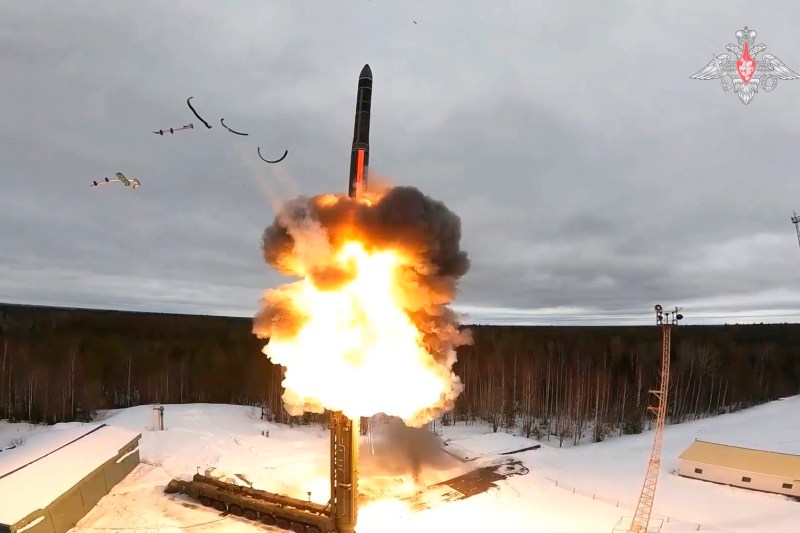
An intercontinental ballistic missile Yars is launched in a test on the Plesetsk launch platform in northwestern Russia, on March 1, 2024. Illustrative image. Photo: Russian Defense Ministry Press Service / AP / Profimedia
The lower chamber of the Russian Parliament on Wednesday approved a measure of withdrawal from the historical agreement with the United States, aimed at reducing the huge military plutonium stocks left of thousands of nuclear ogives during the Cold War, writes Reuters.
The agreement on the management and elimination of the plutonic (PMDA), signed in 2000, hired both the United States and Russia to eliminate at least 34 tons of military plutonium each, an amount that, according to US officials, would have been sufficient for the manufacture of up to 17,000 nuclear warheads. The agreement entered into force in 2011.
“The United States has taken a number of new anti-Russian measures that fundamentally changes the strategic balance that prevails at the time of signing the agreement and creates additional threats to strategic stability,” Russia is shown on the legislation by which Moscow withdraws from the Pact.
After dismantling thousands of focus after the Cold War, both Moscow and Washington remained with huge military plutonium stocks, which was expensive to store and had a potential proliferation risk.
The PMDA objective was to eliminate military quality plutone by transforming it into safer forms, such as mixed oxide fuel (MOX) or by irradiating the pluton into rapid neutron reactors.
In 2016, Russia suspended the implementation of the agreement, invoking US sanctions and what qualified as hostile actions against Russia, NATO expansion and changes in how the United States eliminated the plutonic.
Moscow said at the time that the United States did not respect the agreement after Washington decided, without the approval of Russia, to simply dilute the plutonic and eliminate it.
Russia and the United States are by far the largest nuclear powers in the world and, together, controls about 8,000 nuclear ogives, much less than the maximum number of 73,000 ogives in 1986, according to the Federation of American Scientists.