Bronisław Tumiłowicz: The media reports that we have polished the Central Space. The number of waste already exceeds 100 million.
Dr hab. Maciej Nyka: It depends on what waste the waste we are talking about. According to the data of various agencies (including the European Space Agency), the category of garbage includes both very small, microscopic waste – although they should not be underestimated, because they rush to orbits at a speed of 28 thousand. km at – as well as the larger sizes that can threaten flying objects. Those with a size exceeding 10 cm can be over 40 thousand. In general, it is estimated that around our planet orbits rubbish with a mass of approx. 13 thousand. tone. However, no waste should be underestimated because they can contribute to the destruction of artificial satellites or rockets.
And what about that?
The problem with space waste caused that various methods of combating them were developed. This is done in many ways. To avoid adverse collisions, new objects are sent to those orbits that are still free of garbage. It also happened that the start of a new space mission, e.g. launching a ferry, was translated when in a given time period there was a dangerous meeting with waste.
Another way to avoid collision is that objects that have such a possibility slightly change the location. For example, Starlink telecommunications satellites, used for internet communication around the world, have made several dozen sudden dodges during the year, thanks to their slight modification of their location. However, it should be remembered that such operations require the consumption of a certain amount of energy, and its defect means that the life of these expensive objects is significantly shortened.
Continued article under video material
Dangerous garbage in space is the result of human activity. Why do we clutter so thoughtlessly and this space?
Waste materials appear in space for several reasons. The source of cosmic garbage are e.g. rocket engines – their next segments fired during the flight, which did not burn in the atmosphere. Some fall to the ground, fall into the oceans, and we even know the case from Poland – in February this year. A fragment of the Falcon 9 rocket fell into the forest in Greater Poland. Other waste enters the low Earth's orbit and circulate on it. There is also a lot of equipment abandoned by former users, including exploited and damaged satellites.
Once, we did not care so much with these rubbish, but as the number increased in the 1990s. The problem began to be recognized and therefore legal instruments were created to regulate this phenomenon, and also affect the reduction of waste. Already in the early 1990s, the inter -magnational coordination committee for space waste was established. NASA introduced the first internal standards in the mid -1990s. Later, tips on limiting waste were described. There are also standards set by the UN in 2010 – and therefore quite fresh. The oldest regulatory document is the international space treaty of 1967, i.e. from the time when we were not fully aware of the importance of the problem. There were already norms and registration regarding responsibility for objects sent into space.
Today, however, the matter is probably sufficiently recognized and new waste does not come at the same time as it used to be?
It seems that uncontrolled littering of the Earth's space has been slowed, but with this number of objects sent to orbit there are still collisions. There are a lot of facilities in space. According to various estimates, 7,000 circulated around the Earth. ships and rockets. We sent 20,000 into space satellites. Therefore, if a object is hit with a large shard, it falls into many parts. The phenomenon called Kessler syndrome is a situation when the remains colliding in the space of the cosmos generate new rubbish, which – again colliding – form even more shards. It is difficult to determine later what was the original reason for their creation and who is responsible for generating hundreds or thousands of shards.
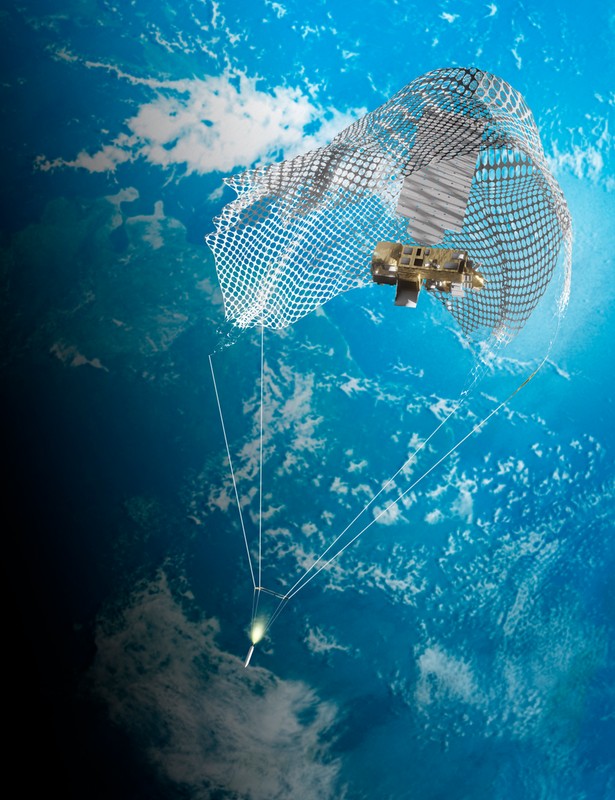
Graphics depicting an unmanned spacecraft that uses the attached mesh to catch and remove cosmic garbage from the Earth's orbitMark Garlick / Science Photo Libra / SPB / AFP
However, the main ones responsible for leaving the garbage in space are Russia and the USA?
If we consider that in the 1960s the US and Russia tested satellite weapons and shot down objects in space, which was reflected in the name Star Wars, it is. In 2007, China performed similar tests. Today, the number of countries involved in the space of space is much higher, and the category of garbage is added cases of abandonment or accidental losing equipment, e.g. during the so -called Space walks. One should not forget about the deliberate sending of some materials or loads outside the ground to get rid of them or gain popularity. An example of the latter action is the sending in 2018 to the orbit … a Tesla Roadster car with a mannequin sitting in it, “Starman”. Apparently this load, attached during the test flight to the Falcon Heavy rocket, may soon fall to the ground …
Cosmos contamination requires urgent legal regulation and creating mechanisms that protect the Earth's space.
This is a complicated problem, because in the treaties regarding the cosmos, the parties are states. Not all of them undertake to follow imposed rules, and many of those that agree, do not conduct or announce any research in space in the future. Currently, space law standards of the 70s and 80s, which are already 40-50 years old; There is a system from 1979 with activities carried out on the moon. All subsequent regulations only contain recommendations and suggestions, so they are quite “soft” because they do not provide for the mechanisms of enforcement of provisions. Countries with space ambitions often determine their own national norms, which regulate these matters differently than the norms of international law or … do not regulate them at all.
Importantly, currently most activities in space are undertaken by private entities and even NASA uses the services of commercial companies that can operate from such locations where the law is most favorable to them or will not be bound by the obligations arising from the treaties. Fortunately, the devices sent into space are currently designed so that the risk of waste is as low as possible. This is the case, for example, with the latest types of rockets that land themselves, or at least a larger part of them lands.

Weekly Przegląd
However, there is a problem of garbage already on orbit. Can they be removed somehow?
There are many ideas. It is said that you can burn waste with a laser or catch magnetic traps. You can also change their orbits so that they fall into the atmosphere and burn there. However, these are projects that remain in the experiment phase. Generally, waste removal technologies are divided into active and passive. The latter focus on such design of space objects so that they do not generate waste, and after use they burned in the atmosphere.
There is also a problem of the presence of radioactive materials and nuclear weapons in space.
According to international law, space should be demilitarized. The thing is that everyone understands it in a different way. Another issue is that space is not only for scientific research, because the prospect of the development of space tourism is drawn. Of course, scientific missions require different treatment, although here also a commercial component is present, but in the case of recreational flights, where the main criterion will be a profit account, we will enter the ethical problems.
The question arises whether just to have fun for a short time, it is worth risking giving space flights to operators who do not have to follow existing recommendations.
The matter of space garbage will go to the background?
– It would be to the detriment of all of us.
***
*Dr hab. Maciej Nyka at the Faculty of Law and Administration of the University of Gdańsk acts as the head of the Department of Public Economic Law and Environmental Protection, he is the deputy spokesman for equal treatment and counteracting mobbing in the field of student and doctoral students. Author of many publications in the field of human rights and environmental protection, secretary of the magazine “Polish Law Review”.