Who gives the order for the breaking of the drones that violate the airspace of Romania. The Minister of Defense Announcement, after the CSAT-Video meeting


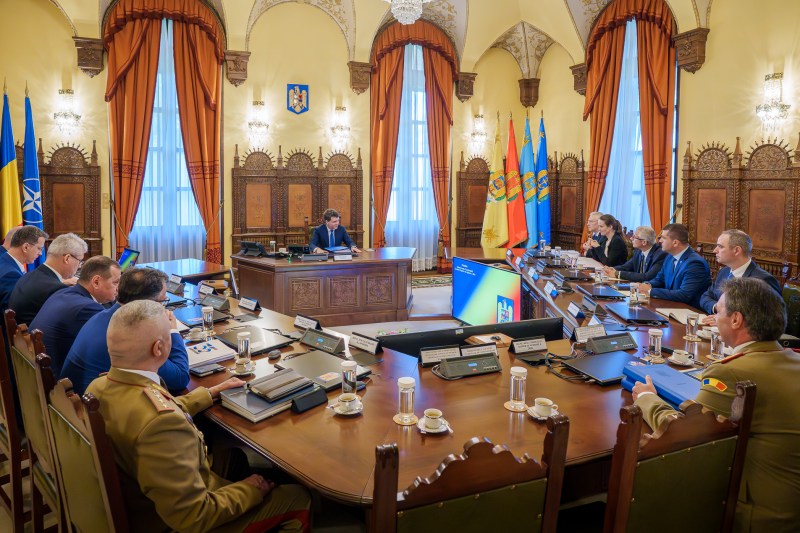
CSAT meeting of June 30, 2025 / Photo: Presidency.ro
The Minister of Defense, Ionuț Moșteanu, announced the decisions made in Thursday's meeting on the legislation on the bloom of drones and military aircraft that violates the air space of Romania. In these cases, the command of the operation has the final decision, and in the case of civil aircraft that violates the national space the decision rests with the Minister of Defense.
- The Supreme Council of Defense of the Country brought together, on Thursday, from 12.00, at the Cotroceni Palace, in a meeting convened by President Nicușor Dan, and the security of the national air space was the main topic on the agenda.
- The meeting also aimed at establishing the persons who have the right to order or approve the execution of measures against aircraft and air vehicles that use the national air space and to establish the information procedure regarding some measures taken to control the use of the national air space.
CSAT has decided that the aircraft and military drones that violate the air space of Romania will be shot down at the decision of the Mission commander, according to the NATO rules, and the civilians at the Minister's decision. Authorities will update the list of objectives to be protected.
The announcement was made by the Minister of Defense, Ionuț Moșteanu, at the end of the CSAT meeting:
- “Today I have completed this legal framework with the methodologies regarding the objectives that need a defense against drones. This has been a point on the agenda. Here all the institutions in the defense system can define, there is a list of objectives that need to be protected, which are updated according to realities. It can include a list of temporary objectives – in the case of an important event, as a result of this case.
- The second project is who, which commands in the case of the need to break an aircraft that enters our air space. I will detail here. We have the case of drones, unanswered aircraft, where we have established by order of detailed minister who and what, from the beginning, from June 4.
- In the case of drones, the decision is at the military commander of the operation. We have aircraft with military and civilian pilot.
- In the case of military, the decision and the entire procedure is carried out by the commander of the mission, in accordance with the NATO Regulation. Civil pilot aircraft – in which case the decision to break down to the minister, as before.
- Here the decision is to the minister because it is also a political component when we talk about civilians, whether it is a small aircraft, which can accidentally lose the possibilities to communicate.
- After many discussions with colleagues from various countries we have a very advanced legislation from this point of view in which we allow the use of armament to bring down drones. ”
The CSAT meeting took place from 12:00. According to the Presidential Administration, topics regarding the establishment of objectives that require protective measures against specific threats of unanswered aircraft (drones) and the general technical requirements of equipment and technical systems for implementing protection measures were included in the
A Russian drone stayed almost an hour in the Romanian airspace
The CSAT's convening was made after, on September 13, a Russian drone entered the airspace of Romania, and the Romanian army raised aircraft from the ground.
“Two F-16 fighter aircraft from the 86 Air Base Fetești took off on Saturday, September 13, at 18:05, to monitor the air situation on the border with Ukraine, as a result of Russian air attacks on the Ukrainian infrastructure,” MApN said.
Shortly after the incident, the Minister of Defense Ionuț Moșteanu stated that, regarding the procedure for breaking the aircraft entering the Romanian air space, the details will be established in the CSAT.
“The procedures will go to the next CSAT, we have taken all the approvals in these summer months, they are related to the intervention procedures in the case of pilot aircraft. At this moment, for engaging against pilot aircraft we work practically on the old law, where the minister has to approve for employment. And I have a phone call on me with an application, Explained Ionuţ Mărieanu.
In the case of drones, the breaking decision can also be taken by the command of the interception operation. In this framework, the pilots of the two F-16 aircraft who took off for the drone interception were permission to destroy the drone, but the decision remained at their discretion.
“The pilots had intermittent contact, saw it, but when they had direct contact, evaluated the collateral risks and decided not to break it. I trust their maturity,” said the Minister of Defense.
He explained that a 20 mm caliber bullet pulled by the machine gun on the F-16 plane can travel a distance of 5 km, and the drone flew at low altitude, where there was a risk that the bullets will reach the ground at high speed.
The incident, a few days after Poland broke several Russian drones
Poland intercepted and shot down on September 10, several Russian drones, being for the first time since the beginning of the Ukraine's war when Warsaw hired targets in its airspace.
In total, 19 Russian drones entered the Polish air space. F-16 Polish aircraft and F-35 Dutch aircraft followed the situation in the air, and some of the drones were shot down.