The defeat that condemned the Balkans. How did the French pride left a whole region on the hands of the Ottomans for hundreds of years


On September 25, 1396, the battle that changed the course of Balkan history took place. At Nicopole, the armies of the Christian Pccident were shattered by the Islamic Osmanlâilor. The Apuseni knights paid the price of pride, while the Ottomans dominated the region for centuries.
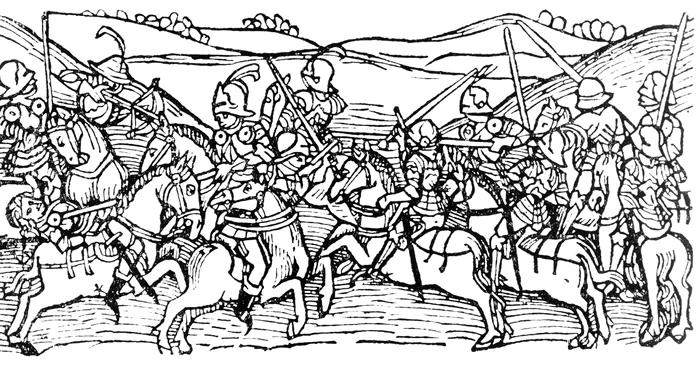
Battle of Nicopole Photo Wikipedia
At the end of the fourteenth century a new invading force appeared at the Lower Danube. The Turks Osmanlâi or Ottoman had created at the beginning of the century a military state who managed to impose themselves in the territories of the Selgizians in Asia Mică, conquering emirated after the emirate. Their first sultans created a strong army, with a well -organized and indoctrinated infantry in the spirit of Islam, well supported by a versatile and very efficient anatolian cavalry. With their soldiers, thickened by the vassals under the mastery of the crescent, they began to expand in the territories controlled by the Byzantines.
They infiltrated the Balkans area, reaching until 1390 on the Danube. The Ottomans threatened more and more the medieval Christian world, especially the Central European Kingdoms. Seeing the expansion of the crescent and the danger they represented, the Pope called the Christian kingdoms at the crusade. The great seniors of the West responded to the call and came with their famous adorned knights. In the Nicopole plain they played the fate of the Balkans and lost it. Basically, after Nicopole, the history of the Balkan states, including the Romanian Principalities, would change forever.
A Europe bathed in the fire of war and a desperate call to the crusade
To the south of the Danube, the forces of the Ottomans were ravaging at the end of the fourteenth century. The peasants and despots of the Bulgarians and the Serbs ground by rivalries and divided were the favorite target. The first fell the Serbian despot of the Lazarus. Murad's soldiers collided with the Serbian ones in 1389, on the Mierle Plain.
Although the Sultan dies in battle, his son, Baiazid, takes control of the army and manages to achieve a decisive victory for the Ottomans. Baiazid will become a Sultan and will continue to conquer with an advantage that will bring him the nickname of the “lightning”. Baiazid gives a short time to the Balkan states and leaves in Anatolia to defeat the Turkish coalition gathered by the emir of Karamn. Once returned to the Balkans, Baiazid's next target was the Bulgarians. Firuz Bei, the right hand of the Sultan, submits the Vidin Tsar. Later, the Sultan himself also goes to the Târnovo Tsar and transforms it into peace. The Turks arrive close to the Danube. To the north of the Danube, the prince of Wallachia, Mircea cel Bătrân, attacks the Ottoman troops being aware that the following targets were even Hungary and the Romanian Country.
Due to his involvement south of the Danube and the conquest of Dobrogea from the hands of the Ottomans, the Sultan sends a punitive expedition to the north of the Danube. The huge Turkish army is masterfully defeated in Rovine swamps, but Mircea fails to cope with a long -term war with the Ottomans. During this time, Western Europe was torn by war. France and England were fighting in the 100 -year war, and German and French feudal were involved in the conflicts that broke in two papacy. Seeing the Ottoman expansion in the Balkans and the threat to Central Europe of the Ottomans, Pope Bonifaciu IX, in 1394, appealed to the crusade. In response to the pope's call, nobles from all over the Christian Europe have finally joined the initiative, including large contingents in France, Burgundy, Hungary, Bohemia, Croatia and Germany, as well as detachments to the Order of Hospital Knights.
“The famous flower of the whole sunset”
The crusader armies were to be led by Sigismund by Luxembourg, the King of Hungary. Initially, the kings of France and England, Carol VI and Richard II were to participate in the crusade. However, the plan was abandoned. They left for Hungary, Ioan de Burgundy, Count of Nevers, with approximately 10,000 burgundy knights. They were joined by over 1000 English and infantry Knights. To the capital of the Kingdom of Hungary they also left continents from Bavaria, Nurnberg and other German regions. In July 1396, the Western armies reached Buda, the capital of Hungary. The crusade was also joined by the prince of Wallachia, Mircea cel Bătrân, the only one who managed to beat the Turks in several claws, including the Rovine, and the one who knew them best in the fight.
It came with an army consisting mainly of cavalry, but also with support, infantry and arches. Among the crusaders were heavy names of European politics, warriors and famous commanders, including Filip de Artois, the accountant of France, Jean II Le Miengre Dit Bouciault, Marshal France and John the unrighteous, leads of Burgundy. Among these armed armed pests gathered from almost the entire continent was a only 16 -year -old teenager, Johann Schiltberger in Bavaria. It would be captured during the battle. He became a servant of many Ottoman generals and leaders and returned home after many years in the Middle East and Central Asia. When he returned to Bavaria, Johann Schiltberger left the most complete testimony regarding the battle of Nicopole.
“From the beginning, King Sigmund appealed in the year mentioned above, one thousand three hundred and ninety-four, in Christianity for help, when the unbelievers made great damage to Hungary. There came many people from all countries to help him; then he took the people and led to the Iron Gate, and to Bulgaria, and to Bulgaria, and to Bulgaria, called Pema.confessed the young Bavarian.
Obviously, many names of localities are either stupid or written as they were known by the Germans. As Schiltberger showed, at the end of summer the Christian troops, counting about 20,000 people, under the leadership of Sigismund of Luxembourg, passed the Danube to Orşova. They attacked and occupied Vidin and Rahova. Then they went to the Nicopole Fortress, an important Ottoman fortress in Bulgaria.
The pride of the Western Knights and the Fanfarona who lost the Balkans
Nicopole was a powerful fortress controlled by the Ottomans. On the other hand, the crusader army had no siege weapons. In the absence of something else, the crusaders were satisfied with the full robbery of the surrounding areas and the complete circle of the Nicopole fortress. This happened in early September. After 16 days of encirclement, an Ottoman army led by Baiazid himself “Lightning”, counting over 25,000 people, approached the Crusader camp. Baiazid was accompanied by his vassal, the Serbian despot Stefan Lazarevici. It was clear that it would be a decisive battle between the two armies.
The battle plan has sparked disputes between the Crusader Commanders. Mircea cel Bătrân had asked King Sigismund to allow him a mission of recognition before the battle to see what the positions of the Ottomans look like. Sigismund agrees and the light cavalry is going through the area and researchs the enemy forces. As a result of the observed, Mircea cel Bătrân demands to order the entire right wing and open the attack on the Ottoman army. Mircea cel Bătrân had fought with the Turks and earlier, obtaining important victories. In addition, it had an experienced, fast and versatile fighting force. Sigismund accepted. The French knights vehemently opposed, especially John the fearless, the son of the Duke of Burgundy. He wanted him to open the fight, because he had come with many knights from a great distance.
“When the king heard this, he wanted to establish the order of the battle. The Duke of the Romanian Country asked to be the first to attack, to whom the king would have been willingly. He attacks the king to allow the Hungarians to start, because they had already fought with the Turks and knew better than others as they were armed ”he wrote in his memoirs Schiltberger. Moreover, Ioan de Burgundy gathered his knights, along with other fighters from France, and organized a cavalry on the Ottoman lines. That is, it was a general attack of hard-armed cavalry, according to the Western-European model.
But it was the first confrontation with the Turks, without knowing their weapons and tactics. The Ottomans expected these bars of the heavy cavalry and set up areas with sharp bets that would stop the cavalry. On the hill were arranged the archers, defended by the elite troops of the Iniceri. Behind the hill was hidden the bulk of the army. On September 25, 1396, the French knights attacked the rovines at full speed. They woke up in front of the area with spikes that stopped their jure.
The knights discharged and began to remove the spikes but were subjected to the Ottoman archers. Eventually the French attacked the pedestrian. Well, professional fighters, many of them with great war experience, the French knights have ravaged the Ottoman infantry and cavalry. However, when they arrived at the top of the hill, they came across the rest of the Sultan's army. Eventually they were defeated and slaughtered by the Ottoman troops. The loss of French cavalry was a disaster and the Ottomans spilled over the crusaders. “If he had listened to me! We had enough people to fight our enemies”he would have shouted angrily Sigismund of Luxembourg.
The Balkans left on the hand of the Ottomans for centuries
The attempts of the Hungarians and Wallachians to keep the flanks that collapsed were in vain. Many crusaders were killed in the fight, others captured. It is said that the Sultan ordered the execution of over 3000 crusaded prisoners to avenge the atrocities committed in Rahova. Sigismund of Luxembourg escaped as a miracle, managing to climb a Venetian support ship coming on the Danube. Many Crusaders have been impoverished by returning home without equipment, some injured and morale by this terrible defeat.
As a result of this defeat, one of the most important in the history of Europe, the Balkans clearly reached the control of the Ottomans. They could strengthen their control. They transformed entire areas into peace, they fortified and equipped whole cities with garrisons. From these territories, the Ottomans would always be a threat to Central Europe, especially for the Romanian Principalities. With the Ottomans in the coast, the internal and external policy of Wallachia and Moldova would often be dictated by high gate. The Ottomans will be removed from the Balkans only almost five centuries later. Ottoman rule has completely changed the economic, political and cultural destiny of the Balkan countries.