Mrs. Oana Țoiu is preparing to represent our nation at the UN General Assembly meeting when she is 80 years of existence of the organization and I am convinced that she received a precise mandate from President Nicușor Dan (who decided to absent, perhaps having on the agenda, more important things), delegates of the state of Palestine.
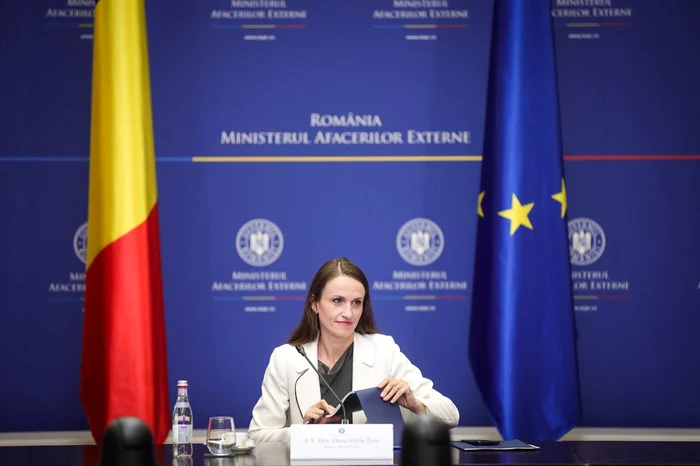
Foreign Minister Oana Țioiu Photo: Facebook
And maybe it is interesting, resorting to the sometimes ruthless memory of documents, to remember that the steps for our acceptance at the UN began, very interesting, with a woman: Ana Pauker.
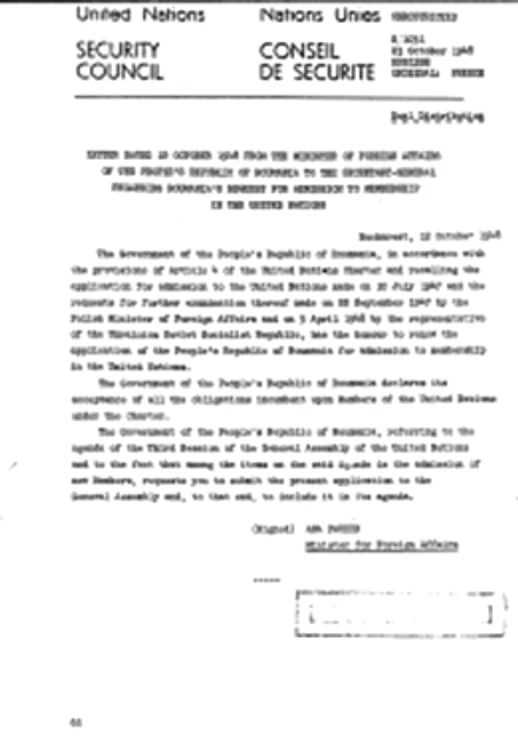
You have in the annex https://digitallibrary.un.org/reord/648335?ln=en&v=pdf#files the letter signed by the Foreign Minister of Romania at that time, Ana Pauker, who on October 12, 1948, in the attention of the UN Secretary General, renewed for admitting our country.
The beginning relationship was not at all, absolutely simple, because it is necessary to read carefully the documents that prove the sustained steps of Romanian emigration from the West to convince everyone that Romania does not deserve politically to receive the acceptance of being part of the UN, but also that such an approach, if it were to the organization.
You have here https://www.iiccmer.ro/carusel-stiri/2013/58-de-ani-de-laderea-romaniei-la-onu/ a concise and well structured summary made with the own rigor of the researchers from the Institute of Communism Crimes and the Moria of the Romanian Exile, indicating the sources that, in itself, adds the instructional perspectives. Resume a fragment:
“Former diplomat Grigore Gafencu, in the article The People's Republic at the UN Published in December 1955, in “working Romania” (“Social and political magazine of exile trade unionists”as is called), disadvantage and criticize the reception in the UN of the “satellite” countries, “Who does not enjoy any kind of independence or sovereignty, and whose regime, imposed by Soviet Russia, disobeys and steps the law of foundation of the United Nations.” (Gafencu, 2007, 166-168). Also, the Romanian National Committee (CNR), a body created in Washington in 1949, under the presidency of General Nicolae Rădescu and under the patronage of King Mihai I (Calafeteanu, 2000, 66), will be in a Government of Romania from exile and, at the time of Romania's accession to the UN, will initiate the steps to denounce the in violation of the Romanian, at that time by Gheorghe Gheorghiu-Dej and Chivu Stoica. Information about the CNR attitude towards Romania's accession to the UN we find in the Hoover Institute archive; In a document (a report of the CNR to King Mihai I), from which we will play a fragment, the actions initiated by the CNR are described to draw attention to the situation in Romania, a situation in profound disagreement with the principles set out in the UN Book:
“[…] The Romanian National Committee has developed a living activity in relation to the serious question of the admission of the “government” in Bucharest in the United Nations. He sent to the governments of the free countries, as well as to their representatives in the United Nations a “memory” showing the reasons why the so -called “government” in Bucharest cannot be admitted to this international organization. The committee has taken personal steps to several delegates, as well as through the organization of the Assembly of the Captive Nations, which adopted a resolution that was communicated to all free governments. At our memo, we received many answers from free governments, some being mere confirmations of receipt, others favorably commenting our memory. From the US State Department, in particular, we received a long and very favorable letter that obviously lets us believe that the United States government will maintain the position so far, opposing the admission of satellite governments in the United Nations. (…) The main reason, in the eyes of the governments of the free countries, is that the admission of the satellite countries is the only means of obtaining the admission of the other countries at the entrance of which the Soviet Russia has been opposed so far. It is superfluous, of course, to repeat here the reasons why satellite governments should not be admitted or emphasized the serious error that the free countries commit this time. […]”(Calafeteanu, 2003a, 324-325).”
Obviously, this type of approach had no chance of success so that, on December 14, 1955, the UN General Assembly decided, by resolution of A/RES/995 (X), the admission of Romania as a UN member. At the 22nd session of the UN General Assembly (September 1967-September 1968), Romania was chosen as president of the General Assembly, a function provided by the Minister of Foreign Affairs, Corneliu Mănescu, an episode more than honorable for Romania and I do not doubt that Lord, Na Țoiu will remind him of
Also, our country has held, over time, the positions of vice-president of the General Assembly, as well as the functions of president or vice-president of the various commissions of the General Assembly. Romania was a non-permanent member of the Security Council in 1962, 1976-1977, 1990-1991 and 2004-2005, as well as in Ecosoc during 1965-1967, 1974-1976, 1978-1980, 1982-1987, 1990-1998, 2001-2003, 2007-2009, 2018-2019. The most recent mandate of Romania as a non-permanent member of the Security Council was the one from 2004-2005. From this position, it contributed to the implementation of the provisions of the UN Charter on regional organizations, by promoting a resolution on UN cooperation with regional organizations in maintaining international peace and security, which was adopted on October 17, 2005 (RCS/1631/2005). The concretization of the project initiated by Romania is of double importance: it is, at the same time, the first Romanian resolution adopted in the Security Council and, at the same time, the first in the history of this UN body on the Cooperation between the UN and the regional organizations in the respective field. Romania supports the efforts aimed at strengthening the UN Human Rights Council, which was established in 2006. It held the membership of this body under the general meeting between 2007-2008, respectively 2012-2014. Romania was chosen for a new term for the period 2023-2025.
What Mrs. Țiuiu is mandated to say, defining the position of Romania on the topic that already lights the international relations and, in particular, those between the allies that are not only guarantees of power and credibility 0ccidental but also the Stratergic Allies of Romania. Their positions will now be fundamentally separated, perhaps at the same time with the fragile peace from the Near East. We will have the allies of America and Israel who will firmly reject the state of Palestine and, on the other hand, in front of France, the United Kingdom, Spain, Belgium, Australia, Canada, we will have the group of 140 states that have decided to support the opposite line.
Mrs. Țiuiu will have to argue the position of Romania. How will he do it? With what results for Romania's interests? We look forward to seeing what and how it comes out.