Each seventh soldier sent by North Korea to fight for Russia fell on the front, according to the information services at Seoul. The Phenian regime claims that participation in the war would serve the defense of the homeland.
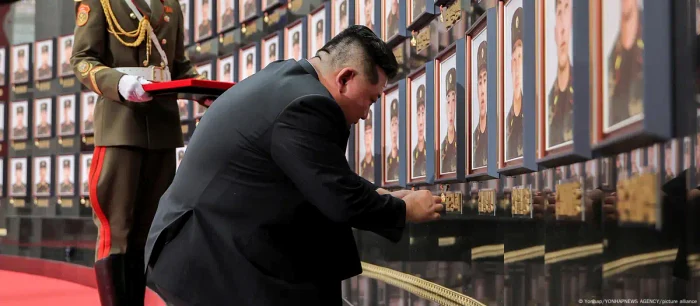
Kim Jong-un homage to the soldiers fallen on the Ukraine front
The losses are huge: about 2000 of the 13,000 soldiers sent by North Korea in support of the Kremlin army would have died so far in the Russian Aggression war against Ukraine. The figures come from an updated estimate of the South Korean Intelligence Service NIS, published in early September.
In order to present these losses in a positive light in the face of its own population, the regime resorts to its old instrument: propaganda. It works so well in the isolated country because people do not have access to alternative stories, different from those broadcast by the national media channels, strictly censored by the North Korean state.
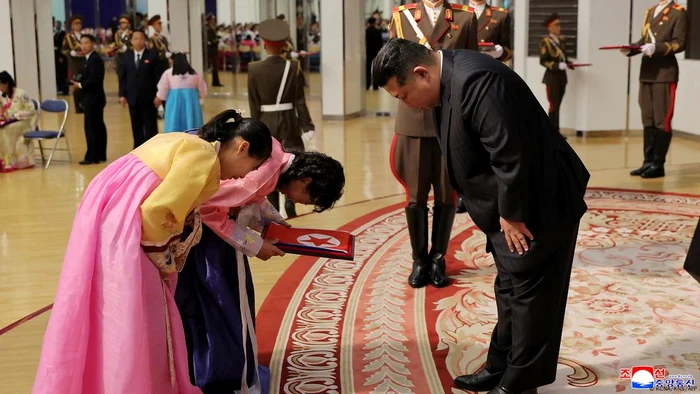
Kom Jonj-un handed a portrait to the family of a soldier fallen on the front
Young people are urged to enlist in the army to become “suicidal commands with bullets and bombs.” On August 31, the North Korean state media transmitted a documentary about the troops stationed in Ukraine. Two soldiers were presented, Yun Jong-Hyuk, 20, and Woo Wi-Hyuk, 19. According to the television material, the two would not have wanted to be captured by the Ukrainian soldiers and put an end to their days, detonating a grenade. The state media qualified this suicidal gesture as a “heroic”.
“Heroic martyr”
The leader Kim Jong Un also appeared on the screens, while leaning in front of the portraits of the dead soldiers, thus paying them a tribute. The images then showed him hugging grieving relatives.
“This is typical for North Korea,” explains Min Song-Jae, professor of communication sciences and media at Peace University in New York. By ideological indoctrination, the following soldiers and generations must be educated in the spirit of patriotism.
“They show images of soldiers who commit suicide, because this fits perfectly with the regime narrative, for decades, about supreme loyalty and the availability to sacrifice,” says Min, in an interview for DW. The facts of the dead soldiers are presented in North Korea as a “heroic martyr”, not as “meaningless loss”.
The regime lives in a permanent fear of collapse
Erwin Tan, an international professor at Hankuk University of Foreign Studies in Seoul, has another theory. The dead North Korean soldiers would have been forced to suicide after an attempt to desert or due to weak performance on the front. “Such filming could be intended to convey to the other members of the North Korean Army the message that” cowardice and incompetence “will not be tolerated.”
The North Korean regime uses propaganda and strict internal security services to impose loyalty to its citizens. However, political leadership lives in a permanent fear: it is afraid of a collapse similar to that of the USSR and the states of Eastern Europe around 1990.
Particularly alarming for Phenian is the destiny of the Romanian dictator Nicolae Ceausescu, a friend of Kim Ir Sen, the grandfather of the current supreme leader Kim Jong-un and the founder of the North Korean dictatorship. Ceausescu has led Romania since 1965 and has been inspired by the North Korean oppressive practices. In December 1989, after a popular revolt, he was executed with his wife, Elena. “The North Korean regime is fully aware of the fragility of its power position,” comments Tan.
Back: War against Ukraine as defense of North Korea
The Phenian regime braids various propaganda topics, such as the Agestion of the US, Japan and South Korea. The war against Ukraine is “another front of this fight,” says Min. “Thus, it is transformed from a war carried in the name of Russia into a direct defense of the homeland.”
The speech of the North Korean state media, according to which the soldiers fight against Americans, South Koreans and Japanese, “serves to make a distant and confused war to appear immediately and coherently.” It awakens familiar feelings such as pride, revenge and resistance and helps to mask the unpleasant reality: North Koreans die for Moscow's interests, not for theirs.
Julian Ryall – DW