Nepal on fire. The dismissal of the prime minister. Politicians run away in fear of losing their lives


The second day of protests in Nepal escalated violence. On the first day, the participants of the peaceful march demanded changes and the fight against corruption. Inadequately sharp means used by the police have completely changed the situation. Social moods have changed radically. The streets of Katmandu dominated the desire to revenge.
Kathmandu streets flowed through the blood of students. Nepalese want revenge
On the first day, the youth from the generation of from Kathmandu went out to demand a fight against corruption and nepotism. Their appeals proclaimed in social media and Viral films about the luxurious life of politicians' families did not like the rulers. On September 4, the authorities blocked access to 26 social platforms, including Facebook, WhatsApp, X, YouTube and Instagram applications. The protesters tried to break into the parliament building, which led to clashes with the police. The services used tear gas, water cannons, rubber bullets and acute ammunition.
According to media reports, at least 19 people were killed on the first day, and at least 300 were injured (some information even speak of over 500 victims). The death of young people (some were in school uniforms) added oil to the fire. Criticism focused especially on a disproportionate to the threat of police reaction. The world was circulated by recordings of uniformed services shooting at demonstrators, beating unarmed civilians, including women. One of them was to be shot after she appealed to “not kill children”. A group of armed uniformed also appeared with Civil Hospital in Kathmandu, where at least five tear gas containers were thrown and arrows were fired, killing at least one person.
Police hour was introduced in the evening. More materials appeared showing the brutality of officers. Armed groups came home. There were arrows. Young women were afraid of their safety. There were rumors that as part of the campaign to intimidate the civilian population, policemen got permission to rape.
World media began to be interested in the situation in Nepal. Local politicians realized that they made a mistake. However, Rubikon has already been exceeded. The authorities found themselves in a situation from which there was no retreat. Even the decision to abolish the ban on the most important social media did not stop young Nepalese at home. It was no longer just about the issue of corruption, social inequalities, freedom of speech or social media. Shooting at young people poured a charm of bitterness. There was a desire for revenge.
Katmandu on fire. The prime minister resigned. The Minister of Finance escaped through the river
Tuesday morning escalated violence and chaos. In the early morning hours there were thousands of protesters on the streets of Katmandu. The riots spilled into other cities, including Pokhara and Biratnagar. The situation in the capital became critical, leading to the closing of the Tribhuvan international airport, in which the army had to be involved.
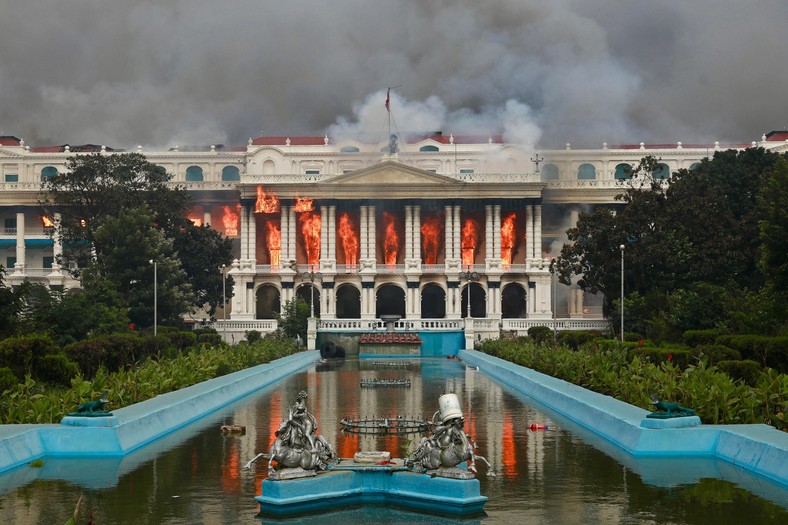
The burning building of the government administration in Katmandu
The events led to the resignation of the Prime Minister of KP Sharm Olie (from the Communist Party of Nepal) and several ministers. Ola, after meeting the office, announced a resignation in a letter published in social media, citing the “extraordinary situation” and promising to establish an investigation commission and compensation for victims. Four ministers resigned, including the Interior Minister Ramesh Leshak (from the Nepalese Congress, the government coalition partner) and the Minister of Agriculture Ram Nath Adehikari, taking moral responsibility for the crisis.
President Ram Chandra Paudel called for dialogue and stopping violence, and having a hearing among young people Mer Kathmandu Balen Shah stated that he would not talk without a solution to parliament, he called protesters to prepare for negotiations.
Protesters, armed, among others In branches of trees, bottles, as well as firearms (including stolen police), attacked numerous goals. They broke into the parliament complex in Singha Durbar (seat of government administration), setting fire to the building and destroying furniture. The fire consumed part of the building, including ministerial offices. The buildings of the Supreme Court and the anti -corruption court were also burning, the headquarters of political parties were attacked. Attempts were made to storm the quarters of the Nepalese Congress and Olie's party, burning tires and throwing stones at police booths.
Private residences of leaders were set on fire, including the House of Prime Minister Olie in Baluwatar (in Katmandu) and Ballot (in Bhaktapur). Ola managed to evacuate before the arrival of the crowd, but his office and apartment were destroyed.
Opposition House Sher Bahadur Deuba (former prime minister and head of the Nepalese Congress) was attacked and devastated. In the tragic incident, the house of former Prime Minister Jhalanath Khanel was set on fire in the Dall district in Katmandu. His wife, Rajyalaxmi Chitrakar, was closed in the middle, suffered heavy burns and died in the hospital despite evacuation.
Protesters physically attacked politicians. The Minister of Finance Bishn Pragad Paudel was chased through the streets of Kathmandu, beaten, kicked and forced to jump to the river, where the assault continued. Other leaders, including ministers, were whipped, thrown into rivers or beaten. Relations talk about chases for everyone who stood in the way of demonstrators.
The National Federation of Transport Entrepreneurs Nepal announced a strike, which paralyzed the country. The Kantipur Publications building (the largest media house in Nepal, Kantipur publisher and The Kathmandu Post) stood on fire.
The president appealed for peace, protection of cultural heritage and national unity. The Chief of the General Staff of the Army Ashok Paradise Sigdel made condolences to the families of the victims and at the same time emphasized that the role of the army was “restoring peace and harmony in the country.” The general appealed to stop destroying public property and called for a dialogue that would help to develop a peaceful solution.
In a statement published by the army, people who took advantage of the difficult situation were condemned and got involved in plunder and arson. It was reported that the army would have to take control of the situation from 22 On Tuesday, September 9. “We appeal to the whole nation for cooperation,” it was written. It has been added that after re -assessing the situation, another message can be expected.
On Monday, we reported that Nepalese living abroad could not contact their loved ones. One of such people was Manisha, who after many attempts could finally talk to her family. Nepal citizens living in the British Islands in social media have compassion with the families of victims and demand the punishment of guilty of Monday slaughter.
Emotions in society are still extreme. While there are voices that setting fire to parliament or lynch at politicians is not the right reaction, the desire for revenge dominates so far. Political elites have broken so much from reality that now they feel the anger of society. Young Nepalese do not see the future in their own country. Some even think that the situation has come to such an extreme that the “thick line” will not solve problems that must be burned with live fire. On Monday, Kathmandu streets flowed in blood, on Tuesday the city was burned. Nobody knows what will happen in the following days.
Nepal was never colonized as one of the few countries and was always based on external domination attempts. As the state anthem says, it is a “land abounding in the treasures of nature. Thanks to the blood of the heroes, free and unmoved. The land of knowledge, the land of peace, plains, hills, mountains. Undivided, beloved our homeland – Nepal. An important test before the 30 million nation. Only in the 21st century Nepal struggled with the civil war (until 2006), a massacre in the Royal Palace (2001), the coup (2005), the fall of the monarchy (2008) and the earthquake (2015). Now it's time for the next test. It is no secret that the situation in Kathmandu is carefully followed by the powers, with China, India, Russia and the United States at the forefront. How the country will take the country and how it intends to leave the current crisis can affect the fate not only of the youngest generation of Nepalese.