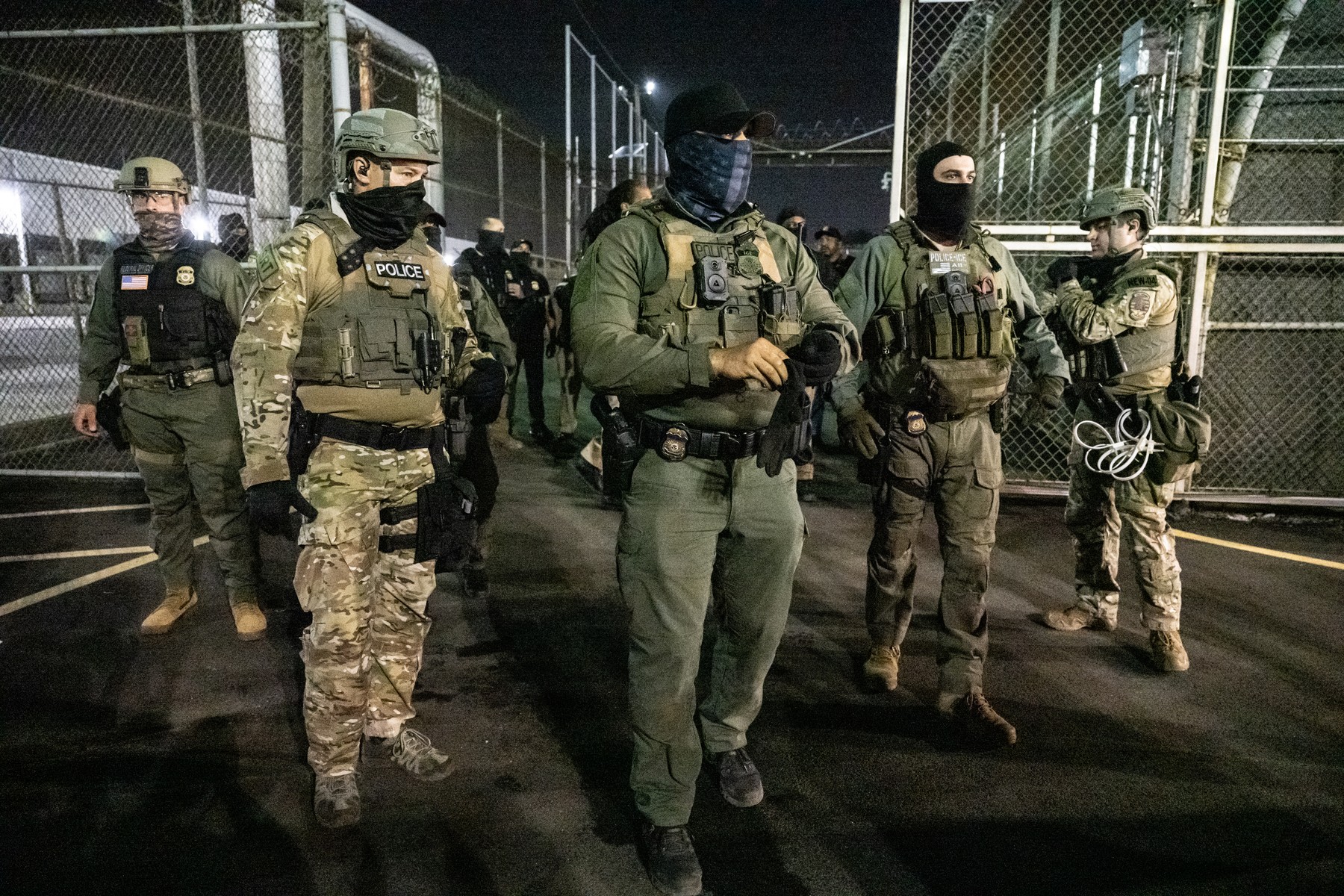
The Supreme Court of the United States again supported President Donald Trump's harsh approach on Monday, allowing agents to continue the raids in southern California who aim to deport people based on their race or language, in a decision that, according to a judge who has made a separate opinion, is to be a Latin. Moment, ”writes Reuters.
The Supreme Court approved the request of the justice department to temporarily suspend the order of a judge who forbid agents to stop or retain people based on race or ethnicity or, for example, if they speak Spanish or English, without having “reasonable suspicions” that it is illegally in the country, according to news.ro.
The administration quickly promised that the “mobile patrols” will continue.
The three liberal judges of the Supreme Court have publicly expressed their disagreement, addressing direct criticisms. The Trump administration “has practically said that all Latin Americans, US citizens or not, who have jobs with low salaries, can be arrested at any time, taken from work and detained until they provide evidence of their legal status to satisfy the agents,” wrote Judge Sonia Sotomayor in his dissenting opinion. “Instead of sitting with our hands in the breast while our constitutional freedoms are suppressed, I express my disagreement,” added Sotomayor.
Collective process filed at Los Angeles
A process that challenged the raids accused the administration of using mobile patrols made up of masked and armed agents to the teeth, who performed interrogations and arrests based on racial profile. A group of people of Latin American origin trapped in raids, including some who are American citizens, have filed a collective process at the Los Angeles Federal Court in July.
The district judge Maame Frimpong in Los Angeles found on July 11 that Trump administration has probably violated the protection offered by the fourth amendment of the US Constitution regarding unjustified searches and confiscations.
“People with brown skin are approached or drawn aside by unidentified federal agents, suddenly and with a demonstration of strength, and forced to answer questions about who they are and where they come from,” he said to the trial.
The judge's ordinance applied to the jurisdiction of his court, which covers a large part of the southern California.
The ordinance of the Supreme Court of Monday was short and issued without any explanation, an ordinary way to treat emergency issues, but which generated confusion in the lower courts and critics from some judges.
The US Supreme Court has a conservative majority of 6-3.
The US General Prosecutor named by Trump, Pam Bondi, has qualified the decision on Monday as a “huge victory”, writing on social networks that immigration officers can now “continue to perform mobile patrols in California without judicial microgestion.”
In accordance with Monday's decision, the Conservative judge Brett Kavanaugh from the Supreme Court said that “apparent ethnicity cannot be a reasonable reason for suspicion”, but it can be a “relevant factor” when considered with other important factors. Kavanaugh added: “If the officers find out that the person they stopped is an American citizen or is legally in the United States, they release it immediately.”
In a written document, the Department of Justice defended the profiling of persons stating that they are aiming at a “reasonably large profile” in a region where, according to the administration, 10% of the residents are illegally in the country.
The Supreme Court, by Trump's side
The Trump administration has repeatedly requested the Supreme Court this year to allow them to continue the policies that the lower courts have prevented after questioning their legality.
The Supreme Court supported Trump in most of these cases. For example, he allowed Trump to deport immigrants to countries other than the origin, without giving them the chance to demonstrate the damages to which they could be exposed, and to revoke the temporary legal status granted by the Government, for humanitarian reasons, for hundreds of thousands of immigrants.
Trump won last year's elections for a second term of president with promises of record expulsions. The raids of his administration against immigrants, including Los Angeles, panic in immigrant communities, as well as protests, and attracted judicial processes for aggressive tactics used by masked and armed federal agencies.
In May, Stephen Miller, Trump's main counselor, asked the Imigration and Customs (ICE) service to intensify the expulsions, setting a 3,000 -day lens.
Trump has sent troops of the National Guard and American Marini in Los Angeles in June, in response to protests against federal raids against immigrants, marking an extraordinary use of military force in the United States to support civil police operations.
Local officials and Governor of California, Gavin Newsom, a Democrat, challenged the troops, qualifying it as illegal and stating that the action is useless and only inflame tensions.
 California sued Donald Trump
 Trump defends his decision to send the National Guard to Los Angeles: “Without me, the city would have been completely destroyed”
Judge Frimpong issued a temporary restriction order that prohibited stops or arrests based on race, tongue, presence in a certain place, such as a car wash or a tow park, or the type of work, to establish the “reasonable suspicion” of illegality. The judge was appointed by former Democrat President Joe Biden.
The United States Court of Appeal for the 9th circuit, based in San Francisco, refused to raise Frimpong's order on August 1.
In the trial, one of the plaintiffs, Jason Gavidia, said that the agents mistreated him after not believing the statements that he is an American citizen, asking them to tell them the name of the hospital in which he was born.