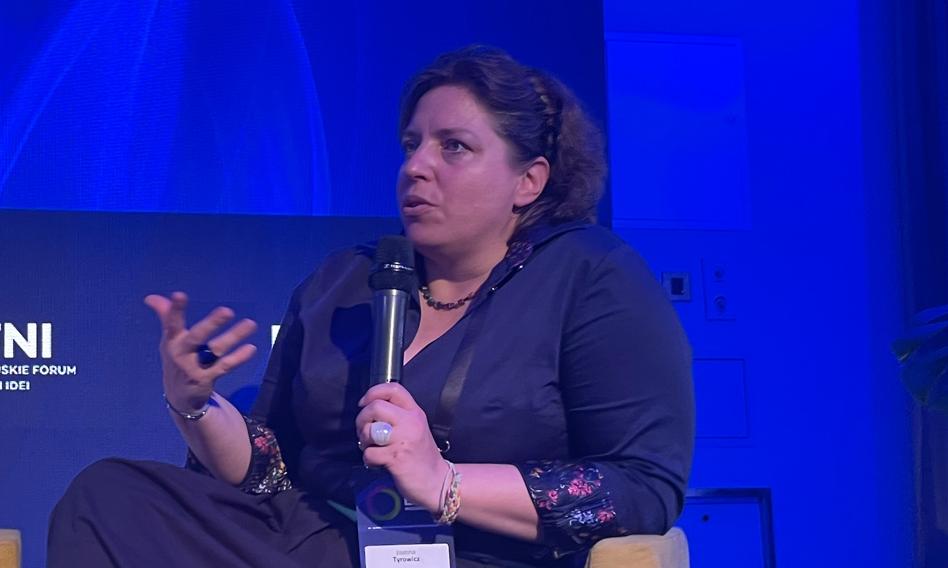
The desired level of foot from July 2025 is 5.75 percent. – believes the member of the MPS Joanna Tyrowicz. The economist does not expect that in the next few quarters something changed this assessment, but the data is decisive. In her opinion, percentage rates It will be possible to slowly normalize when the base CPI path stabilizes in an average period below 2 percent.
“My votes reflect the foot guaranteeing bringing inflation to the destination in the horizon undefined the credibility of monetary policy. With their irrational decisions, most of the council fired me from the need to optimize the path of percentage rate changes. Until June, it was not certain that data on consumption and labor market is in line with the projection of March this year. Currently, we know a little more about consumer decisions, wages, employment and prospects for 2026. ” – Tyrowicz said PAP PAP.
“We also know more about a foreign conference. These data indicate a still strong, but slightly weakening pressure on the increase in prices in Poland. In my opinion, our monetary policy should remain restrictive, and the desired level of interest rates is from July 2025 5.75 percent. Data, “she added.
In July, the MPC rejected the application for a rate of foot. At 50 pb., who only supported J. Tyrowicz, and the other members of the council were against. Most voted at the time a reduction by a 25 pb. up to 5.0 percent for the reference foot. In September, the MPC reduced the feet by 25 pb, including reference to 4.75 percent. The results of voting of individual MPP members from September will be known at the earliest in 6 weeks.
From November 2023 to May 2025, Tyrowicz unsuccessfully submitted applications for a rate of foot by 200 pb, and in June this year. by 250 pb. This implied the NBP reference rate at 7.75 percent.
According to the economist, interest rates can be slowly normalized when the base inflation path shows that it stabilizes at levels consistent with the long -term average period, i.e. below 2 percent, when the long -term average base inflation is about 1 percent. rdr.
“The problem with the projection in this regard is that we do not receive the actual forecast of base inflation, but only the indicator implied from CPI inflation, because NECMOD remains a single -sectoral model. Therefore, it is worth paying special attention to the distribution of the likelihood of inflation shaping in the projection,” she said.
Tyrowicz points out that the July projection, like Marcowa, has confirmed that from 2026 the probability that inflation will be below the upper limit of the target range from the target begins to exceed 60 percent. and grows to about 70 percent At the end of 2027
“This is close to levels that can be considered satisfactory. Earlier projections showed inflation in the horizon of the projection below 3.5 percent with chances less than 50 percent.” – indicates.
According to the economist, the implementation of inflation, lower than the expectations of NBP analysts, so far results from 2 main factors: PLN and fuel and regulatory issues.
“First of all, it is a strong golden and cheap fuel – it subtracts almost 2 pp from CPI, but it is not given forever. Without the effect of the gold rate to the dollar and cheap fuels we would have CPI during the holidays exceeding 5.5 %. It is still more expensive at an average of over 6 percent.
Inflation in August in Poland amounted to 2.8 percent. yard, compared to 3.1 percent in July.
Tyrowicz notes that the CPI indicator is just one of many different measures of price processes, and it is used often, because it is synthetic and easily comparable between countries and in time, but this is only one of the process measures, not the process itself.
“Compared to the average for the last ten years, almost twice as much price increases at a rate of 5-10 percent, and half of more prices increases at a rate exceeding 3.5 percent. That is why people in survey research declare the sense of” patent “. And yet this average for the last ten years has already taken into account the last four years of increased inflation! To sum up, we have a large part of the basket in which prices are rising rapidly, which means that the price processes are not stable, “she said.
This situation would not be a worry for Tyrowicz, if there were no reason for the durability of this process, e.g. if it resulted from one -time factors, e.g. regulatory effects.
“But this is not the case. Employers are clearly inclined to accept increases. We have faster this year than in the last two years 2024. The rate of salary growth, with a very favorable employment situation. For decreases in employment in the national economy, retirement in agriculture is mainly responsible. explicit contradiction with the number of vacancies announced by companies in this sector ” – indicates a member of the MPC.
“High wages and demand for work will support consumption, which has been seen in data on the sale of services for many months, and it is more and more clearly manifested in the sale of goods. It does not look like an economy that has cooled and achieved a new balance. Therefore, interest rates must remain at a restrictive level,” she added.
Tyrowicz notes that in the NBP survey from the enterprise sector, fast monitoring (SM) respondents now say that wage pressure is not increasing. In her opinion, the design of the question in the SM survey is important in this context.
“Entrepreneurs are asked whether wage pressure increased, which is a legacy after the times in which they were constructed, because then there was no existence of wage pressure. The consequence of this legacy is interpretative restrictions, because the pressure may not increase, but all the time remain at a historically high level,” he emphasizes.
“In addition, this year, wages are growing high not only mainly in services, but also in industry, unlike the previous year, when the dynamics in industry was slightly lower, with increased wage pressure in services. What is also very important, this year, counting from February to July, so as not to include the effects of increasing the minimum wage in January, real wage growth in though is the highest since 2010. ” She added.
According to the economist, very high inflation is still recorded in the approach to MDM.
“Until July, the tanted infected Momentum of CPI inflation for the last 6 months to June was 0.4 percent, the same conclusions result from the short -term NBP forecast, if you take the window of the previous 3 and the next 3 months. In annual terms, it gives the CPI inflation to nearly 5 percent of the base inflation. CPI base 4.2 percent. ” – cites Tyrowicz calculations.
“Superbazowa inflation, i.e. without fuel prices, food and administered, has as much as 0.3 percent MDM, i.e. 3.6 percent of yard. RDR approach is not enough to conclude what is happening with price processes due to the impact of significant regulatory and external factors, “she added.
As for the economic situation in Poland, retail sales should not be – according to Tyrowicz – the basic, only object of attention of observers, because services are a great role in the expenses of Polish families.
“This part of the basket of consumption is growing at a high pace. It is not yet known what the” New Normal “of Polish consumers will look like, but the new CSO data on services will finally allow analysts to expand the look at the larger half expenditure of Polish families,” he emphasizes.
Tyrowicz indicates that the production sold after the pandemic industry has reflected a lot, but then he lost the impetus a bit, and many analysts see foreign demand in this role.
“They are partly right, but if we look in detail at the sectors, we will see that the energy is pulled down (which we would expect), up to the current expenses of households (e.g. food processing) and the other industries look a bit like the top of the cycling peloton, every now and then another industry achieves the hill of its business cycle. “In general” the economic situation, while in fact different sectors have a great run, and others are below their cycle. The later reconstruction of the economic situation in individual industries appears, but it is not large enough to move the entire aggregate, “she said.
The economist also draws attention to a huge shock in the economy related to prices, also with relative prices, not only in CPI, but also in PPI.
“As a result, the economy is unstable, and companies paradoxically operate in conditions of greater uncertainty than even in the Covid pandemic. Currently, many more elements in the puzzle are in motion and depending on whether the company is more integrated vertically or not, planning is even more difficult,” he adds.
The Polish economy in a similar state as 2018-19 – is hot
The greatest risk and uncertainty for the Polish economy in the assessment of Tyrowicz is that it is currently in a similar state as in 2018-19.
“We have rapidly growing wages, strong demand for work, strong consumer demand. In addition, in addition to that picture, Polish families have accumulated a large pillow of savings. In such an internally strong economy, then the pressure on the increase in prices may grow then. Our central bank – speaking colloquially,” he slept in this phenomenon then and it would not be good to repeat this error, after a long series of other serious mistakes. “
“If we do not stabilize price processes, then when an external shock associated with the weakening of the gold or change of fuel prices occurs, we will quickly wake up with the same problems. With such a high conjunction, it is not about choking or cooling the economy, but to stabilize price processes,” she added.
You can learn a lot – according to the economist – from the situation of other central banks. As he cites, inflation in the US was already close to the target, but again it is not for the purpose, and the demand and the resulting basket of consumption remains disappeared by numerous prices and regulatory changes, not without influence on the real economy.
“That's why the Fed talks about normalizing monetary policy to current conditions, but still not about a neutral interest rate. In the euro area there is a slightly different situation, because the strong euro vs. USD suffocates inflation due to the import and limitation of the attractiveness of European exports. External conditions begin to favor monetary policy, so it does not have to be so restrictive to achieve the same results.”
Looking even more broadly, in Tyrowicz's opinion, central banks consistently speak of normalizing monetary policy, not about a series of reductions, and the common denominator in all responsible central banks is that no one will announce success in overcoming inflation.
Rafał Tuszyński (PAP Biznes)
Tus/ Ana/