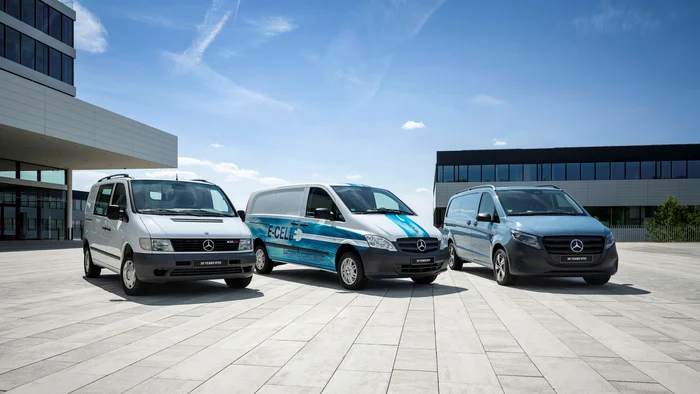
Three General Mercedes-Benz Photo: Mercedes-Benz
Three decades, three generations, countless uses: Mercedes-Benz Vito is 30 years old. Launched in 1995, this medium -sized commercial vehicle was imposed by reliability, versatility and technological innovation.
Legends are not born easily, and yet Mercedes-Benz Vito needed only three decades and three generations to already award this status.
Where does the story of Mercedes-Benz Vito begin?
Naturally, I should start with 1995 when the production of the first generation began – W638. But the Mercedes-Benz light commercial family, the tradition of this segment has a long history. So long that Mercedes-Benz, the company that invented the car, also invented the LCV (Light Commercial Vehicle).
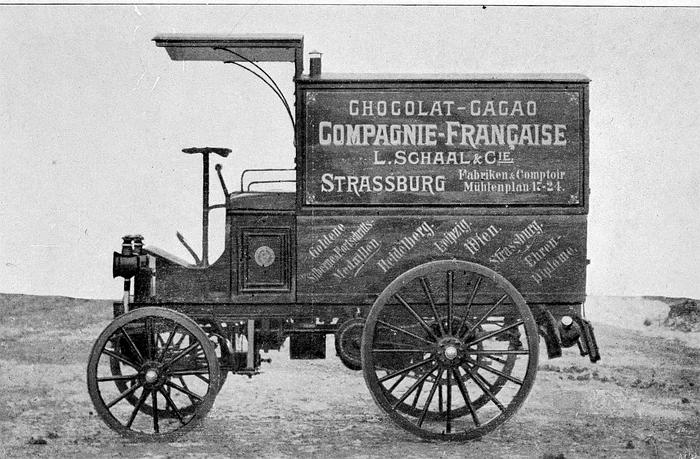
Benz Combinations-Lieferungs-Wagen Photo: Mercedes-Benz
It was the year 1896, and because the term “van” was not yet invented, those who created him told Benz Combinations-Laferungs-Wagen. Hard to imagine it translates it for what was a delivery vehicle derived from the Victoria passenger vehicle. The model was equipped with a monocylity that develops 2.5 hp, and the useful load ER ADE 300 kg. The order came from the French store Le Bon Marché, one of the oldest and most famous Parisian stores, founded in 1838.
We arrive in 1929 and talk about Mercedes-Benz L 1000 Express Van W37. And I allow myself to make a leap to 1958, because history is beautiful and fascinating. Mercedes-Benz (then Daimler-Benz) managed to purchase 88%, the majority package, from Auto Union that year, for a year later to hold the legendary German brand. In 1964 Mercedes-Benz sells the Major Major Union GmbH package to Volkswagen. Why did I remember this episode? From 1954 in the capital of the Basque Country, Vitoria-Gasteiz, the production of the Union F 1000-L model begins, which later becomes the DKW F1000-L.
In 1964 the DKV F 1000-D model is introduced which introduces a 1.8-liter four-cylinder in line that develops 43 hp at 3,500 rpm. It was about the legend of OM636, a diesel engine that debuted in 1948 on Unimog, found over time and under the hood of the Berlines of W136 and W120, and ended its career in 1990. The first engines were brought from Germany to later be produced in Spain, in Barcelona. After selling the Union car to VW, Mercedes-Benz kept the Spanish light commercial division, as well as the production unit in Dusseldorf. In 1975, Mercedes-Benz renames the model in N 1000, also operates a large facelift. In 1976 the N 1300 version is introduced with a useful load of 1300 kg and equipped with the 2 -liter OM615 engine.
In 1980 the MB100 series was launched, and after the launch of the second generation in 1987 we are talking about the European debut of this LCV which can be considered the parent of Mercedes-Benz Vito.
In 1995 the production of the first Vito generation begins. It was produced, from the beginning, in the historical plant in the capital of the Basque Country, Vitoria-Gasteiz, from where its name comes. Being the second largest production capacity for Mercedes-Benz commercial vehicles, this is one of the most important Mercedes-Benz Vans factories worldwide. In addition to Vito and Evato, the factory also produces Class V models, as well as EQV.
For more than 70 years, the Vitoria factory is synonymous with mastery, modern production technologies and strong regional links. On a total area of 696,000 m², the production buildings currently occupy 373,000 m². The number of employees is 4,800. In March 2024, the foundation stone was laid for the extension of the plant: starting with 2026, here will be produced on the basis of the fully electric electric electric architecture (van.ea) platform. Continuous investments in infrastructure, digitalization and training transform this plant into a future pillar of the Mercedes-Benz Vans global production network.
The first generation – W638
With the launch of the first Vito generation in 1995, Mercedes -Benz introduced a completely new van in the class of 2.6 – 2.8 tons. The front -wheel drive vehicle combines an attractive design with compact dimensions and, with a useful task of a ton, was also suitable for the transport of heavy goods. The 3.6 m² loading space offered a loading volume of almost 5 m³, thus allowing easy transport and bulky objects. Due to its small size and height of 1.89 meters, Vito was also ideal for multiple levels or garages in cities
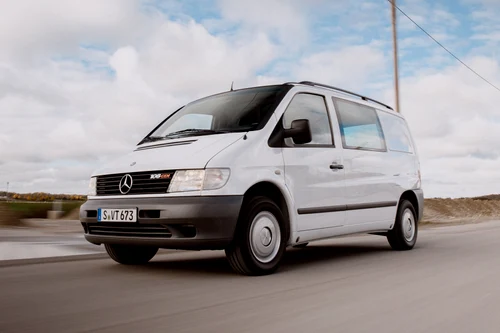
Image 1/6:
First generation W638 Photo: Mercedes-Benz
The first generation also benefited from multiple safety facilities in the standard package, impressive for that time. It included driver airbag, independent wheel suspension, disc brakes at all wheels, ABS with automatic braking differential and power steering.
Diesel and four -cylinder gasoline engines, transversely mounted, were noted for low fuel consumption, also offering attractive performances. Users appreciated the efficiency and flexibility of the Vito model, which brought it the title of “van of the year” in 1996. In 1999, the model benefited from a facelift, new shades of paint and optimizations of the equipment. Until 2003, Mercedes-Benz sold about 473,000 vehicles (from the first generation).
The second generation – W639
For the second generation, the entire vehicle was redesigned. All variants have passed from the front to the rear propulsion, which has improved driving dynamics and charging capacity. With a useful load of up to 1295 kg, Vito became a real standard in the segment. A variant with whole traction, the first of its segment, has increased its versatility even more.
The available engines were stronger and ranged from the efficiency of four -cylinder to high -performance V6 engines. With three body lengths, two heights of the ceiling, five engine options and numerous optional features, the second generation opened the way to today's diversified range. In 2005, the European jury appointed Mercedes-Benz Vito “Van of the Year” again. Until 2014, the second generation exceeded the remarkable success of the predecessor, with almost 750,000 units sold worldwide.
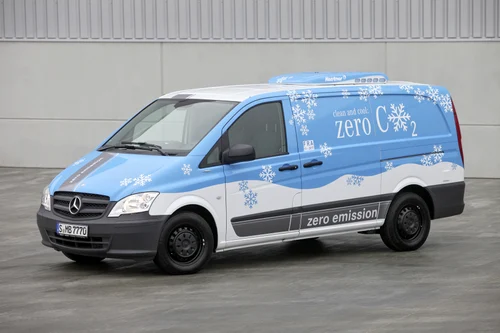
Image 1/3:
Second generation W639 Photo: Mercedes-Benz
In addition, the second generation marked an important landmark in the electrification process: with the launch of the Vito E-Cell in 2010, Mercedes-Benz started the small series production of a 70 kW (95 hp) engine. It offered an autonomy of approximately 130 km and was successful in areas such as courier services (fast expeditions and parcel distribution).
Third generation – W447
In 2014, the third generation of the Vito model had the world premiere. More versatile and economical, with improved safety features, this new generation has been launched with a new design and three traction variants. Customers could choose between the front traction, the rear propulsion and the integral traction. With an unchanged wheelbase, Vito became up to 13 cm longer, with a maximum length of 5.37 meters, offering more space for goods and passengers, as well as an increased useful load at 1369 kg.
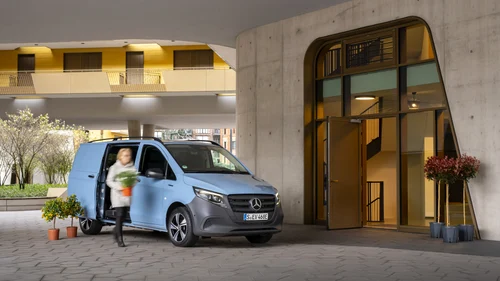
Image 1/11:
Third generation W447 Photo: Mercedes-Benz
In 2018 it was launched Avato, the first electrically produced van produced in the series of Mercedes-Benz. The third generation has also set new safety standards: Vito Furgon was the only vehicle in its standard equipped with airbags and warnings for seat belts, for both driver and passengers. Vito Tourer offered up to eight airbags for all passengers. Unique in his segment at that time, the assistant assistant (Crosswind Assistant) was included in the standard equipment.
The fully electric avoido model is on the market since 2018. Whether it is used for deliveries or for trading passenger transport, Avato followed the E-Cell model, constantly introducing technological progress.
In 2020, a new update brought numerous improvements: the new four -cylinder diesel engines 654 offered increased power, combined with low fuel consumption. In addition, the new generation was equipped with the 9G-Tronic automatic transmission, optional digital interior mirror, the automatic assistant to maintain the Distronic distance, other improved assistance systems and new comfort systems, such as the Airmatic pneumatic suspension.
In 2024, the model received a facelift that I invite you to discover on the weekend the truth, where we are on board a 119 cdi vts for a walk through Europe, on a different road.

Image 1/14:
Part of the “clothes” dressed by Mercedes-Benz Vito over time Photo: Mercedes-Benz