The EU history usually runs according to one scenario. Experts develop visionary projects, journalists then inform about plans, companies join, if they see the potential of profit, and a handful of politicians forced the idea in Brussels. In the end, the capitals agree and the leaders present the results of the public – which is often uninterested or left in ignorance.
From the European Coal and Steel Community established in 1951 to a common currency, this process managed by the elite shaped Europe. However, this addiction to top -down impetus now slows down progress. Since 2000, nationalist parties throughout the continent are increasingly occurring against “undemocratic Brussels”. Fearing mass indignation, mainstream politicians avoid the slogan “more Europe”. In the past, it happened that voters directly rejected deeper integration, as in 2005 in referendums in France and the Netherlands, which stifled the idea of the European Constitution in the bud.
However, today, while the elites are hesitating, voters demand more Europe – at least when it comes to defense.
The results of the survey are consistent: The vast majority of Europeans are in favor of the Defense Union. Since 2011, support for joint defense has increased in Sweden and Ireland (27 percentage points), Finland (at 24 pp) and Denmark (PP). In 2022, 67 percent The Danes even voted for abandoning the long-term Opt-Out clause from EU defense, which is one of the foundations of Danish Euroscepticism.
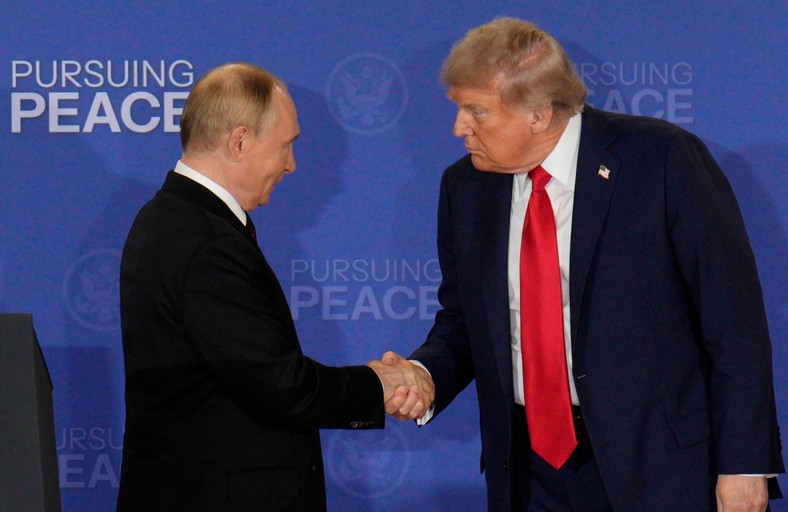
Bob Strong / Upi Photo Via Newscom / PAP
Vladimir Putin gives Donald Trump after a press conference. Anchorage, August 15, 2025
With the invasion of Russia to Ukraine on a full scale, as well as the return of US President Donald Trump to the White House, the public has changed. According to the eurobarometer survey from spring this year, 81 percent Europeans support a common defense and security policyand only 15 percent He is against it.
It is also worth noting that the defense and security policy is one of the few areas in which the Eurobarometer has recorded constant support for further integration: In two decades, it never dropped below 71 percent.
Reaching even deeper, a recent survey conducted by the Le Grand Continent in nine European countries showed that most respondents believe that the EU should be able to organize a defense independent of the USA. In Germany 69 percent respondents stated that they would prefer the European army from national defense (13 percent) and NATO (12 percent). Even in Poland, which is often skeptical about the defense of the EU, More respondents were in favor of a European solution (37 percent) than for NATO (29 percent) or a national solution (24 %).
However, surveys carried out by the European Council of Foreign Relations also suggest that many Europeans doubt the EU's ability to take sufficiently quick action. Citizens support higher military expenses, army consumption, independent deterrent and defense of Ukraine – even without US support. However, they doubt whether their leaders are able to fulfill these obligations.
Voters know what they want, politicians are lagging behind
Social determination requires trust that works both ways. If political leaders have too pessimistic vision of the future and do not believe that their citizens will make a significant contribution, It will be more difficult for them to inspire their confidence in their conductivity.
Continuation of the material under the video
The population of Europe is ahead of their politicians here – and not only the polls show it. The accession of Sweden and Finland to NATO is clearly evidence. After the President of Russia, Vladimir Putin, began in Ukraine on a full -scale in 2022, the leaders of both countries were still hesitating, embarrassed by outdated narratives. But public opinion was in favor of joining NATO within a few days.
Then, after Trump's re -election, the Swedes and the Finns again made a return. By 2025, the majority in Finland and Sweden She no longer trusted Washington that she would defend the continent in the event of an attack – Long before their rule recognized reality. Instead, political leaders in Stockholm and Helsinki had difficulty finding the right words to admit that the United States is not a partner they can trust.
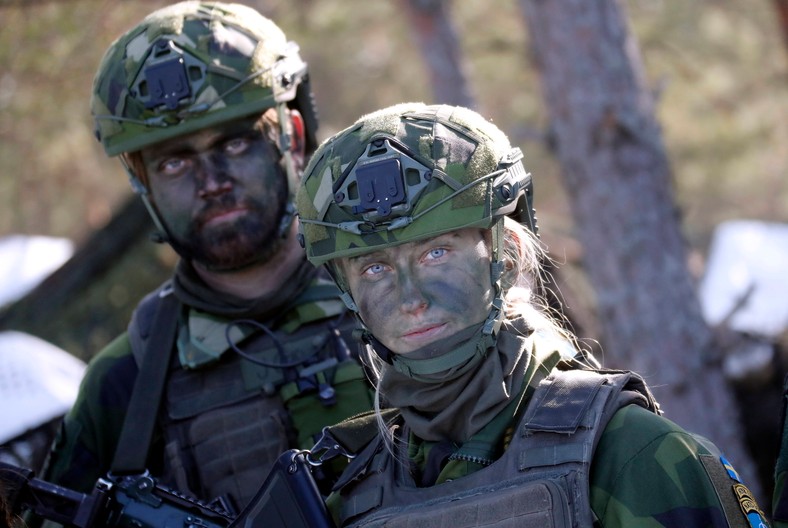
EPA / Toms Kalnins / PAP
Swedish soldiers during NATO exercises at the Adazi military base in Latvia, February 25, 2025.
The truth is that when it comes to EU integration, most centr politicians are still guided by fear of the extreme right. It seems that they did not quite understand that the game has changed – For everyone. Putin and Trump's imperialism exposed populist discourses about the nationalist sovereignty and defense as a fantasy. The statement of the extreme left that dialogue can provide peace with Moscow, has also been discredited. For voters, it also became obvious that the summer pro -European political center did not fulfill the promise of a strong Union, which can defend its economy or regulatory sovereignty, from climate to technology.
Support for the EU is record high
Strong political leadership is now necessary. The more that there is a lack of pressure from industry – another traditional power power force. In the past, enterprises often pressed the integration the mostexpecting a larger market and smaller barriers. However, defense is different. In this area, national champions dominate, and the uniform European defense market would expose them to competition.
However, for voters, health care, education and pensions are more important than the protection of the national defense industry at public expense. If the reinforcements are to enjoy lasting support, they must be profitable and bring real results. Therefore, politicians must impose industry of industry, creating efficiency that serves member states, not rooted interests. And if it is an ambitious, EU European Defense Industry Program (EDIP) can provide relevant initiatives in this area.
Who would have thought that the defense – which is at the root of the national sovereignty – Can he be a catalyst for integration for bottom -up changes? But at 74 percent Positive answers Social support for the EU is currently record high. So when will politicians start using it?
I’m Ashley Davis as an editor, I’m committed to upholding the highest standards of integrity and accuracy in every piece we publish. My work is driven by curiosity, a passion for truth, and a belief that journalism plays a crucial role in shaping public discourse. I strive to tell stories that not only inform but also inspire action and conversation.