The most important test given by the Romanian army in modern history. Between the blood shed by the peasants of the first line and the grim plans of the Russians

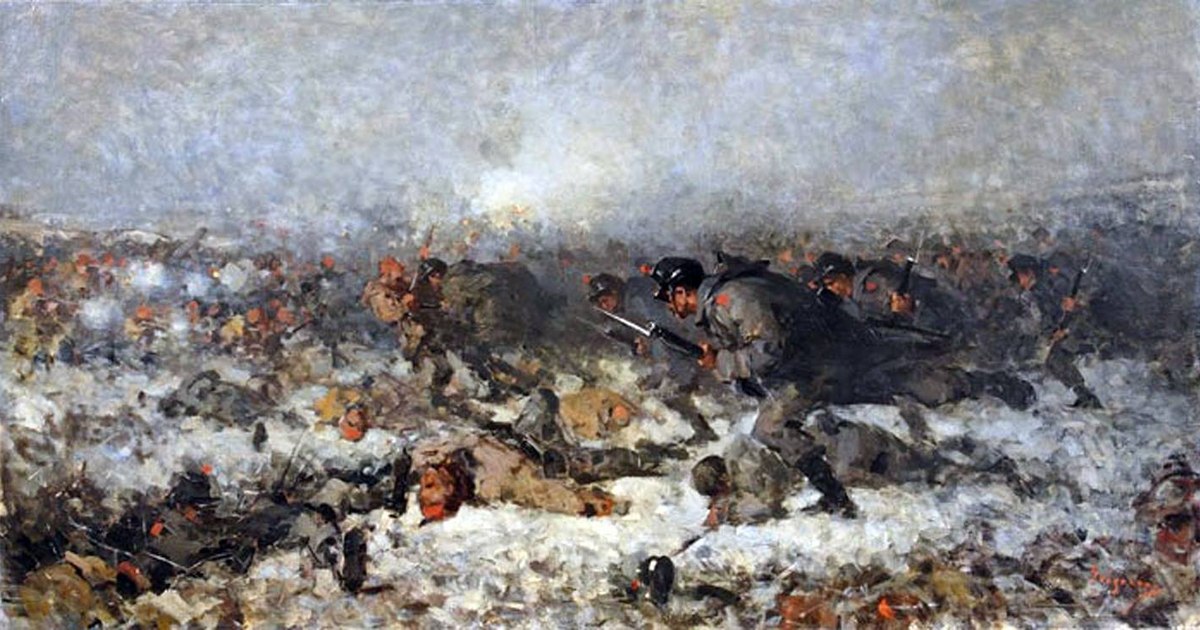
On August 30, 1877, 148 years ago, the Romanians attacked the Reduta Grivița in force. With shortcomings and after an exhausting road, the “turkey” blindly attacked the reinforced positions of the Ottomans and gained a unique glory in the military history of the Romanians, the Romanian army proving value on the battlefield.
Alexandru Grigorescu's Smârdan painting attack
In 1876, the Balkans, the powder barrel of Europe, was about to explode. Anti-Ottoman revolts broke out everywhere. The Ottoman Empire, a huge clay legs, was close to collapse. He was a “patient” of the Euro-Asian geopolitics kept alive by the great Western powers only to ensure a political and military equilibre in the eastern area, preventing the exhibited ambitions of the Tsarist Empire. However, the Russians took full advantage of the Balkan uprising. Under the pretext of defending the Christian-Orthodox brothers, the Tsarist Empire declares war on the Ottoman Empire, and in 1877 Russia receives a free hand in the Eastern issue from Germany.
Otto von Bismarck, the great Prussian politician, the reward of Russia for non -involvement in the war against France with the slaughter of Ottoman territories. For the Romanians, at that time, you still have high gates, a unique chance was watched. Especially in the conditions in which the great Duke Nicolae asked the Romanian government to grant to the Russian troops the right to cross the territory of our country to Bulgaria, where the attacks were to take place. Moreover, Romania was on the war of war if the needs of the war demand. Carol I had already mobilized the army and hoped for an intervention that would turn Romania into co-belligerant and participant in the negotiation table at the Peace Conference. In order to achieve independence, the Romanians risked everything. They gave up the collective guarantee of the great European powers for the Russian guarantees. On April 4, 1877, the Ministry of Foreign Affairs, Mihail Kogălniceanu, and Baron Dimitrie Stuart, the general consul of Russia in Romania, signed a convention by which the Russian armies could cross the territory of Romania.
The express condition was for Russia to guarantee the political rights of the Romanian state and especially to maintain and defend the territorial integrity of Romania. The document had 26 points or articles through which all administrative and logistical details were developed. Initially, with pride, the Russians told the Romanians that they did not need them on the battlefield. However, the evolution of the war has made the Romanian soldiers who will save the Russian honor on the battlefield and those who will decisively inclined the Balance of Victoria in favor of the Christian forces. The Romanians would earn their independence with the weapon in hand in one of the most glorious military campaigns of the Romanian people.
The Russians got stuck in front of Plevna. Ottomans killed thousands of soldiers
The key to the defeat of the Ottomans in Bulgaria was the Plevna Fortress. It was in a special strategic position at the crossroads between Nicopole, Rusciuk, Sofia, Târnovo and Filipopol. The fortress was defended by several renderings and a strongly injured relief, marked by a succession of hills and valleys that made it difficult for any direct assault. The Ottoman garrison from Plevna initially numbered 24,000 people. Their number increased, by reinforcements, to 70,000. The Ottoman soldiers had high-performance rifles, with a large long-drawn and beating cadence, Martini-Henry type, model 1871. In addition, it had a strong artillery that used shrapnel projectiles, killer on the infantry on a rather significant radius. On July 20, 1877, the Russians confidently throw themselves on Plevna with the 10,000 soldiers of the Western Army.
However, I give over the Ottoman registers and are effectively shattered by Ottoman defense. At that time, Duke Nicolae, the commander of the Russian troops from the Balkans, sends a telegram to Carol I asking him to put pressure on the Danube. The request is also reinforced by Alexander II, the Tsar of Russia. Carol I immediately ordered the 4th Infantry Division to occupy the city of Nicopole, south of the Danube. Even under these conditions, the Russians did not ask for the help of the Romanians in the fights in Plevna. They believed that they would do themselves, without sharing the glory of Victoria with anyone, especially with the Romanians for whom, as will be seen, they will have other plans. On July 30, 1877, the Russians give the second assault on Plevna, this time with 30,000 soldiers and an artillery dam pulled over 170 cannons. And this time the Russians are defeated, leaving behind over 7000 dead. The situation became critical for the Russians, especially since they were to be attacked from the flanks by the reinforcements sent by the Turks.
“Please make merger, demonstration and, if possible, cross the Danube with the army”
With very high losses, on a 300 -kilometer front and threatened with the circle, the Russians leave the pride and call the Romanians for help. “The Turks, gathering the largest troops in Plevna, crush us. Please make merger, demonstration and, if possible, pass the Danube with the army, as you wish. Between Jiu and Corabia, this demonstration is necessarily necessary to facilitate my movements ”wrote the archduke Nicolae in his telegram to Carol I of July 31, 1877. It was the time expected by Romanians. The Danube passes over 43,000 Romanian soldiers with 110 cannons and over 7000 knights. The Russians also had over 50,000 soldiers in the Plevnei area and around 300 cannons. The third assault was prepared on Lorveni. The command of the operations was entrusted to the ruler Carol and General Russian Zotov. Following the supreme test of the Romanian Army.
“Considering that the next day the observers were going to compare the behavior and performances of the young Romanian army with those of the Russian imperial army, with a good renowned over time, at the level of the Romanian leadership there was a desire to prove that on the battlefield the two army was on the Equality. They escaped any opportunity to show their contempt for the inexperienced Romanian army ””said Dr. Horia-Vladimir Șerbănescu in “Battle of Plevna, an important test for the Romanian army”, in the magazine Historia.
Iron ambition of Division 4. The time of the heroes at Grivița
On August 29, 1877, after four days of almost continuous bombing, a war council was organized, which was attended by Carol I, Tsar Alexander II, the Grand Duke Nicolae and the chiefs of the Major States. It was decided to organize a general attack on the onomastic day of the Tsar. The main attack was to be given by the IX and IV bodies of the Russian army, in the direction of Radișevo. To the left attacked the IMeretinski detachment, from Brestovaț, and from the right the Romanian army, directly to the Grivița and Opanese regesses. In addition to the Russian and Ottoman army, the Romanian army was young, just set up by Cuza, had no proper features and was composed largely of the country recruits. They were easy to underestimate especially by those who did not know the strength of the Romanian infantryman in the rural area.
On August 30, after a bombing executed by the combined artillery of the Russian and Romanian armies, at 3:15 pm, the Romanian troops go to assault on Grivita. The Romanian soldiers went blind. Without a correct recognition on the ground, they woke up with two reduces instead of one. The third Romanian division was rejected with great losses after 40 minutes of attack, realizing that they had another reduction whose existence they did not have. “The superficial research of the land before the battle created the false impression of the existence of a single Grivița, when in reality there were two, which made the attacker troops halve their forces, each attack column attacking another lens. The attack columns, especially that of Division 3, faced the great distance they had to travel to the enemy positions, with the uneven and slippery ground as a result of the rain that had fallen in the morning of the attack, sprinkled with obstacles installed by the Turks in the area of the outposts, which made the movement and tired the troops.“Add Horia-Vladimir Șerbănescu, in the same material.
The fourth infantry division also went on an attack supported by the battery fire of the Romanian artillery. It was rejected three times, even though it was reinforced with two Russian battalions. Personally embedded by Carol I, the soldiers of the 4th Division succeeded after the fourth assault to conquer Grivița Reduta. It was an incredible success of the Romanian army that fully proved its value. “The Carpathian children fought as lei!”wrote the journalists from “Free Romania” of September 3, 1877. One of the heroes who were noted in the battles in Grivița was Major Gheorghe Şonțu. It was at the forefront of his battalion in the third division and was part of the first Romanian attack on Reduta. He died trying to put the flag on a parapet of the redoubt. “Major Şonţu sprinkled with his blood the fruitful earth of glory. His memory will be expensive to all those who love freedom, justice and courage.”it was stated in the newspaper “Dorobanțul”. Impressive is the story of the 16th Regiment made up of boys from the country in Botosani county. They fought in all the assaults in the center of attack, in the first line, managing to impress by bravery and the strength of the attacks on the battlefield. “On that day of August 30 of 1877, on the fields of Bulgaria, the honor of the flag with no. 16 As with his family, all the legitimate sons of Botosani county, to form the center of the attack line of that great redress called Griviţa no. I. took part in that baptism 595 people, all with turkey feathers “, Wrote in his memoirs Neculai Codrescu, captain in the 1st Battalion of the 16 Dorobanti Regiment.
The Russians wanted to take care of us
Finally, the Romanians contributed decisively to the fall of the fortress Plevna and in general to the entire operations theater after which the Ottoman Empire was defeated. However, the plans of the Russians with the Romanians were others. The Russian army, returning home, was installed on the Romanian territory and had begun propaganda. There were suspecting that a military occupation was being prepared. “The soldiers of the Russian XI Division spread the rumor that now Romania is no longer an independent state but has incorporated with Russia, and even Carol I fled from the country, being replaced by the great Duke Nicolae”was shown in a document sent to the Ministry of Interior. Another report stated that Russian agents scattered the rumor that “The Russians came to the country only from the desire to improve the fate of the peasants and that for this they will occupy Bucharest, will disarm the Romanian army, kill the owners and take their lands to divide them to the villagers to cultivate them and will make the Diama reduced to one of ten.”.
The Russians organized Argeș and Neajlov, the main way to Bucharest. In a meeting of the Council of Ministers of April 6, 1878, the act of occupying a part of the territory of Romania by the Russian troops was taken. The situation was defused after the UK had pressure and threatened with the war. The Russians were afraid that the Romanians would not understand each other with the English and cut their withdrawal, especially since the Romanian army had shown its qualities on the battlefield. Only in the last months of 1879, the Russian troops withdrew from Romania.