The biggest problem with Russia. Donald Trump and the company did not notice him


Why is the US president who boasts the end of five wars and promised to end the invasion of Ukraine in 24 hours, he is still unable to do it? Because Kremlin's obsession On the point of influence zone, its unlimited appetite and internal problems cannot be solved with quick resources.
From the very beginning, the strategic goal of Putin was not so much the annexation of Ukrainian territories as Restoring Russia's status of world power and domination in Europe.
However, it is difficult to behave like a power, having modest economic possibilities. The last resort is therefore the demonstration of the strength and nuclear arsenal. That is why on the eve of the meeting with Trump, analysts discovered that Moscow is preparing for testing a new maneuvering rocket equipped with a nuclear head and a nuclear drive. For a long time, the Russians, suffering from international isolation, could comfort themselves that at least powerful countries are afraid of them.
In this way, the US President welcoming Putin in Alaska and the nostalgic sweatshirt of the Minister of Foreign Affairs Sergei Lavrov with the motive of the USSR probably served the main purpose of the Kremlin. Today, presenting Russia as world power in a world shaped by the competition of great powers has returned to a serious political discourse.
Another important, driving war is a factor hesitation of the West before the introduction and full enforcement of strict sanctions against Russia After the invasion and annexation of Crimea, which gave the Kremlin time to rebuild trade. Today, in the face of global sanctions, Russia's income from exports exceed the level of 2015.
Obstacles on the road to the room
As a result, the Russian war economy did not fall, but adapted. Only now, after three years of unbalanced growth driven by government expenditure, did she finally slow down and before she falls, will she be able to survive for some time. Currently, secondary sanctions for countries trading with Russia and lowering oil prices are the last resort for peace.
Continued article under video material
The deep sigh of the Russian Minister of Finance Siluanov in response to the journalist's question regarding economic conversations may reflect the situation of Russian finances. For 2025, Russia allocated approx. 13.2 trillion of rubles (at the current exchange rate PLN 593 billion) for defense. This is about 6 percent GDP and nearly a third of federal expenses, which is the highest military burden since the Cold War.
Another obstacle in the end of the war are Financial interests of people enriched on the military and industrial complex and the restructuring of the economy during the warcreating a class of winners. Since the beginning of the full -scale invasion, the number of Russian billionaires has increased thanks to cheap purchases of foreign assets, activities in industries that replace imports, using interference in European markets and benefiting from the production of domestic substitutes for inaccessible Western goods.
Members of the armed forces also benefited from this. Corrupt officers got used to huge profits, taking over the remuneration cards of soldiers and PIN codes before sending them to the front. By delaying death reports for months, they are enriched to a level that they would never achieve as civilians.
Financial turbulence in the Kremlin
In addition to financial corruption, there are also problems such as mental scars and challenges related to the reintegration of people with combat experience in frequently affected communities. The level of crime among Russian veterans has already increased rapidly.
The Moscow information machine can present almost everything as a victory and change yesterday's enemies in today's friends, dictating social moods. On the eve of the summit with Trump, after years of demonizing the US, Russian propagandists published a film showing the bonds between the United States and Russia.
However, when it comes to peace, the political problem is hidden, but obvious: when the spectacle ends and the costs increase, victory may turn out to be an endless payment for occupied territories, which are not able to support themselves.
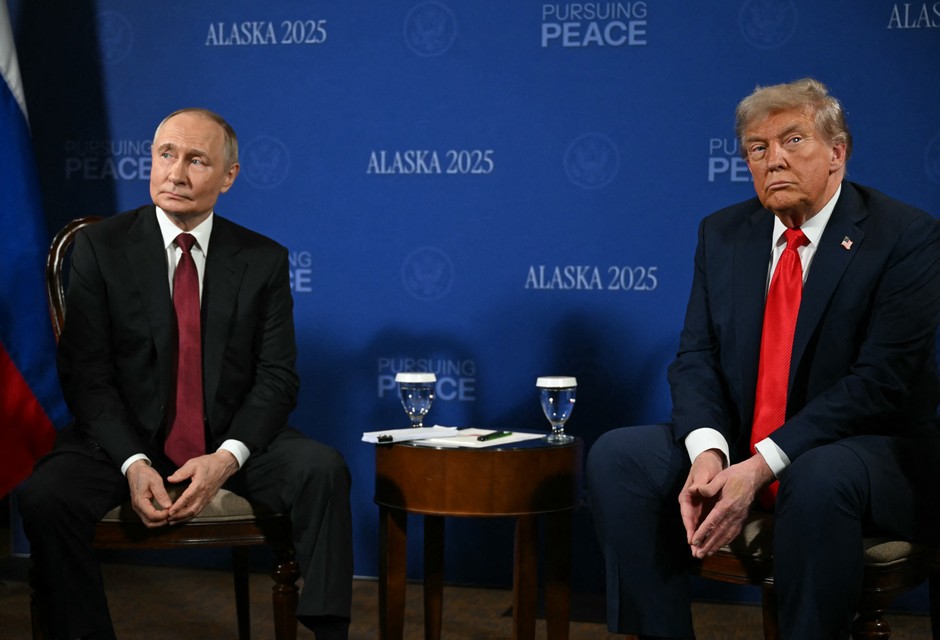
Russian President Vladimir Putin and US President Donald Trump in Anchorage, August 15, 2025.Andrew Caballero-Reynolds / AFP
Territories occupied by Russia, illegally annexed in September 2022, are financial without bottomrequiring significant federal transfers. 10 years after the occupation of Crimea by Moscow, more than half of the region's expenses come from a subsidy. In the case of the self -proclaimed Donetsk People's Republic, this percentage is 70 percent, and in the newly occupied Cheron region – 78 percent.
However, the money of Russian taxpayers, which could be allocated to improving living standards, are not used to rebuild or prosperize other regions – they are barely enough for basic needs. For example, in the once vibrant Donetsk life, residents have access to running water only once every three days.
The new nature of the war
What's more, due to the fact that Russia has not managed to change its image and create a non -unimperial narrative about building a nation, Searching for enemies will last. In the face of the growing internal problems of the country, after the war, another war may become a remedy for the inefficient solving of these problems.
Most importantly, however, Russia is gaining experience in a modern military, which is currently missing to other armies, maintaining officer's knowledge. High losses among soldiers mainly suffer troops on the front. The Kremlin plans to open 15 new educational institutions with a military profile to consolidate and institutionalize this knowledge from 2025.
At the same time, Russia industrializes the transition to autonomous and precise combat systems, planning by 2025 the purchase of 2 million FPV drones and 30,000. long-range drones and drones-drones. Although in a real approach, the Kremlin invests in its forces nine times less than the United States and the European Union together, adapts to the new nature of the war faster than many European countries think that they are unable to arm themselves again. Western and Ukrainian intelligence services constantly warn against Moscow's intention to the end of the decade test NATO's commitment in a collective response to aggression, preferably with the least US participation.
So when Russia claims that it strives to eliminate the “source causes” of war, it means the independent, pro -European, pro -democratic and prosperous Ukraine, capable of protecting Europe from the Russian invasion. The goal of Moscow is to destroy the Ukrainian identity, and when it is impossible, the Ukrainian nation itself, transforming the country into a smaller Russia to strengthen its army in pursuit of major purposes.