In January 2025, new regulations regarding the segregation of textile waste entered into force – clothes can no longer be thrown into the mixed garbage container, but should be referred to selective waste collection points (PSZOK).
Until recently, containers for the clothes of the Polish Red Cross (PCK) were an alternative, but in July the organization announced on limiting your activities related to the collection of clothes – the reason was the deterioration of the quality of clothing collected for containers and a significant increase in the cost of its disposal. The Wtórpol company, which was responsible for the logistics and sale of collected textiles, terminated the Polish Red Cross agreement.
Turmoil around unwanted clothing management
Another company that temporarily suspended taking clothes because of the new regulations is a start-up of clothes to give away. Founded by Tomasz Bocian and Zofia Zochniak, the organization sells clothes in the second circulation. In May, they decided to suspend the admission of parcels with clothes.
– Since the introduction of the new regulations, the number of packages transmitted to us twice and at the same time the quality of clothes has deteriorated significantly. Previously destroyed clothes accounted for about 15 percent, and after the introduction of new regulations – 35 percent. Our sorting house has achieved maximum operational occupancy, and we must change the way our portal has been active so far – explained the stork in an interview with PAP.
He emphasized that apart from the two main problems with the Polish clothing market – i.e. by regulations and war in Ukraine, which closed a very large Ukrainian market for exporting used textiles – We are dealing with a significantly reduced interest of the used clothing market by consumers.
Tomasz Bocian added that although unfortunately there are no research describing the causes of such poor results of the used clothing market, on the basis of observations you can draw several conclusions. First of all, in his opinion, the so -called The second-hand customer is still mainly a budget customer. The low price is, along with ecological reasons, the most common reason for purchasing in the second circulation. With a huge increase in the popularity of Ultra Fast-Fashion brands-the express clothing production-the prices of new clothes have very close to the used ones.
– You do not have to reach far, to Chinese brands like this or Shein – even on our Polish market, the Gigant LPP gigant bases its strategy on the development of the cheapest Sinsay brand. And from a business point of view, I understand the decisions about the aggressive expansion of these stores, but this also significantly hits the secondary market, where there is nothing to hide, it is not going well now – he explained.
What happens to used clothes?
When asked about the issue of market monitoring of used clothes, Stork confirmed that There are no consolidated data showing what is happening with clothes when there is not enough space for them in the closet. There is no monitoring that I would include both a legal and illegal zone in Poland and Europe.
It is known that some clothes are sold by portals such as Allegro, OLX or Vinted, thanks to which they get a second life immediately and remain in circulation. The condition here is a good condition of clothing, a sufficiently low price and a good brand, which is becoming harder and harder for ultra fast-fascion clothes. This is the way for clothing in the best condition.
See also: Personal investment account. Here are arguments for and against a new tax solution
Some, in accordance with applicable regulations, are referred to PSZOKs. Press Department of the Capital City of Warsaw Warsaw told PAP that From January 2025, an increase in the amount of waste donated to Warsaw PSZOKs has been noted compared to last year – The largest was recorded in the case of clothing and textile waste. As the office emphasized, about 225 percent have already been collected. More clothing and textiles than in all of 2024 collected from January to the end of June this year. Clothing and textiles accounted for about 7.63 percent all collected municipal waste during this period in Warsaw's PSZOKs.
However, even in PSZOKs, clothes are much less likely to recycle, and more often to the oven – According to the findings of “Dziennik Gazeta Prawna” from March this year. The collected clothes in the crushing majority end in incineration plants. These findings are confirmed by Tomasz Bocian, who pointed out that Municipalities often do not have control over what is happening in PSZOKs with textiles.
– Apart from the fact that it is often very difficult to deliver waste to Pszok, because you have to travel a dozen or so kilometers, the commune does not monitor what PSZOK does with these clothes. This is the first thing to change – these clothes should be sorted and checked before burning, otherwise there will be no second circulation – he explained.
“Mysterious” clothing containers
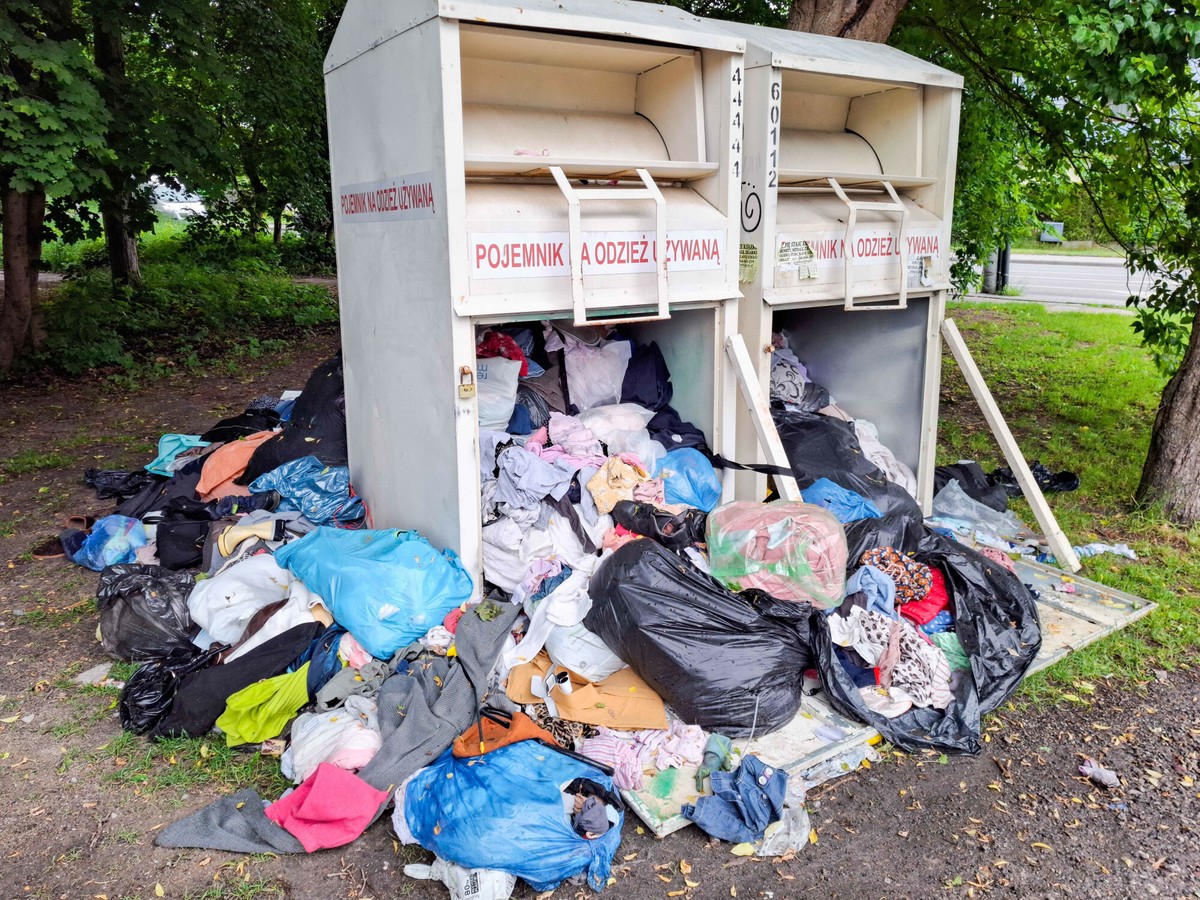
In addition to PSZOKs and PCK containers, many housing estates also have other containers for clothes, colorful, with the logo of various foundations – Often placed illegally, with an impossible to determine the owner, covered with unpaid weeks with clothing bags. Clothes from such rebounds hit, among others To the so -called A gray zone in which it is not entirely clear what happens to them – except that … they can sometimes be found in a rural fireplace or West Pomeranian forest.
You can hear about such situations mainly when a single event attracts the attention of the media, as in the case of March action in the Pładnica Forest District, when – as described by the Forest District on Facebook – a large amount of used clothing packed in Big Bag bags was taken to the forest, which most likely came from the so -called Second-Hand trading.
Poor quality of clothing given to foundations
Some clothes go to legal foundations or organizations working with foundations, such as the already mentioned clothes to be given or to shelters for people, including in the crisis of homelessness. Although, according to Małgorzata Chmielewska's sister, founder and president of the “Houses of the Community Bread of Life” Foundation, clothes are too big euphemism for what goes to her houses.
– Since the introduction of new regulations, not so much the amount of clothing capable of use left under our houses has increased as rags – she described in an interview with PAP. – And this is a huge problem for us, because someone has to change and sort it, and then pay for the container. And these are thousands of zlotys – she emphasized.
As Chmielewska pointed out, Good quality clothes and thoughtful gifts are very much needed, but leaving a scattered loose, fatal quality of clothing is a bigger problem than the benefit.
– People get rid of such clothes, because who will go with a sack, or without a sack, to the other end of the city. And this is a very big problem, not only ours. Many charity organizations are treated as garbage cans with which there is nothing to do with – she emphasized.
Part of the clothing goes to export
However, not all clothes land on the streets and dumps in Poland – some are intended for export from the country. Legal export of used textiles from the European Union has tripled for 19 years – from 550 thousand. tons in 2000 to 1.7 million tons in 2019, according to the report “Export of used textiles from the EU in an economy with a closed circulation in Europe” published by the European Environment Agency in 2023.
The main recipients of used clothing are found in Africa and Asia. According to the authors of the report, 40 percent go to dumps. textiles exported from the EU to Africa; This number failed to determine in the case of the Asian market. Up to the five largest exporters of used textiles in the EU, who are responsible for 80 percent. exports, Germany, Poland, the Netherlands, Italy and Lithuania include.
The Supreme Audit Office in published in March this year informed about the fact that the Ministry of Climate and the Environment has not prepared an “effective and reliable waste market monitoring system”. information entitled “Defeat in waste management”. NIK negatively assessed the activities of public administration for the limitation of waste and recycling and assessed that rational waste management was limited. One of the municipalities was sent to Germany.
How to improve unwanted clothing management
After the entry into force of the new regulations, the “Catalog of Good Practices” has prepared the new regulations, in which it encourages municipalities to act: sack collection “door-to-door”, i.e. displaying bags with clothes in front of the house, containers in urban spaces, “municipal re-butik” (interchange of used clothing) or cooperation with non-profit organizations and companies that convert text into new products- Unless they suspended their activities after the regulations came into force. It is not known how many municipalities implement these recommendations to solve the clothing problem.
Tomasz Bocian emphasized that above all We have very few installations for recycling and textile recycling in Poland. – As for the utilization of textiles, i.e. burning clothing, mainly to obtain alternative fuel, this is most often done in cement plants that use clothing as fuel for cement production. But due to the fact that there are so few installations and new regulations have entered, the cost of utilization of textiles will double during the year. And when it comes to recycling, companies that deal with recycling clothes in Poland can be counted on the fingers of one hand – he noted. The effect is that a small part of the collected textiles is converted into a cleaner, and the crushing majority goes to the incineration plant.