

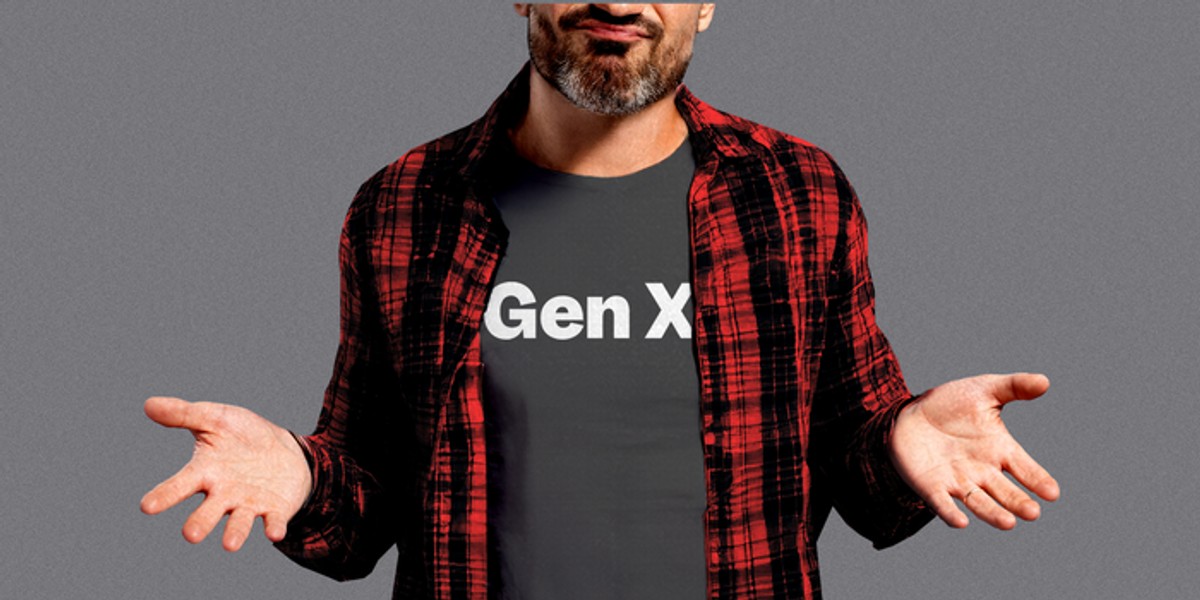
Generation X – people born between 1965 and 1980 – has the opinion of “a forgotten generation”. When the subject of generations appears in popular culture, work or media, this usually comes down to boomers versus millennials or millennials versus Gen Z. Generation X is somewhere pressed between if it appears at all. To be completely honest – we in Business Insider also contribute to this: this year we published 166 articles about the gene with, 123 Millenials and 97 about boomers, and generation X we mentioned only 34 times. And they were often only mentioned.
It is difficult to clearly explain why the X generation is so overlooked and what it actually means. It is partly about numbers. Generation X is located between two huge, breakthrough generations. In a sense, it is a transition bridge between them.
It's a bit like a generation X was a journey from boomers to millennials, but it was never a goal in itself
-says Jason Salmon, a stand-up comedian, whose performances often focus on the fate of generation X. On the internet he jokes that younger generations identify with the help of pronouns, older with flags, and “we are somewhere in the middle where there is no emote for t-shirts from concerts.”
The disappearance of generation X from social discourse also has a cultural context. Many representatives of this generation are the famous “children with the key around the neck” – Often left alone after school when parents were at work. They grew up in the 90s, which were economically stable for the USA, but also a temporary time in technology, politics and culture. As children, they loved Luke Skywalker and grew up with Kurt Cobain – this is a transition from romantic heroism to Grunge cynicism. While Boomers were “Generation Ja” and the millennials “Generation I, I, I”, the X generation became “the generation of Meh”.
Historically, we wanted to stay under the radar
– says Erin Mantz, founder of the blog and group on Facebook “Gen X Girls Grow Up”. “We were a bit like that” I have it somewhere “.”
Generation X is independent. They are old children with a key around the neck
Since the X generation has always said 'I have it somewhere', society also approaches them with indifference.
When I called Megan Gerhardt, a professor of leadership and management at the University of Miami, who belongs to the X generation to ask her opinion about the “forgotten generation”, I suggested that maybe it was average age. Generation X is now 44 to 60 years old – this is a period of life that is considered the most depressing. Is the problem that talking about it would simply be too depressive? Gerhardt immediately rejects this thesis.
It is all in line with our brand that we are skipped
– says Gerhardt, author of the book “Gentelligence: The Revolutionary Approach to Leading An Intergenerational Workforce”.
See also: A generation with does not want to say “halo” while answering the phone. I'm concerned
A large part of the problem is that the X generation has never become a dominant strength in terms of numbers. Millennials have long surpassed boomers as the largest generation in the US – generation X never achieved it. “I do not think that generation X causes significant waves when it comes to statistics,” he says. Another statistical aspect: Generation X was the “least supervised” generation. In many homes, they were the first generation of children, whom both parents worked outside the home, and at a time when there was no well -developed day care or fashion for “helicopter parenting”. This meant that many representatives of the X generation had to be more independent and independent. There was no technology that would allow parents to follow them or cell phones to contact them. Children of generation X were to watch TV after school and put dinner in the oven before the parents' return. They were “supporting actors” in the family – says Gerhardt, not its center.
Forgotten generation. Somewhere between boomers and millennials
It is actually compatible with their brand that they are skipped.
Jean Twenge, author of the book “Generations: The Real Differences Between Gen Z, Millennials, Gen X, Boomers, and Silents – and What They Mean for America's Future” says that many people from her generation say they do not feel as clearly defined as older or younger groups. The psychological profile of generation X reflects intergenerational changes – he says – “When we look at the increase in positive perception of ourselves and individualism, which gradually grew from boomers through the X generation to millenials.”
Referring to the American Freshman Survey, who studies the attitudes of American first -year students, Twenge notes that from boomers through generation X to Millenials, young people are increasingly focusing on financial prosperity than on developing life philosophy and are more often considered above average. Generation X was a transitional phase between these two ways of thinking.
This dynamics made generation X suffer from a kind of “child syndrome”. They feel overlooked and imprisoned between focused parents-boomers and perhaps even more focused millennials. But they are also good at solving problems independently – and many of them say that they would really prefer to leave them alone.
We are very proud of how independent and resourceful we are
– says Mantz.
“I don't care.” And there are effects
The ambivalent attitude represented by the X generation has its charm. Part of Salmon's performances of the X generation is a joke that their slogan is “I don't care” – What can be liberating, but also creates problems at work and in everyday life.
Generation X was the first to reject the ethics of boomers and the rat race. It is not without reason that films such as “The Breakfast Club”, “Slackers”, “Ferris Bueller”, “Reality Bites” or “Office Space” have become their symbol. It's good, because life is not only work, but more difficult when a generation of success is coming behind you. Millennials, although they value a balance between life and work, also want to climb up – and employers are happy to help them in this.
When the millennials entered the labor market, they brought with them a Harys' culture – you work hard, strive for the goal, everything is possible
– says Gerhardt.
Many companies have created quick promotion programs for millennials, which often meant jumping the X generation in a queue to some positions. Generation X found itself as a mediator in the hierarchy – in a strange suspension. Considering their age, representatives of the X generation occupy boards – about half of the presidents of companies from the Fortune 500 list are people from generation X – but millennials are currently the largest group of managers in general. As “Wall Street Journal” notes, people in fifty lose their shares in the CEO positions in the Russell 3000 index.
Many representatives of the X generation feel that they got stuck between a boomer who does not want to retire, and a young millennial who quickly jumped to the top. They are translators between the old and young generation, trying to find a common language. It is also worth noting that we have not yet had the US president from generation X – this generation is probably the biggest victim of the problem of gerontocracy in American politics.
Generation X is not happy? They are under pressure to provide their children with a good start
Mantz says that one of the reasons why she founded a community for women from generation X was to encourage them to make greater noise and gain an influence position – despite their natural tendency to remain in the shade.
One of the aspects of the financial history of the X generation is that they suffered a lot during the financial crisis in 2007–2008 – when they were just starting to build their assets.
“We need to change the approach. We are forgetted. We are taken for granted,” he says. We are such a strong and stable force at work, and if we do not start changing the way we strengthen our generation, we will continue to be overlooked.
Generation X is also not particularly happy – And it's not just average age. Frank Infrna, a professor of psychology at the Arizona State University, says that representatives of the X generation in the US report a higher level of loneliness, more symptoms of depression and worse physical health than other generations. According to him, their cognitive functions are also weaker.
He sees the causes in many factors. Generation X began working during the transition from company pensions to plans 401 (K), when responsibility for saving for retirement passed from employers to employees – and many of them were just taught the system. This is the first generation raising children in today's hyperconal educational environment, with great pressure to ensure their success. They also survived many economic turmoil, although they are not always talked about.
“They survived the crack of the dotcom bubbles, a great recession – and this: can you just have some stability in these great economic events?” – says infurna.
Jeremy Horpedahl, an economist from the Arkansas Central University, who is investigating the property of generations, confirms: “One of the aspects of the financial history of generation X is that they suffered a lot during the financial crisis in 2007–2008, when they were just starting to build their property,” he says. “They have rebuilt themselves since then, but it took them a lot of time to catch up with boomers at the same stage of their lives. “
The mood of generation X is mixed in the face of skipping. On the one hand, many of them feel good doing their own. On the other – it is not particularly pleasant when your experiences are constantly erased from the narrative.
Nobody pays attention to them and this is fine
It is not that generation X did not leave its stigma on American culture. It can be argued that in many aspects their impact was greater than boomers or millennials, but many of what they brought are not ascribed as in the case of other generations. “Friends” is the X generation, but today they are not perceived. Similarly, “buffy: vampire terror”, “from archive X” or “Bajer from Bel-Air”. They do not seem so generationally specific as, for example, “girls” or “m*a*s*h”. Angelina Jolie is the X generation, similarly to Jennifer Aniston, Ethan Hawke, Will Smith – and let's add Brad Pitt. We perceive them as great film stars, not the stars of a specific era. Co -founder of Facebook Mark Zuckerberg – typical millennials. Steve Jobs from Apple – Boomer. Google founders, Larry Page and Sergey Brin – generation X, which you probably didn't even think about.
Of course, this does not apply to every field. Beck, Nirvana and Pearl Jam are the essence of the musical culture of the X generation – just like today Taylor Swift and Beyoncé for millenials. Generation X also got a dose of nostalgia in recent years, which the millennials are just beginning to experience, and the gene with it has it in ahead in about 10 years.
Maybe I say it because I am a millennial – after all, teenagers from the X generation were “cool kids” for me – but the fact that the X generation can work under the radar seems to be a pretty good arrangement. They may not be managers at work, but the medium level of management is gradually eliminated, and apart from the salary, being responsible for everything does not seem particularly attractive when it comes to enjoying the joy of life. They are not blamed for ruining everything, like millennials for eating toasts from avocado or a gene with a strange look. Generation X has a soft force resulting from the fact that no one pays attention to them. And they experienced their lives before the Internet – what a joy! They know how to adapt to technology, but they are also aware that it can be treacherous.
Before we got the internet, we had a terminator
Salmon says.
Maybe the X generation will finally get its moment in the spotlight – politically, culturally etc. At the end of the 1990s they return to favor. And if not? Well … “they have it somewhere”.
The above text is a translation with American Business Insider edition


