“I went through hell and back.” Unknown details about the secret operation that destroyed dozens of Russian bombers, revealed by the SBU chief

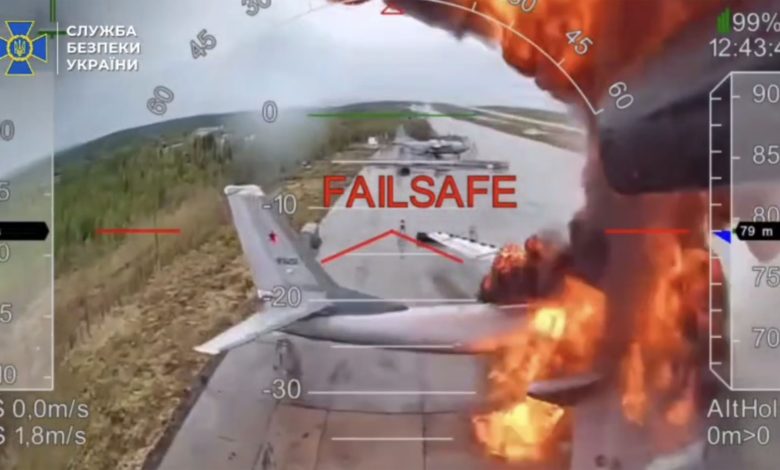
Attack on Russian aerodromes, carried out within the Ukrainian operation “Spiderweb”. Photo: East2west News / Willwest News / Profimedia
Only one street away from the headquarters of the Federal Security Service (FSB, former KGB) in the Chelyabinsk region, Russia, Ukraine's Security Service (SBU) secretly rented an office and deposit to prepare one of his most daring missions during the war.
In the next year and a half, SBU used these spaces to organize the operation “Spider web” (“Spiderweb”)-an attack in several stages that destroyed between 13 and 21 heavy Russian bombers and damaged another 41, said SBU chief Vasil Maliuk, in an interview broadcast on Tuesday, August 12
The TU-95 and TU-22M3 bombers were among the main Kremlin aircraft for launching long-range rockets on Ukrainian cities, which means that their loss could severely limit Russia's ability to perform such attacks.
“We went through hell and back to achieve this result,” said Maliuk, qualifying “Spiderweb” as “a unique special operation, in several stages”, which involved logistics, spy activities, communications and secret deliveries.
Maliuk added that SBU has been inspired by the methods used to combat transnational organized crime, studying how international drug cards manage to carry out smuggling actions that pass customs services and border control.
Ukraine's plan was based on the clandestine introduction of FPV (“first-view”) drones in Russia, hiding them in the retractable roofs of the wooden hunting booths.
Maliuk said that the drones used in the operation looked like ordinary FPVs, but they were specially modified, carrying 1.6 kilograms of explosive made to order, designed to burn the fuselage of a plane and detonate inside.
Fully autonomous hunting cabins, hunting cabins, equipped with EcoFlow batteries and solar panels to keep drones charged even at minus 40 degrees, were then transported with trucks to subsequently target four Russian air bases – Belaya in the Irkutsk region, Olenya in the Murmansk region, Diaghilev, Diaghilev, Ivanovo region.
Once they arrived at the destination, the roofs were withdrawn from a distance, and the drones were launched directly on the bombers.
Russian truck drivers who delivered the cabins were involuntary participants. “They were used” in the dark “and had no intention in their actions,” said Maliuk.
On July 11, Russia was arrested Mihail Ryumin, 55, a resident in Chelyabinsk, accused of transporting Drone in a truck in the Ukrainian operation “Câza de Pianjen”, wrote the Russian Mediazona, citing a court of appeal.
Western analysts and military officials praised the ingenuity of Ukraine in the “Spider cloth” operation. Admiral NATO Pierre Vandier qualified the mission as a modern reinvention of the “Trojan Horse”, which demonstrated the increasing technical sophistication and the ability to hit Ukraine, while the American senator Richard Blumento told Politico, in an interview published on June 3, that the attack of Ukraine was a “and the” US ” Elimination of Osama Bin Laden.
According to Maliuk, President Volodimir Zelenski was in permanent contact with the organizers of the operation. “He was interested in specific details often and, honestly, he insisted on (accelerating the operation),” said Maliuk.
After carrying out this secret operation of Kiev, Russia has moved dozens of long-range bombers in farther military bases in the country, according to satellite images.