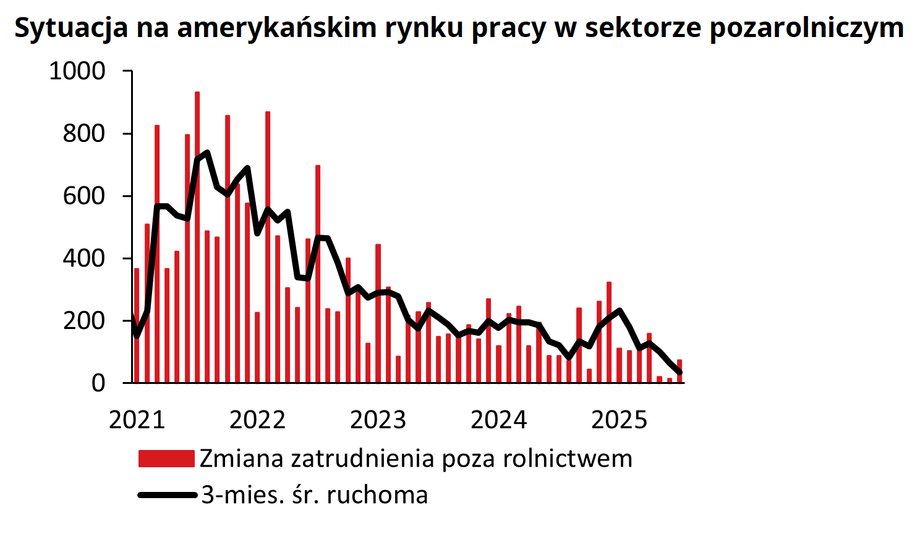
Published on Friday, August 1, monthly data from the American labor market chilled investors. NFP statistics (English non farm payrolls) have shown that employment in the non -agricultural sector increased in the US in July by only 73,000, which is much less than the forecast 110,000. The average increase in employment in the last three months was only 35,000. full -time jobs, i.e. the least from the beginning of the pandemic.
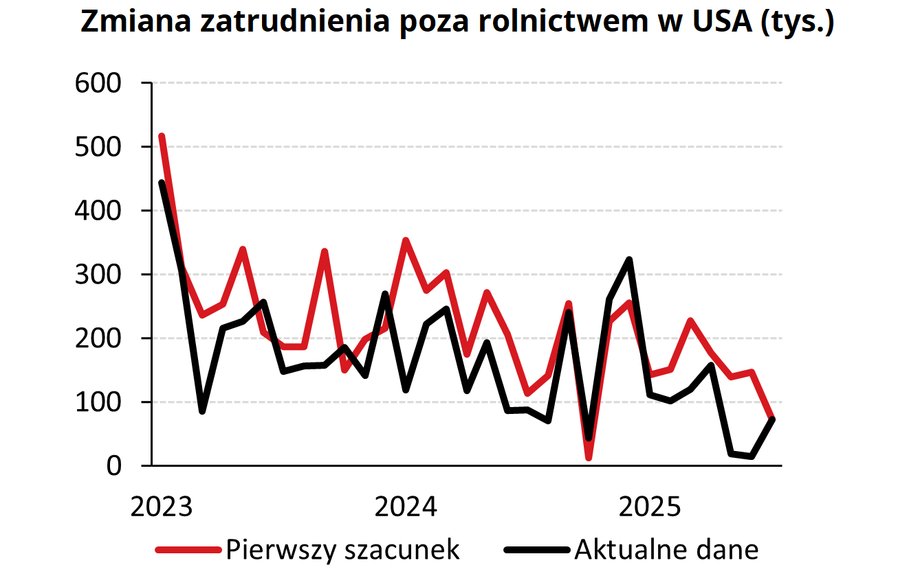
The report surprised negatively not only with low employment increases in July, but above all the scale of revision down results for previous months. Data for May and June were revised down by a total of 258,000, which is largely the effect of smaller employment in the government sector.
The economists of Bank Pekao pointed out that searches are usually pro -cyclical (during the slowdown of the searches to deepen its scale): in the last three years, when the activity of the American economy was muffled, most monthly increases in employment outside agriculture were revised down. However – according to the data of Bank Goldman Sachs – this is the largest two -month correction in five years. It is also the largest two -month search since 1968, taking into account the periods when the American economy was not in the recession.
Clear deterioration, but the situation of the labor market in the USA is not bad
“The report from the American labor market for July not only disappointed, but completely reversed the current narrative about the US economic situation. Everything indicates that earlier signals to improve the labor market could be only an illusion. Meanwhile, the unemployment rate increased to 4.2 percent. – The highest level from October 2021 – and the number of professionally active people fell. This is a rare and disturbing combination: unemployment is growing, even though fewer people are looking for a job, “Velobank economists pointed out.
|
Pekao analysis
The data shocked the markets: the dollar began to weaken, the profitability of bonds decreased (their prices were rising), and in the New York stock exchange there were declines. In the market assessment, the likelihood of interest rate reduction in the US has increased rapidly. In addition, other disappointing statistics came in the following days: ISM service in July fell to 50.1 points from 50.8 points. In the previous month, which increased the fears of stagging. Services are the largest part of the American economy (they are responsible for about 70 percent).
“The American economy inhibits. Maintaining employment data in recent months is consistent with what we already know about the US economy, Namely, with a deterioration of soft and hard data signaling its precipitation from the trajectory from previous years. We would be surprised if the dullness of the expenditure of companies and households did not translate into less demand for work. This can be seen in the sector breakthrough – were it not for the increases in employment in principle, in principle, the healthcare of healthcare, in July, we would see a decrease in employment, “PEKAO analysts wrote. They added that the role of lower immigration is an open issue in braking employment increases.
See also: TOP 20 companies from the S&P 500 index with the fastest sales increase [TABELA]
They assessed that “we undoubtedly have a period of increased exemptions behind us and the economy is unable absorb losing work, which we saw in weekly data. “Nevertheless, the lack of a significant increase in the unemployment rate this year suggests that the situation on the labor market is not yet bad,” they added.
Velobank experts pointed out that though The wage dynamics in July was in line with forecasts (0.3 % m/Mi 3.9 percent y/y), and the increase in salaries still exceeds inflation, this does not balance the clearly deteriorating situation on the labor market. “The most alarming is a decrease in professional activity: the indicator decreased to 62.2 percent, and the number of people ready for work, but inactive, increased by more than half a million y/year. Employment has dropped by 260,000, unemployment increased by 221,000, and the overall workforce has decreased by 38,000, which indicates the phenomenon quiet resignation from the labor market. (…) All this shows a weakening demand for work and growing barriers on the supply side, which increases the risk of economic slowdown” – they added.
Is the American economy heading towards the recession?
– A fatal report in the labor market and the ISM index for services for services below all forecasts does not necessarily have to herald that the American economy is heading towards an indispensable recession. We observed a similar situation even exactly a year ago, when the increase in the unemployment rate was activated by the so -called The Sahm rule, mistakenly identifying the time of starting the recession – comments Bartosz Sawicki, an analyst at Exante.
– The last, the highest weight readings, however, again shaken by faith in the unique resistance of the economic situation and thus, among others They interrupted the dollar reflection and spoiled the moods on Wall Street. Macroeconomic indicators illustrating the condition of the economy such as June retail sales or GDP dynamics for the second quarter fell out. As a result, in July, the index measuring the level of surprise with the data calculated by the Bloomberg agency turned sharply from ten -year minima, and faith in the quick loosening of the Fed clearly weakened. After the August information from the economy, the previous market narrative seems to speak about the gradual decrease in the pace of economic growth – he adds.
In his opinion, the dissemination of macroeconomic indicators and an inconsistent image of the economy can be further compounded by uncertainty about commercial policy. – It is customary perceived as typical for turning points in the business cycle, especially at the end of the expansion phase Sawicki indicates.
|
Pekao analysis
In addition to the strong market reaction, the data caused a political storm. President Donald Trump accused Erika Mcentarfer, appointed by Biden's administration, the head of the Labor Statistics Office (BLS), for falsification of statistics and ordered her to release her from his position. In Trump's opinion, she underestimated Friday's readings to present Republicans and the president in a bad light. In addition, the president added that if the president of the Federal Reserve refuse to lower interest rates, the Fed Governors Council should take over the reins.
“BLS has been considered for decades for decades golden standard in work statistics and uses transparent data revision methods when more accurate information flows. These types of attacks undermine public trust in one of the most reliable government institutions, “said Velobank economists.
Will interest rates in the USA will fall earlier than thought?
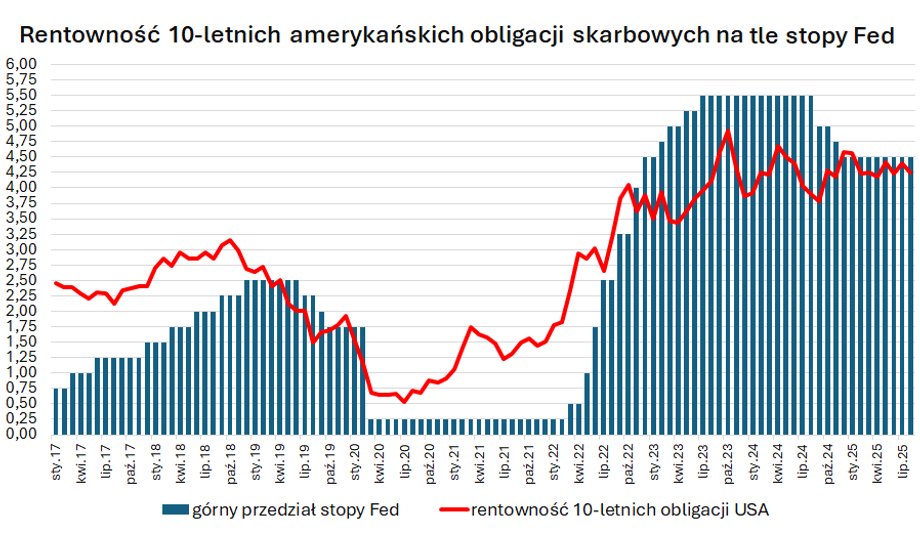
Data from the US labor market will be of great importance for the next decisions of the local Central Bank. The federal reserve for the last time reduced the feet in December 2024, in total in the autumn a year ago reduced the cost of money by a total of 1 percentage point, to a range of 4.25-4.50 percent. Pause causes the irritation and anger of President Donald Trump, who attacks President Jerome Powell and demands an early cutting cost to drive the economy.
Economists Credit Agricole Bank Polska upheld the forecast according to which the FED will decide in September for a reduction of interest rates by 0.25 percentage points. “The condition for the implementation of such a scenario, however, is a further deterioration of the situation on the labor market in July and August. Thus, the data on employment outside agriculture in the USA, published last week, constitute significant support for our forecast, “they added.
The economists of ING Bank Śląski said that disappointing data from the labor market increases the chance of changing the balance of power in the Open Market Committee (FOMC, the equivalent of our Monetary Policy Council) and the FED foot cutting in September, because the labor market looks worse than the Fed evaluated before.
After publishing data, the market assigns almost 90 percent. The probability of September reduction by 0.25 percentage points and 60 percent next at the end of October (based on CME Fedwatch Tool). There is also a cut in the game in December: 47 % is attributed to such a variant. probability. This is a big change, because at the end of July (after the Fed meeting) one reduction was expected, the probability of the other was assessed as marginal.
“In the face of a clear slowdown in employment dynamics and the fact that the negative effects of duties are just beginning to be felt, one can expect further deterioration of the situation on the labor market in the following months. Current data will strengthen the wing pigeons and can change the distribution of votes in FOMC. Currently, FOMC may attach more importance to the weakness of the labor market than inflation risks associated with price adaptation due to duties that may prove to be one -off and do not have a lasting impact on inflationary processes, “ING experts pointed out.
|
FED, STOOQ, own study
“In the past, we pointed out that the Fed has a space for cutting feet this year and that it needs weaker data from the labor market that would provide reliable justification for markets and decision -makers themselves. The July PayRolls report is exactly one that moves the pendulum back towards the cuts” – added Pekao experts.
Also PKO BP analysts estimated that the latest NFP report has significantly increased the likelihood of further foot reductions this year. “It is worth emphasizing, however, that this is not the last data at the FOMC will have at the September meetingand the revision up, in the next month, although unlikely, is not excluded, “they added.
According to PEKAO experts, data from the labor market is not that bad in themselves. “It is rather a continuation of trends visible for many months. In their light, however, it is difficult to argue that the US labor market is resistant to this year's shock. It will be a good opportunity for the FED to communicate a possible change in the attitude in connection with the update of the information set” – they pointed out.
In addition, in their opinion, the weakness of the labor market revealed on Friday strengthens the position dissidents In the Fed, in particular, consistently pigeon Christopher Waller (together with Michelle Bowman they voted during a recent meeting over the reduction of the feet). Waller is mentioned as one of the favorites to take the position of the President of the Fed after the end of Jerome Powell's term (end falls on May 2026).