Investigation regarding the air disaster in Washington. It wasn't a coincidence

During the three -day interrogations before the Independent National Transport Security Council, the investigators described the air system, which simply had to break down.
Problems in the airspace near the Ronald Reagan Washington National Airport airport reflect those observed throughout the country: equipment that does not meet standards, crowded and complicated airspace and overworked air traffic controllers. These issues are as well documented as difficult to solve, especially at a time when political priorities change with each administration.
– I was the president of the board for almost eight years. I have been following aviation for several decades. Nothing surprises me here – said Jim Hall, who was the chairman of the NTSB [Narodowej Rady Bezpieczeństwa Transportu, która bada wszystkie wypadki w lotnictwie cywilnym w USA] During the presidency of Bill Clinton and observed part of the NTSB proceedings during the investigation. “It only shows that the past is a prologue [do styczniowej katastrofy]”.
Asked by Politico for a comment, FAA [Federalna Administracja Lotnictwa] She sent us back to the Thursday statement in which she stated that she would cooperate with NTSB “in order to determine the truth and ensure that such a thing would never happen again.”
Here are four conclusions that we drew from the three -day interrogation of the NTSB regarding the disaster.
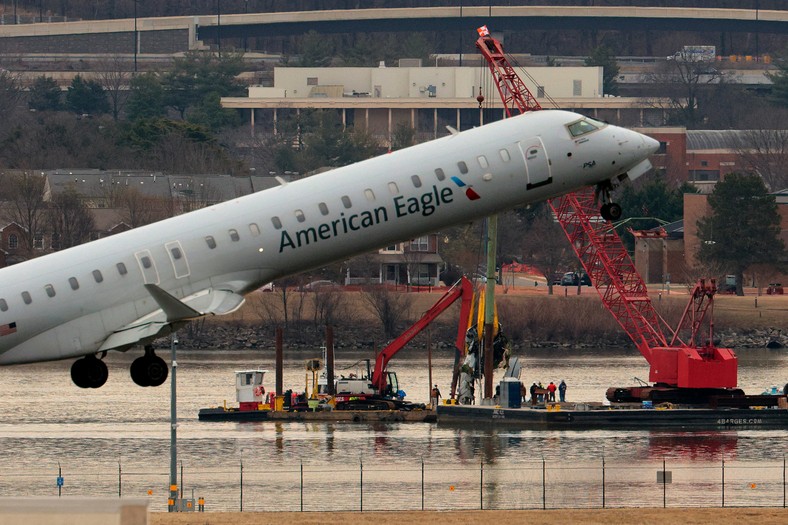
Aircraft starting from the Ronald Reagan National Airport airport during the Helicopter and Passenger Wreck Wrecking Action from the Potomac River, which collided with each other on January 29, 2025, USA, February 3, 2025.
1. Changes were proposed that could increase security, but have never been implemented.
The final NTSB report regarding the causes of the disaster will only be published in about a year. However, for several days witnesses have been presenting a number of solutions proposed long before the disaster, which have never been implemented. They mainly include changing the helicopter route, limiting the number of flights at the Reagan National Airport, which has one of the most busy runways in the country, or better use of collision warning technology. None of these solutions have been implemented.
FAA has been trying to modernize its equipment and strengthen the air traffic controllers staff for years. However, financing depends on the policy, and the indicator of the controllers from work is high.
– Could you speed them up? – A member of the board of NTSB Todd Inman asked many times, listening to the explanations of various FAA officials and the army about actions taken to solve problems.
Jeff Guzzetti, a consultant for aviation safety, who for many years was an official in both FAA and NTSB, called the interrogation “day of settlement for FAA” and predicted that he could put pressure on aviation administration, so that she eventually limits flights at the Reagan National Airport and took further action to strengthen the air traffic controllers. It may also encourage the army to limit helicopter surgery in this area.
Too many flights, too dangerous routes
2. The airspace over Washington is crowded and used by dozens of federal entities with competitive priorities.
In the testimonies, representatives of the army and federal investigators described the chaotic and crowded airspace around the Reagan National Airport, where military helicopters often operate next to commercial aircraft, and sometimes even fly behind or under passenger aircraft during landing. In the case of a disaster, the army helicopter performed a training mission. Investigators believe that the crew may have been wearing night vision goggles that are difficult to use in a clearly lit urban environment, such as Washington.
The space around Reagan National is not foreign to the control authorities. For at least ten years, pilots have been complaining about the threats associated with the growing congestion of helicopters – mostly military – near this airport.
The legislators questioned why the army must fly so close, especially in the case of flights for transporting important officials to the Pentagon. Over the years, the route has been changed, but mainly to reduce noise (Documents disclosed as part of the disaster investigation indicate that noise -related changes could make the routes even more dangerous).
The working group, which included air traffic controllers from the Reagan National Airport, previously pressed the removal of the route, which the helicopter used on the night of the disaster. However, the air traffic controller testified that the management rejected this idea because the change was “too political”.
FAA closed the route for good for the “non -critical” movement in March this year – one and a half months after the disaster.
Tragic chorus
3. Tired controllers simply have to “do it so that it works”.
In interviews with the NTSB investigators and testimonies, air traffic controllers described the atmosphere at the Reagan National Airport, where they felt forced to come up with ways to make it “work”, despite the concerns about the risk of safety resulting from a busy flight rate.
This chorus – “do it to work” – appeared many times during interrogations, although FAA representatives have maintained that on the night of the disaster the personnel of the object was planted sufficiently.
Clark Allen, operating manager at the Reagan National Airport on the night of the disaster, in the transcription of the intelligence said that “everyone is simply trying to constantly make it work, work and acts.”
Before the disaster, air traffic controllers asked their superiors to reduce the flight rate at the Reagan National Airport. However, this recommendation has not been included. On Thursday, some FAA officials dealing with air traffic management said that the problem is not only in a large number of flights, but in the fact that some airlines plan them at certain times of the day. They recommended limiting flights to 30-minute intervals, instead of current hourly, as in the case of procedures in force at the Laguardia International Airport airport in New York.
On Friday, some senators called for action.
Senator Jerry Moran, who chaired the Senate Commission for Trade and Aviation, said that he wants to organize a hearing on why FAA applies such tedious and burdensome procedures when it comes to taking action in connection with the recommendations of employees regarding security. His counterpart, Senator Tammy Duckworth, agreed with this and said that she wanted to examine the FAA process regarding the reporting of fears by first -line employees.
“We need more aggressive FAA,” Maria Cantwell, a member of the Senate Trade Commission, said on Thursday at CNN. “This is her task to protect the aircraft passengers, make appropriate decisions, and if air traffic controllers tell them:” Listen, it's too much “, she must listen to them.”
Keying key technology
4. Unresolved problems significantly reduce the safety margin, leaving little space for mistakes.
On the night of the disaster, during which there was a typical intensive movement, the air traffic control did not provide a key warning to the passenger aircraft, and the helicopter pilot could not hear the key directive.
On the cockpit recordings, you can hear how air traffic control orders helicopter pilots to bypass the plane that tried to land. However, at a crucial moment the microphone in the helicopter was muted, so that the words “bypass” were incomprehensible.
The problem was deepened by the fact that the air traffic controller did not warn the plane, that the helicopter would fly nearby. Interviews with controllers carried out that night show that they were unable to detect that the helicopter and plane were to collide. FAA officials who testified were not able to explain why the controller did not notice what was going on.
The technology of transferring a position that would help controllers see the location of the helicopter did not work during the flight. Investigators determined that the device was inactive for two years before that night. Nobody checked if the device was working tonight – said Colonel Andy Defoxy.
In addition, the helicopter used the altimeter, which determines the height above the surface, which could make the pilots think that they were flying lower than in reality. Army spokesman Matt Ahearn said in a statement that the army is investigating NTSB's findings regarding the restrictions of the altimeter and tries to determine whether “this is a serious mistake about the entire fleet”.
John Cox, an aviation safety consultant who previously served as an aviation security director at the Air Line Pilots Association, said that problems with helicopters in the Black Hawk helicopters of the American army seem to reflect a more systemic problem.
“You need a campaign covering the entire fleet to fix the altimeter,” he said. For now, however, there are no appropriate solutions.