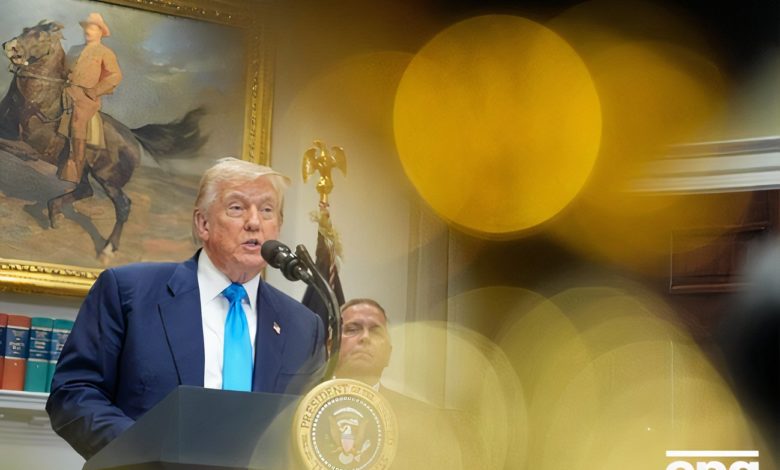
It is good that US President Donald Trump began to see the true essence of the Russian regime, but less good that nuclear policy is determined by posts in social networks, the article says.
Although the risk that Putin will order the use of nuclear weapons is small, he still is, the author believes. He added that everyone was already accustomed to “bloody nuclear threats from the Russian leadership”, but this time Trump very publicly responded to them, moving two atomic submarines closer to Russia.
Russia uses nuclear rattling weapons mainly as part of the information war – to intimidate the West, the journalist notes. In his opinion, unfortunately, this works: Western states acted “extremely carefully after Russia's invasion of Ukraine in 2022 precisely because of these nuclear threats.”
However, Trump’s decision relative to the submarine became a direct reaction to the posts of the head of the Security Council of the Russian aggressor country Dmitry Medvedev on social networks. Many in Russia consider Medvedev a drunkard, and they say that some of his threats were written in a state of intoxication, the author of the material noted. He emphasized that today Medvedev plays the role of a “dog regime”, which is sprinkled with terrible threats to the Kremlin’s enemies.
Trump is annoying that his policy of peace did not work – even though he proposed (bypassing Ukrainians) a peace plan that would allow the illegitimate President of the Russian Federation Vladimir Putin to avoid the punishment of his army, Sili emphasized.
It is less good that Trump made it clear that he was responding directly to Medvedev nuclear intimidation, the article notes. There they added that this means that the Kremlin now knows: “If you just make up the president online, you can cause real actions.”
Historically, nuclear policy was the subject of deep professional discussions. Now she can turn into a dangerous “conversation on emotions” in the style of social networks, writes The Telegraph.
In Russia, the theory “escalation for de -escalation” has long been circulated: the point use of nuclear weapons in order to force the enemy to surrender under the threat of destruction, reasons the power.
Putin has already changed the doctrine of nuclear use-until 2014, it allowed the use only in response or in the threat of the existence of the Russian Federation, in 2020 the grounds were added: the threat of a nuclear strike or the risk of loss of weapons (for example, after a series of spotlights), and in 2024, Putin even more reduced the threshold and even a blow to conventional missiles can become a reason for a nuclear response, the journalist reminded.
However, after the “spider attack” of Ukrainians on his strategic bombers in June this year, there was no nuclear answer, he notes.
The best that the West can do is help Ukraine, especially with air defense, so that it can stop Russia, forcing Putin to finally go to the end of the war, the author summarizes.
Context
After Trump expressed disappointment Putin's actions and announced a reduction in the previously announced 50-day period To conclude a peace agreement between Moscow and Kiev up to 10 days, Medvedev said that “each new ultimatum is a threat and a step towards war.” In response, Trump called Medvedev the “failed president” and ordered him to “follow his words.”
Ex-president of the Russian Federation, in turnadvised the head of the White House Recall the danger of “dead hand” – the Soviet system of automated control of nuclear forces developed for the guaranteed “impact of retaliation” even in case of damage to the lines of communication or destruction of the command.
On August 1, the head of the White House stated that the states will place two atomic submarines “in the relevant regions” in response to “stupid and extremely provocative” statements of Medvedev. Axios noted that this was the first military step that Trump publicly took to restrain the Russian Federation. Trump later celebrated to reporters that he ordered to place two atomic submarines to “protect his people”.
On the same day, he confirmed that the atomic submarines of the United States of America are now “closer to Russia”.