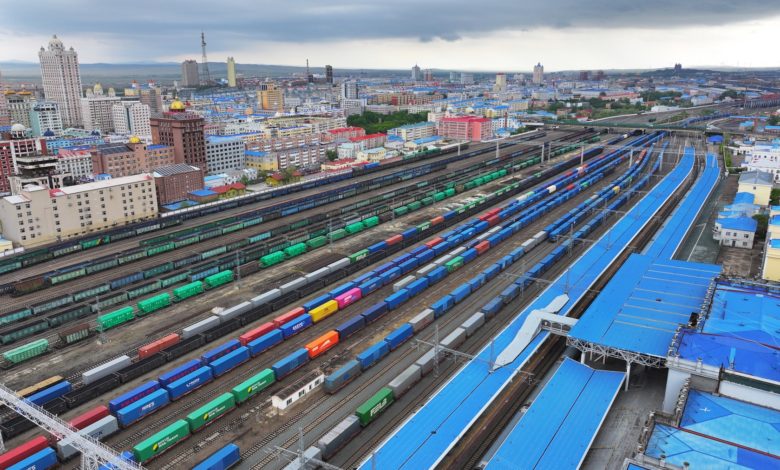
China's firm support for Russia's economy has helped Moscow survive at a time when dozens of countries excluded Russia from much of the global financial system, destabilizing its internal economy. This support can be best seen in Manzhouli, the main border crossing point between China and Russia, the economies of the two countries are increasingly interconnected, the New York Times reports.
China is the largest buyer of oil, wood and coal in Russia and will soon become the largest natural gas buyer. The trade between the two countries has exceeded $ 240 billion last year, increasing by two -thirds since Russia invaded Ukraine in February 2022. China has provided many of the drones and components used by Russia in conflict.
Much of the trade between China and Russia has long been running through Manzhouli. Russia has built a railway line through the city to northeast of China in 1900. Today, Russian trains and trucks pass the border in China, many of them transporting wood or freshly cut boards: pine for construction and furniture, white birch, poplar for the classification of concrete and robust elm to support mines.
This flow emphasizes the precarious economic position of Russia. Currently, Russia is practically an economic satellite of China, dependent on Beijing for manufactured products, while selling raw materials that China could buy, if they like, on the other hand, the New York Times remarked.
“Supply from Russia, processing in China”
Almost 6% of the entire Russian economy is currently represented by exports to China. This proportion is matched by Iran, another country subject to international sanctions. As part of Russia's pressures to accept an armistice, Donald Trump threatened to impose high rates or other sanctions to trade with Russia, although not mentioned.
The official economic strategy in Manzhouli is “supply from Russia, processing in China”, a strategy that emphasizes Russia's evolution to the status of raw material supplier for China's vast manufacturing sector, which eclipses that of Russia.
Russia depends on China for clothing, electronics and even cars. China's exports to the north have increased by 71% since the beginning of the Ukraine war.
The commercial alliance manifests itself in other contexts. The state press in China has been strongly oriented towards Russia in the Ukraine war. Russian television channels have gradually replaced American channels in Chinese hotels. China's sympathy manifests on the shelves of stores in Manzhouli: wine, vodka and crushed coffee Stalin are for sale, and a store is even specialized in busts of former Soviet leaders and Matrioşka dolls that resemble President Vladimir Putin.
The new approach signals a radical change in the relationship between the two countries. In the 1950s, Soviet advisers helped China, a largely rural and underdeveloped country to build many of its first steel, railways and weapons factories. But now, China produces 32% of worldwide manufactured goods, more than the United States, Japan, Germany, South Korea and the United Kingdom.
What is Russia's weight in world production?
Only 1.33%, even including Russia's weapons production, according to the United Nations Industrial Development.
China also benefits from imports. Through the purchase of wood and other goods from Russia, through Manzhouli, Beijing has managed to avoid the purchase of imports from the United States and their allies. China used to buy raw materials such as the rapeseed in Canada, for example, but went on to purchase a larger amount of these goods in Russia, after Canada was largely with President Joseph Biden last year and then with Donald Trump in imposing higher rates on Chinese goods.
China responded against Canada by imposing 100% tariffs on imports of canola oil and canola flour from Canada. China also initiated a commercial process against Canadian rapeseed, aimed at some of Canada's largest exports to China.
At Manzhouli Xinfeng Grain and Oil Industry Limited Company, heated red forklifts carry bags with supplies. The highly automated factory, located less than a kilometer of border, removes the Russian rapeseed shells and presses them to produce canola oil.
Huang Baoqiang, the general manager of a nearby timber factory, said that his company bought large quantities of wood in the neighboring Siberia and turned them into beds for beds and other furniture components.
The US Treasury Department has tried to block the use of dollars for transactions with Russia, but Mr. Huang said he was able to pay with Chinese Renminbi or Russian rubles through the VTB bank. The bank, one of the largest financial institutions in Russia, faced sanctions from the United States and the European Union shortly after the invasion of Ukraine by Russia.
China – Russia tensions
But, while Russia and China intensify trade between them, there are some tension signs.
Russia forbade the transport of freshly cut pins to China. Thus, the bark is removed from the pins, and the logs are cut into planks in the timber factories in Siberia, to the dissatisfaction of the businessmen.
In turn, China has imposed rates for Russian coal imports at the beginning of last year, after China's state coal mines expanded their production and complained about Russian competition.