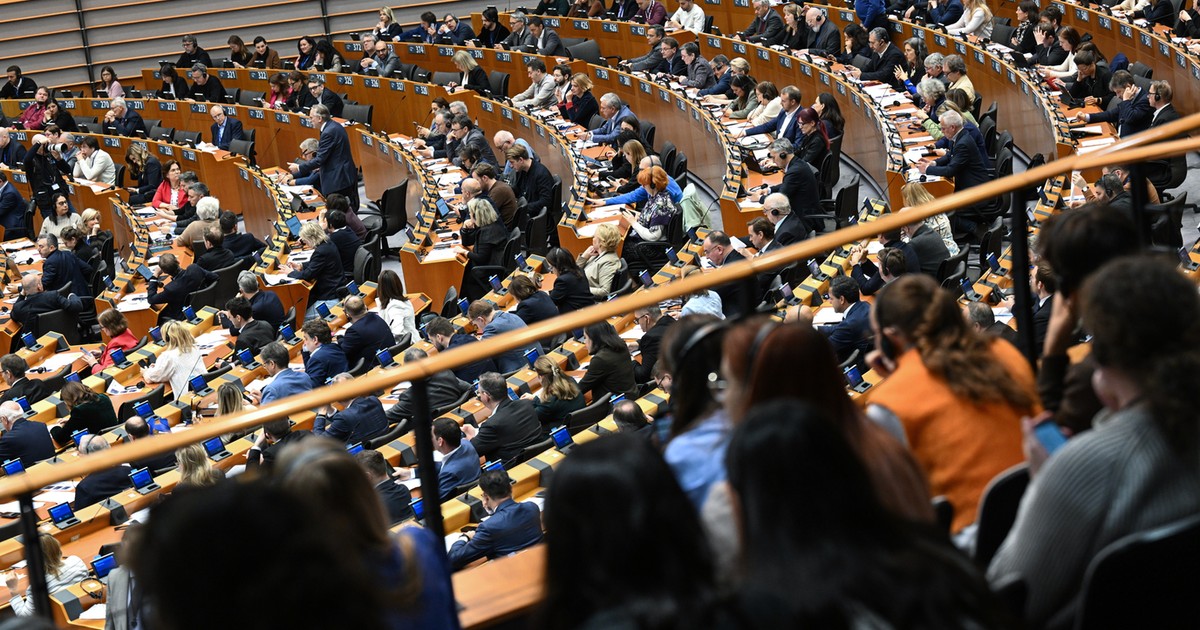
MPs of PiS and Confederation Clubs and the Free Republicans circled on Tuesday in the Sejm for rejection of the KO project, which assumes the extension of the possibility of voting correspondence for all voters. Other clubs were in favor of the project and its further procedure.
Deputy Speaker of the Sejm Dorota Niedziela announced that the Sejm would vote in the voting block of the voting block about rejecting the draft changes in the election code.
On Tuesday, the Sejm began work on a deputy's project by the KO amendment to the Electoral Code. It provides for expanding the possibility of voting correspondence for all voters. The justification emphasized that correspondence voting will always be voluntary; It is to be excluded in elections to the bodies of local government units and the election of the commune head. However, voters with a significant or moderate degree of disability will be able to vote correspondence also in these elections.
Mariusz Witczak (KO), taking the floor on behalf of the applicants, estimated that the solution that would be a widespread correspondence vote, the benefits would flow for citizens. At the same time, he emphasized that this is only an alternative form of voting. – In a changing reality, in new habits related to work culture, traveling our countrymen, you need to create alternative forms that complement and strengthen art. 62. The constitution, which tells us about active electoral law – he said.
According to the MP, this form of voting is safe. – When there was a correspondence election, we did not notice any practices that would make us arouse some anxiety when it comes to the functioning and security of correspondence elections – he noted. He added that the so -called Electoral packages are very well secured. Witczak also compared the proceduated solutions to the so -called envelope elections. He pointed out that they were “pure pathology” because – as he said – they received the rights of the National Electoral Commission. – Here, PKW is the host of the whole election process – emphasized Witczak.
He added that the solution modernizes Polish choices due to the introduction of the possibilities of the so -called earlier voting. He noted that if a citizen would not be able to carry out the election procedure on the day of election due to their duties, he would be able to obtain a package during the election week and then submit it at any postal point.
Łukasz Schreiber (PiS) assessed that the KO project is to cause “giant confusion” in the election process. According to him, correspondence elections could be considered in 2020, i.e. during the coronavirus pandemic period, but not now. He added that today people with disabilities and people over 60 can vote to vote today. According to Schreiber, the introduction of solutions contained in the KO project would cause that doubts about the election process would be even greater and even more serious. “The PiS Parliamentary Club requests the rejection of the project at first reading,” said Schreiber.
Agnieszka Hanajczyk (KO) emphasized that the purpose of the amendment to the Electoral Code is to introduce facilitation for voters by enabling correspondence to vote for all citizens. – Reducing barriers in access to voting allows you to implement the constitutional principle of equality before the law and can contribute to increasing election attendance – argued the MP. She expressed the hope that “this important amendment would come into force.”
Michał Pyrzyk (PSL) also noticed that the extension of the possibility of voting correspondence may increase the election attendance. He pointed out that currently a group of people who can use this form of voting is very narrow. – Correspondence voting is the right of all voters, regardless of the place of permanent residence, stay or other conditions, for example in Greece, Luxembourg, Germany, Great Britain and Romania – noted MP PSL. He added that his club would be in favor of referring the project to further work in the committee.
Barbara Oliwiecka (Poland 2050) emphasized that “every Pole, every Polish woman has no restrictions, without discrimination to use her active, passive electoral right.” – This is the basis of reliable, equal choices, this is the implementation of the constitutional principle of universality of elections. And widespread elections are the heart of our democracy – said Oliwiecka. She noticed that the correspondence voting would be voluntary, she would be “an option in which someone can use if necessary.” She declared that her club was supported by a bill prepared by KO.
Arkadiusz Sikora (left) said that “the time has come for the right to correspondence voting to be extended to all citizens.” – This will cause, above all, that the election attendance will increase, which we care about, but also eliminate some barriers that today occur during an election act, such as transport barriers – argued MP of the left. He announced that his club would support the project.
Witold Tumanowicz (Confederation) decided that the introduction of a correspondence voting for all voters “carries a huge risk of abuse, the risk of buying votes.” He emphasized that people with disabilities can already use correspondence voting. Tumanowicz submitted a request to reject the KO project at first reading.
Jarosław Sachajko, MP of the Free Republicans, also in favor of rejecting the project. He stated that the provisions contained in the project not only do not solve the problems of the Polish election system, “but they would even deepen the chaos and undermine the citizens' trust in the integrity of the election process.”
The project states that the intention to vote in a correspondence in the country of the voter reports to the commune head in which the voter is included in the voter list, until the 13th day before the election day. However, the intention to vote for correspondence should be reported to the consul by the 30th day before the election day. (PAP)
kos/ from/ par/