Although it lowers, because it regularly reached 12 percent several months ago, but – as the economists of ING Bank Śląski pointed out – it still remains increased due to the limited work supply and lack of qualified employees in many industries. This limits the rate of decrease in services and base inflation. In June, services prices increased by 6.3 percent. year to year, and base inflation increased to 3.4 percent. year on year with 3.3 percent in May.
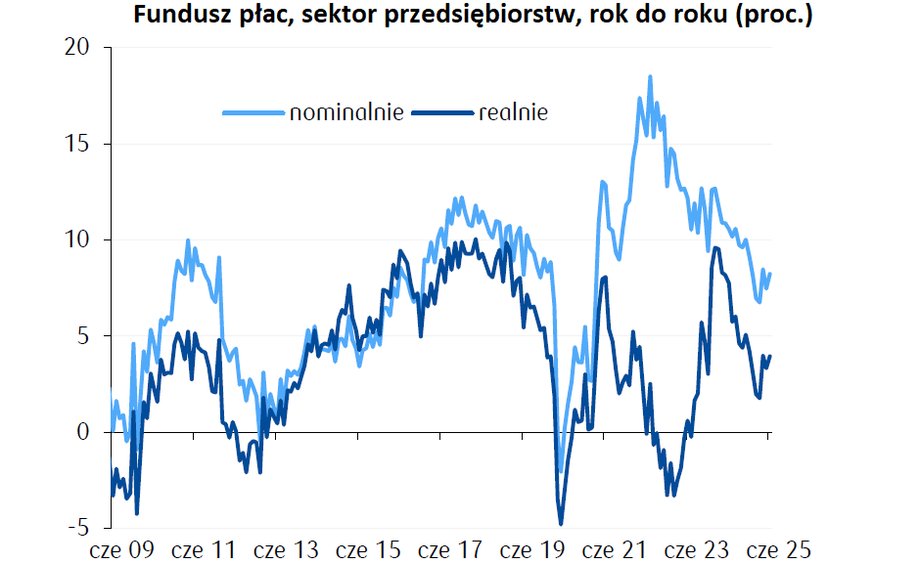
According to Credit Agricole Bank Polska analysts, in real terms (i.e. after correction on inflation), the rate of salary growth in companies in June increased to 4.8 percent. year to year compared to 4.2 percent in May. “As a consequence, the real dynamics of the payroll fund increased in the second quarter of 2025 to 3.8 percent year on year on 2.3 percent in the first quarter,” they wrote. The payroll fund is the product of the number of employees and the average salary. Employment in companies in June slightly increased against May and fell by 0.8 percent. year on year.
Lower inflation and increase in the minimum wage will help cool the salary dynamics
Economists of PKO BP see the reasons for accelerating the nominal wage dynamics in June mainly in bonuses and awards. They maintain the forecast that in the following quarters pay will inhibit. But, as noted by the analysts of Bank Millennium, acceleration of growth was also recorded in some service subsidies.
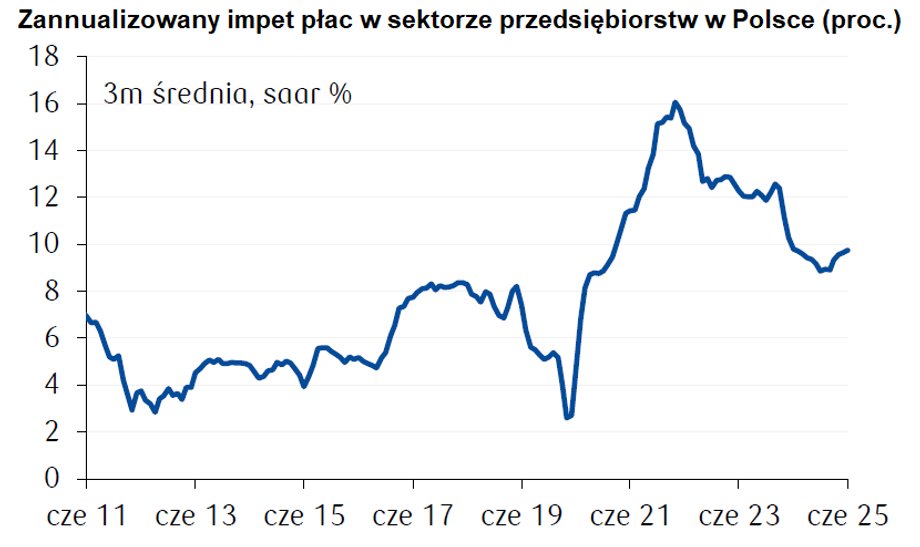
According to Bank Pekao economists, in June, the payment of another tranche of increases in one of the mining companies, which conquered the June reading by about 0.3-0.4 percentage points. In addition, the dynamics was conquered by a quite low base from the previous year. And thirdly and most important: The pace of weakening wage pressure has slowed down in recent months. “Even when we exclude the variable mining sector from the analysis. Annalized wage rate remains at elevated levels, slightly below 10 percent. ” – they pointed out.
|
PKO Research
“Referring to the results of quick monitoring, we see that the second quarter of the participation of enterprises feeling wage pressure and was below the many years of median for many years. What's more, the company's survey reports that once again the participation of enterprises planning to increase salaries in the quarter horizon. In the long run, however, a slightly larger share of companies plans to increase pay increases, but on a smaller scale. In our opinion, we will see a stronger decrease in wage dynamics from January next year. A much smaller scale of a minimum wage increase (by 3 %), through indexing mechanisms, will also translate into wages of employees and higher salary. What's more, payroll demands will probably decrease slightly with the expected decrease in inflation, “indicate the experts of Bank Millennium.
“Despite the surprise up (regarding wage dynamics – ed.), Our forecasts of the decrease in the rate of wage, although their path may be bumpy. Citing the results of fast NBP monitoring (cyclical survey report regarding a wide sector of companies), we see that in the second quarter the participation of enterprises feeling the payroll pressure has decreased and shaped below for many years median ” – assess the economists of Bank Pekao.
They point out that real wage dynamics – taking into account the expected decrease in inflation in July below 3 percent. year to year and its stabilization in the range of 2.5-3 percent. In the following months – it will grow around 6 percent “The purchasing power of households will clearly increase, which will translate into reviving consumption in the second half of the year, which will limit the rate of decrease in inflation of services and base inflation” – they warn.
How many interest rates in Poland this year?
Santander Bank Polska analysts expect that In the following months, wage dynamics will remain around or above 8 percent. “Considering that the Monetary Policy Council has recently pointed to the rate of wage growth as one of the main reference points for percentage decisions, these data may be an important argument for caution in the matter of alleviating monetary policy in the coming months” – they emphasize. However, they are still expecting two more interest rate discounts this year: in September and November, both by 0.25 percentage points.
In May, the MPC changed the cost of money for the first time in 19 months, cutting the interest rate by 0.50 percentage points. Previously, it lowered her feet in October 2023 (by 0.25 percentage points) and in September 2023 (by 0.75 percentage points). Earlier, between October 2021 and September 2022, the Council – fighting with the highest inflation in 25 years – raised a reference rate from 0.1 percent. up to 6.75 percent, which is the largest ceiling since 2002.
|
PKO Research
Also, ING Bank Śląski experts indicate that The wage dynamics is one of the key variables for decisions regarding monetary policy for the MPC. “Increased wage growth is a pro-inflationary factor, but the general image of inflation perspectives remains beneficial. We expect inflation drop below 3 % year-on-year in July and stabilization in the range of 2.5-3 percent in the following months. It gives a significant space to the council to reduce interest rates to avoid strong growth of real rates. We expect that at the next meeting in September, the MPC may lower the feet by up to 0.50 percentage points. and another 0.25 percentage points At the meeting in November” – ING experts forecast. This would mean that at the end of this year the NBP reference rate would be 4.25 percent.
“Cutting the cost of money this year is the base scenario for us and for financial markets. The reduction may occur at the next meeting in September, when the MPC sees the CPI index, the inflationary purpose (2.5 percent). By the end of the year, the basic NBP interest rate will only be reduced to 4.50 percent. with 5 percent Currently” – economists of Bank Millennium write.