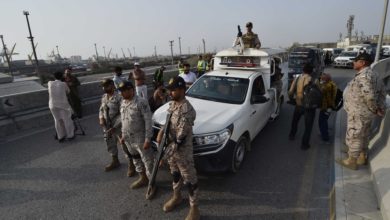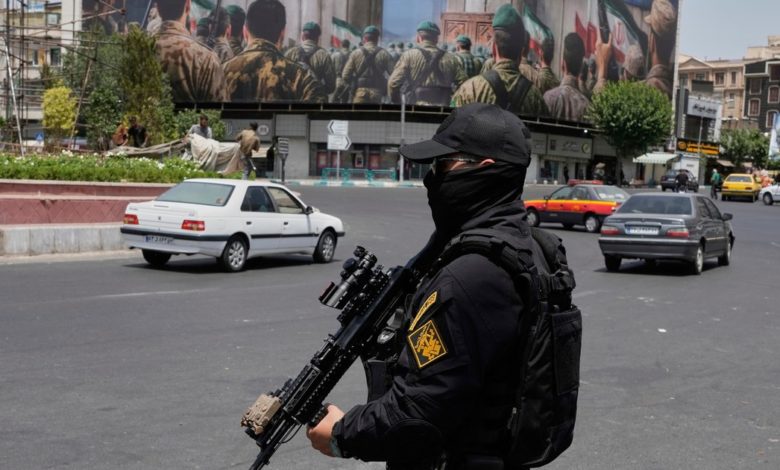
Volunteer members of the paramilitary wing of revolutionary guards, Basij, supervise roads and inspect vehicles, to prevent the Mossad from setting out new attacks, reports Financial Times.
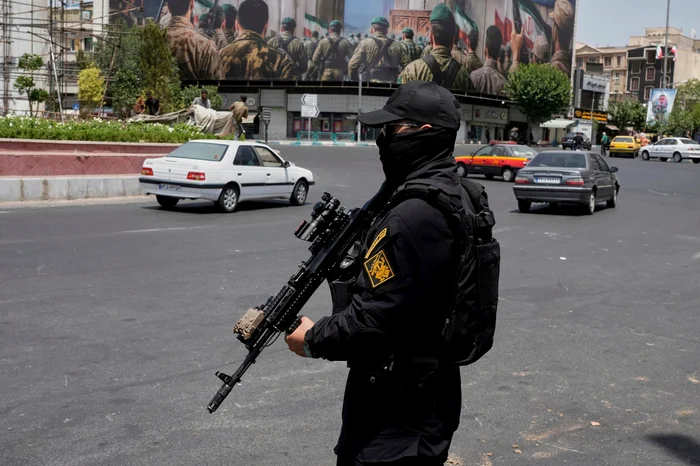
Member of the Guardians of the Revolution, guard in Tehran Photo Profimedia
In a village near Tehran, locals joined police and security forces to combat what Iranian authorities claim to be a vast spy network built by the Israeli agency over the years.
Recently, hundreds of people – most Iranian and Afghan citizens – have been arrested throughout the country in the effort to stop potential spies.
“Now there have been control points administered by Basij with the police at the city entrances – which did not exist before this war with Israel,” a driver said.
“I usually stop SUVs, vans and trucks, searching them thoroughly in search of explosives or drones.”
Ever since Israeli attacks began, officials suspect that Israeli spies have long been infiltrated in the country, have been actively involved in operations inside Iran, and local spies have supported Israeli Air attacks, providing information on target locations and illegally introducing drone and explosive components. Given the murders committed on the higher commanders and nuclear scientists, officials believe that the level of Israeli infiltration is a large one.
The support for control actions has increased in recent days, as the US tensions have escalated, culminating in American attacks on Iranian nuclear sites and with Tehran's retrsancy attacks on the largest US military base in the Middle East.
On Saturday, before the attacks, the head of the Iranian judicial system, Gholam-Hossein Mohseni-Ejei, stressed the need to accelerate the resolution of espionage.
“It is a time of war … There should be no delay. We cannot afford to stay for two or three months on a single file,” he told the counselors in a video published by the state press.
Iran has performed in the last few days two men for espionage in favor of Israel. Mohammad-amin Mahdavi-Shayesteh was accused of coordinating a cyber team related to Mossad through an immigration consulting company that served as a screen. He would have met with Mossad agents in a neighboring country.
The second, Majid Mosayebi, was accused of sending confidential information about sensitive sites and high -ranking people to Israel, in exchange for cryptocurrency payments. The authorities also claimed that he had regular meetings with Mossad agents in the Gulf states.
Mass arrests
Basij members entered the role and treated each activity suspicious with great seriousness.
“Two men who took pictures at some villas were immediately arrested by Basij … and handed over to the police,” said a service man who witnessed the incident.
“Also, Basij closes the roads from midnight to morning and searches every car that leaves or enters the village.”
A witness from the great bazaar in Tehran said the police arrested “many” Afghan citizens on Monday, a frequent action in recent days.
The resuscitation of these forces formed by approximately 12 million volunteers – mostly young, loyal to the regime, who are not paid by the guards of the Revolution – reminds of the first years after the 1979 Revolution.
At that time, Basij also carried out searches at home, confiscating large quantities of weapons and contributing to the establishment of order in the middle of chaos and violence.
The Islamic Republic considers its experience of collaboration with local forces Basij a brand realization by resorting to similar groups even in Iraq and Syria during civil wars.
In this context of mistrust, the new commander of the guards of the Revolution, Mohammad Pakpour General, has listed “the solidarity of the people” a “blessing from God”. He said that, lately, ordinary citizens have presented themselves at the foundations of the guards to provide volunteers in the field of security and committed them to “mobilize” them.
A source inside the regime called Basij patrols a “good move”.
“The Iranian security forces will not exaggerate by forcing their authorities or searched all cars and irritating people,” the source said.
“There is no plan to go so far to enter the homes of people to sear them out of explosives, unless we have credible reports on organized teams that use housing.”
Iranians have mixed feelings
Many Iranians detest the Basij forces for their role in suppressing anti -regime protests and civil society. However, at the same time a large part of them rally behind the flag, after American and Israeli attacks resuscitated a sense of patriotism to what they consider a threat to Iran itself, not just the government.
“This reminds me of the first years after the Revolution,” said Affaneh, a resident of Tehran.
“He is disturbing, but also somewhat soothing to see them near my house. I would never have imagined that I would see the bass and that they would thank me.”
The head of the judiciary system, Mohseni-Ejei was informed on Saturday about the case of prisoners supposed to be involved in espionage.
According to the state press, one prisoner told the head of the judicial system that he is unemployed and filmed air defense systems to send them to Mossad contacts abroad.
In another case, an Afghan citizen would have confessed that he sent photos and videos with sensitive centers using espionage tools, while another had recognized that he received $ 2,000 in a bank account abroad.
The source inside the regime explained that Iran is vulnerable to infiltration. “In a country with long borders in the east and west and with so many Iranian workers in the border areas, these people were easy to recruit and a simple drone assembly mechanism have been learned. The drones are launched from the roofs of Tehran buildings,” the source said.
“Basij will be able to take care of it soon.”