Here 10 words that are very often used incorrectly.
If you can say about the “art” of making language errors, then the classic in this field can be called incorrect use of the word “by no means”. Most often, we sometimes confuse “by no means” with “at least” or use as a particle emphasizing confirmation. Meanwhile, this word should be used in the opposite way – as a particle emphasizing the negative nature of the statement (e.g. “I am not going to deal with it”) or alone – as a rejection of an affirmative answer or a negative answer to the question (e.g. “Have you finished?” “”). Wojciech Młynarski told about how not to use the word “was” by time “.
Dedicated Dedication
|
East News
You can dedicate a book, picture or other work of art to someone. And that's all. This word is often misused instead of completely enough “allocate”. In this way, we sometimes dedicate a solution to a problem, cosmetics are dedicated to a given age group, etc.
Collaboration Professor Jerzy Bralczyk
|
Michał Woźniak / East News
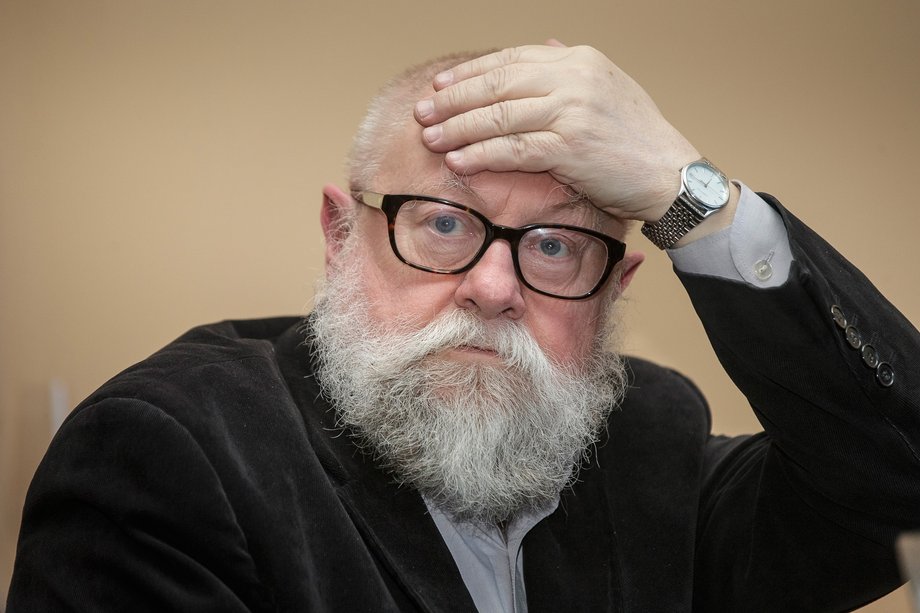
Originally, “collaboration” meant every cooperation in Polish. In this way, we would like to apparently use this word and today. Hence the “collaborations” of some artists with another or one fashion brand with another, etc. Unfortunately, during World War II the word narrowed its meaning. Collaborators were then called people cooperating with the occupier. “Collaboration” therefore has a negative overtones, means cooperation, yes, but with the enemy.
Deference Attention
|
Alex_bond / shutterstock
If you once enjoyed the attention, because it means that someone had great respect for you. However, if it seemed to you so far that this meant that you managed to attract someone's attention, unfortunately it was not. Many people mistakenly use the word “attention”, for which we can blame the popularity of English, in which the similar word “Attention” means “attention”.
And Professor Jan Miodek
|
Bartlomiej Magierowski / East News

And is a conjunction that we can use like “and” or “and”. Often, however, it is incorrectly used interchangeably with “or” or “or”. Anyway, some linguists believe that the word “and” is already archaism and should not be used anymore, unless we stylize our statement.
As if
The word “as if” has become one of the greatest observations of contemporary Polish. His task is to weaken the overtones of the word he accompanies. So when we want to express uncertainty or do not sound too strongly, we can add “as if”. However, we often put this word where it is not needed.
Terribly Frame from the movie “Terrible Film”
|
press materials

It is interesting that the word meaning that something is terrifying has become a term that replaces us with neutral and calm “very”. And so often “we like something”, we consider someone to be “terribly pretty” and we even “enjoy” for some reason. Ultimately, we can “be terribly afraid of something”, because here there is no contrast between the words used (the word “terribly” emphasizes how negative the experience is). But we don't really like someone “terribly”.
Pretentious
Quite often it happens that the adjective “pretentious” we define someone who … has a grudge. Unfortunately, although it might seem logical, Polish likes to play tricks on us. “Pretentious” is one that is unnatural, artificial, testifying to bad taste.
Generally
This is one of the most abused words in Polish. Some start every second sentence with him. Meanwhile, as explained by prof. Bralczyk, they can be used in two different situations: as a substitute for the word “generally” or as a replacement for the word “completely”.
Exactly
Many people use the word “thoroughly” as an answer to the question, for example, “he inelegant” – “exactly!”. Meanwhile, “exactly” means carefully, carefully. Using the word in a similar way, as in the example above, is wrong.
Note from the publisher: The above article was originally published in January 2018 and was updated.