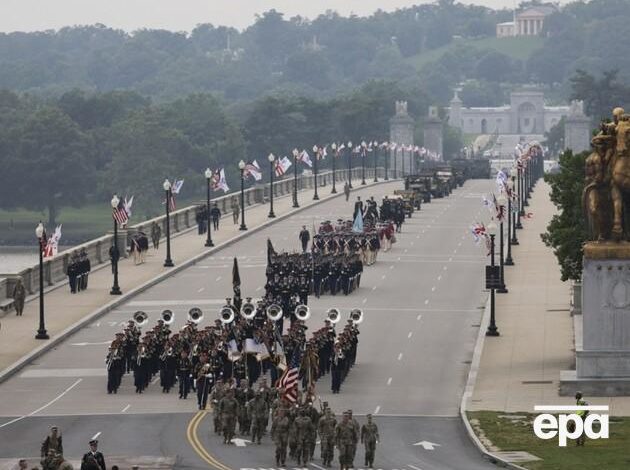
“It was just a parade – and a parade, which, despite all the millions of dollars spent, caused disputes and exhausting security measures, was a little disappointing,” the publication says.
The mood at the army parade itself was quite cordial, the newspaper writes, partly because the vast majority of those present were either supporters of Trump, or military families, or mainly apolitical one -day tourists who simply wanted to see the parade. However, the crowd was a few, given the scale of the event.
In addition, the public event was not very well planned. The garbage tanks, which were few and they stood far from each other, were crowded. The outputs were not enough. The only source of food for thousands of people was a few van with food, each of which lined up a line of 40 or 50 people. In addition, there were no signs, and people could not find a way out of the blocked quarters. An employee of the secret service, trying to explain the universal confusion, complained: “No one knows what is happening.”
A little more than an hour after the start of the parade, when it was still in full swing, the crowd began to show some signs of anxiety. Even Trump's supporters in caps with his slogan Maga robbed their things and headed home. One of the viewers told reporters that he was not impressed. He noted that Trump’s close connection with the celebration politicized him and “made a laughing stock from the army, although this was not the fault of the army. He added that the event was “some sagging.”
The publication recalls that Trump did not hide his desire to hold a grand military parade in the United States, starting from his first presidential term, when he saw and was deeply impressed by the parade in honor of the day of the capture of the Bastille in Paris. Military leaders, realizing the high costs and reputational problems of this idea, in the past resisted this idea.
Context
The military parade in honor of the 250th anniversary of the US Army was held in the US capital Washington on June 14. The parade was presented by many units of military equipment, including dozens of M1-A1 Abrams tanks and Bradley and Stryker combat vehicles, as well as howitzers and other artillery guns. The event told the history of the army throughout its 250-year history, starting from the war for independence and passing through major conflicts. The era of the history of the army was represented by an old uniform and equipment.