The vision that changed the destiny of mankind. Turned a persecuted belief into a religion that would write history

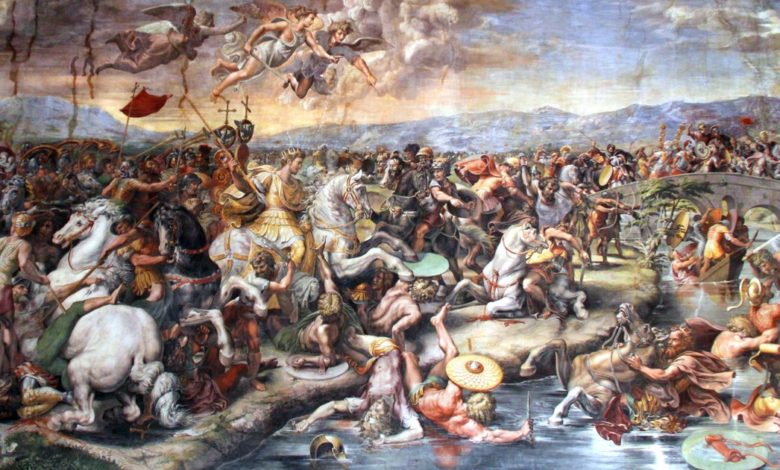
A battle given more than 1700 years ago, apparently trivial, completely changed the history of humanity. The victory of a pretender to the Roman imperial throne has transformed Christianity from a persecuted religion into a faith that has spread throughout the globe and has definitely changed the world's walk.
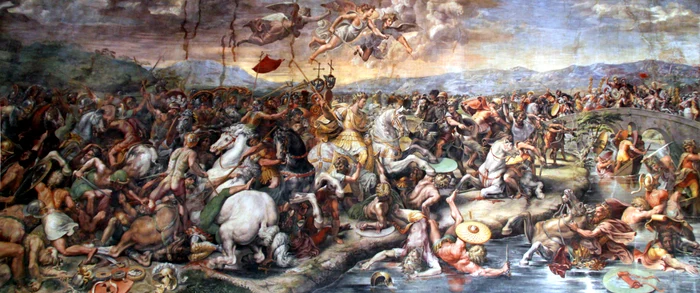
Battle of the Milvius Bridge Photo Wikipedia
On the morning of October 28 of the year 312 D HR, two powerful armies were separated by the Tiber river, that legendary watercourse that crossed Rome, the eternal city of the Roman Empire, the largest empire in the history of humanity. On one side of the river were the faithful legions of Constantine, and on the other of Maxentius. Both disputed their imperial throne and supreme power.
After a period of tactical maneuvers, the two armies clenched in the fight, filling the blood tiber and corpses. Although with a lower numerical army and without benefiting from the protection of the walls of Rome, Constantin destroys the army of his rival. Maxentius's head would end at the top of a hair, carried on the streets of Rome, increasing the prestige of the victorious troops.
Apparently it was a trivial battle on the scene of history. One of the many struggles for power that ended Rome in the centuries and struggles for power between Augusts, Caesari, military commanders, impostors and all those who dreamed of mastering over the whole world (for many of the people of that time, the Roman Empire represented almost the whole known world). In reality, say the specialists, this battle, known as the battle of the Milvius Bridge, has changed the fate of all mankind and decisively modified the course of history. If Victoria were not Constantine, the world would have shown quite differently.
An era of thirst for power and anarchy
The Roman Empire has definitely changed the face and destiny of Europe, but also of all the conquered territories, from Britain to today's Iraq, from the Renan border to the Sahara's leaders. The Romans spread civilization and culture, made peoples and languages that have resisted to this day. The Roman Empire meant an era of conquests, blood of bondage, but also an era of civilization, culture and progress. After two centuries of gold of Roman civilization, under the oblique of capable emperors, visionaries, pacifiers, the mirage of the supreme power collapsed everything. From 235 D HR to 284 D HR, Anarchia has seized the empire. It was a century dominated by the struggles between the suitors to the imperial throne. The military commanders were emperors, the Pretorian guard assassin the emperors, the imperial function took to the middle, and people from all corners of the empire dreamed of the masters of the world. Because of the civil war, the empire became vulnerable.
In addition to the legions that slaughtered each other, the barbarians were ravaging in the provinces, both with hunger and plagues. In this century of crisis Rome was on the verge of collapse. She was rescued by Diocletian, a provincial from Dalmatia (today's Croatia), who has proven to be an extremely capable politician, but also a skilled military commander. Reorganized the empire. More precisely it divided into two, in the year 293 D HR, precisely to be easier to defend and easier to manage. He also inaugurated a new management system. It was called tetrarhia. Power was divided into four. Two Augusts (ie two emperors) and two caesari (two deputies). A August and a Caesar was leading half an empire together. That is, two in the Roman Roman Empire and two in the Eastern Roman Empire. The system has proven viable, leading to the saving of the empire, to a relative peace and stability. Diocletian was the only Roman emperor who decided to give up this dignity, willingly. Sick, he retired to the country and lived as a farmer the rest of the days. In his place, other Augusts and other Caesari came.
Some died pretty quickly. Eventually the balance of the tetrarchy seemed restored. Until the moment, one of the Caesarii from Rome, Maxentius, with the help of Pretorian troops, proclaimed the emperor, despite the will of others. On the other side of the empire, Constantine, the son of a great general in Britain, was, in turn, proclaimed by his own soldiers. The civil wars were returning to the Roman Empire with an unheard of anger. Maxentius has barricaded in Rome and managed to defeat all those who came against him. He killed his superior, August Severus, but also defeated the armies of Galerius, the emperor of the Eastern Roman Empire. The only one who could stop him was Constantine, the Caesar in Britannia.
A march of nearly 3000 kilometers and a divine sign
Constantin did not hesitate. He was recognized as a emperor in Britan and Gallia. He started forced to Rome with 40,000 soldiers, that is, a few legions. The road began in 312 D HR, with the melting of snow. He crossed today's France and passed the Alps to Northern Italy. He managed to defeat the troops sent against him by Maxentius to Turin (Turin, today) but also to Verona. After occupying the north, he continued his march to Rome. He arrived in front of the tiber and only the river separated him from the eternal fortress.
Although it seemed only a hop, Victoria was far away. And Severus but Galerius also bored in front of the walls of Rome. In addition, Maxentius had a numerically superior army. Bizarre, Maxentius did not stay behind the walls and went out to fight in the field with Constantine's troops. The two armies were separated only by the river but also by a bridge, not far from the Milvius Bridge on Via Flaminia, destroyed by Maxentius. Then the supernatural intervened. On the one hand, Maxentius consulted pagan oracles and was told that “The enemy of Rome will die on that day.”. Encouraged, Maxentius decided to face Constantine.
On the other hand, Constantin would have had a vision. This vision is documented. Eusebiu de Caesarea, a Christian theologian who wrote “ecclesiastical history” but also “Constantin's life” describes things as follows: Constantine with his army marched and saw a bright cross above him, and with it the Greek words “en toutōi níka” or in translation “With this sign you will defeat”. Later, on that night, Constantine had a dream in which Christ told him that he should use the sign of the cross against His enemies. Constantin was impressed by these visions and ordered all the soldiers to draw the chi-rho sign, a sacred monogram, representing the first two letters of the Greek word “Christ”. The episode is recorded, with small differences and by Lactantius, the advisor of Constantine and at the same time a well -known Christian author.
“With this sign you will defeat”
Both emperors were provided by visions or oracles that they would get victory. Although less numerous, Constantine's troops were more experienced and better prepared for battle. In addition, Maxentius made the mistake of attacking first. He sent detachments beyond the bridge on Tiber to make a breach in the line of defense of Constantin's legions. Were rejected. Moreover, Constantine triggered the counterattack. In the deskingolade, I hit the people of Maxentius strongly on the bridge. The bridge broke and many soldiers drowned. Including Maxentius. Constantine annihilated the army of his rival and became emperor.
In the year 313 D HR, Constantin gives the Milan edict stating that “no one, but absolutely no one, should not be refused the opportunity to devote himself to the Christian religion.” Subsequently, Christians began to become a constant presence at Constantin's court. He named Christians in high positions and gave Christian priests the same privileges as the pagans. He also gave up his favorite god, Sol Invictus, and from 323 D HR proclaimed December 25th the birthday of Jesus Christ. In the year 325 D HR personally participated in the Niceea Council, the one who laid the dogmatic and canonical bases of Christianity. Constantine, who came to be known as “the Great”, raised churches, including the famous “Saint Sofia”, in his soul city, Constantinople. However, Constantin baptized only on the deathbed in 337 D HR, being considered the 13th Apostle of Christ.
The victory that changed the history of the world
Until Constantine the Great, the Christians were largely persecuted. Even Diocletian initiated Christians and urged them to kill them. Constantine's victory at the Milvius Bridge but also his proximity to Christianity has transformed a persecuted belief into a religion that spread with the speed of lightning throughout the empire. Indeed, the reign of Constantine and the protection of Christians led to the church, dogmatic organization, paving for his recognition as an official religion of the Empire. From that moment Christianity will become the defining religion in the provinces of the empire and the one that will model the course of the whole history. Although many modern historians doubt the truths of the stories with Constantin's visions, it is still difficult to explain how an worshiper of the god Invictus has transformed into a supporter of Christianity. And this despite the persecution exercised by his ancestors. The assumptions are multiple, from political interests, religious experiences or simply a propaganda tool.