– The steel industry has always been the driving force of European prosperity. Pure new generation steel should be further produced to our continent, so we must help producers who face challenges on global markets – In March this year, the preliminary program for the steel and metal industry (European Steel and Metals Action Plan) said the chairwoman of the European Commission Ursula von der Leyen.
There is no exaggeration in the words of the EU leader; This is the creation of a common coal and steel marketput the foundations for modern European integrationand without steel it is difficult to imagine the functioning of motorization, transport, construction, arms industry, infrastructure, but also the production of household appliances or wind turbines or other industries.
The positions of European manufacturers, however, are threatened by the growing competition from the emerging global players, primarily the largest producer of China Stal. Manufacturers are worried about higher energy costs than in other parts of the world and the direction of climate policy, which assumes full decarbonization of the entire EU economy until the middle of the century. For the steel industry, this means the need to switch to zero -emission production methods, but these are not cheap.
Read also: The industry crash in Europe is going on. “These numbers look terrible”
“We face the choice”
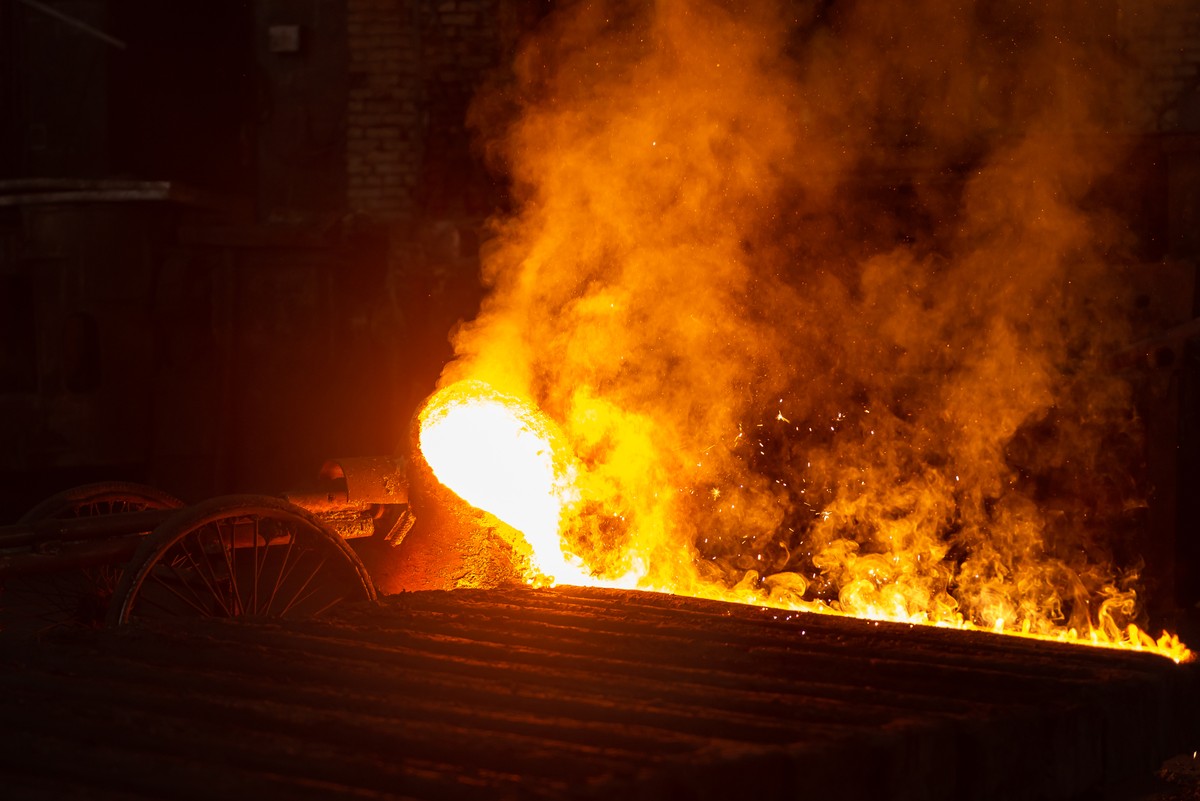
As we read in a report on the sector transformation published by the Beyond Fossil Fuels organization, over 50 percent. European steel is still produced based on the so -called BF-COF the oxygen stoves, in which coking carbon is reduced. The result is high CO2 emissions – the industry is responsible for 5 percent. EU coal trace and for 15 percent emissions from all over the industry. Taking this into account, the authors of the report state that the use of BF-COF stoves is incompatible with the atmospheric goal of the Paris Agreement-and thus maintaining a global increase in temperatures compared to the pre-industrial era of 1.5 degrees C to 2050.
The Eaf's electric arc stoves are less emission alternative, however, full of climate neutrality of the production process can ensure that they are supplemented by reducing iron ore with green hydrogen (produced with renewable energy energy) hydrogen. According to Beyond Fossil Fuels, in February 2025, 33 investments were carried out in the production of the so -called Green Steel – incl. in Germany, Sweden or Finland.
According to Marcin Korolec, director of the Green Economy Institute and the Minister of the Environment in 2011-2013, in the changing world, crawling technology may become a source of competitive advantage for European Steel producers.
– We face the choice; We can be stuck with technologies coming from the nineteenth century, or take a step forward and secure the basics of competitiveness for the future. For example, the Swedes are already investing in the production of green steel. Why couldn't we keep a pace in Poland? – says the expert.
He adds that the optimal direction are zero -emission technologies based on electric stoves and green hydrogen. Much more expensive and more difficult in implementing carbon dioxide capture and storage systems should remain a last resort for those energy -intensive industries in which direct emission reduction is impossible, e.g. for cement production.
Europe abdicates?
The condition for the success of the transformation of steel production is, however, public support and planned industrial policy. Her seeds of the Union presented in the announced this year a packet for pure industry (Clean Industrial Deal) or in the already mentioned plan for the steel and metal industries. Both strategies devote a lot of attention to energy prices, which, according to the European Commission, should be reduced by increasing the participation of renewable sources or such solutions as PPA contracts – direct contracts concluded between green energy producers and its industrial recipients. The injection of funds for decarbonizing companies is to be the so -called European Competitive Fundhowever, this one is to enter the game only with the new EU budget, i.e. in 2028.
In the opinion of Marcin Korolec, a fund worth 237 billion euros should appear faster. – As the Green Economy Institute, together with Cambridge Econometrics, we proposed that the new instrument would debut immediately after the expiry of the funds from Next Generation EU (National Reconstruction Plans – editor's note), i.e. in 2027, the basis of its financing could be a common European debt again. The fiscal space to incur new obligations by the community is much greater than individual, especially indebted Member States – he argues.
He adds that the European Commission today bases the concept of pure order for the industry on expanding the freedom of individual Member States in supporting its economic champions instead of introducing European instruments. This approach, together with the resignation from the incurrence of a common European debt in order to support the modernization of the European clean technologies industry, according to the expert would testify to European abdication from the race for new competitiveness.
– European elites accept further documents in which they write about the seriousness of the situation – the risk of lag behind China and the USA moved, among others Draghi's report. However, actions should be faster and more determined, and they are not taken or shifted the European Competitive Fund to a new financial perspective testify to the resignation from real leadership – comments the director of the Green Economy Institute.
At the same time, he criticizes leaving the issue of support for the production of zero -emission steel at the level of Member States. These are given today – according to Beyond Fossil Fuels, the programs of Germany, Belgium, Finland, France, Sweden and Spain accepted by the European Commission reach a total of EUR 9.3 billion, which mainly includes direct subsidies. The most, over EUR 7 billion to help in decarbonization of their steel industry, is spent by Germany.
According to Korolc, the advantage of a model of assistance from domestic funds threatens to deepen unevenness between different EU countries. – If the Commission is limited to loosening the rules of public aid, we will naturally begin to implement Europe of different speeds. The ability to incur new obligations varies – high in the case of e.g. Germany and small in Italy. We all need a fair transformation of industry – he says.
We are several years old
At the same time, the expert adds that “a lot depends on us.” The potential of the production of green hydrogen – a key element of the puzzle called “Green Stal” – directly depends on access to green energy.
– We are still waiting for the new distance act that will unlock the development of wind energy on land. Without significant amounts of cheap renewable energy, the production of green hydrogen, and therefore also the decarbonization of the steel industry, will not be possible – he concludes.
Read also: Will the new windmills reduce bills? “Not necessarily”
Like Marcin Korolec, for greater coordination of financing for the decarbonization of industry at the EU level, in order to equalize the chances between individual economies, in a letter to Ursula von der Leyen from December last year, representatives of Polish energy consuming industries, including the Hutnicza Chamber of Industrial and Industry, Association of Cement Producers, Association of Cement Producers, Association of Cement Producers, the Association of Cement Producers, the Association of Employers, Foundry Chamber of Commerce.
At the same time, industrialists are full of anxiety about the future and in their public statements resemble, among others on a constantly decreasing pool of emission allowances within the ETS system. Pursuant to the provisions adopted as part of the Fit for 55 package, by 2034 free rights will disappear, which today is entitled to, among others steel industry or other energy -consuming sectors.
According to the estimates presented in the report “Assessment of the impact of the implementation of the goal 90 percent of CO2 emissions reduction in the EU economy until 2040 and the regulation of the” Ready for 55 “package on Polish industry”, by 2039, there may be any powers on the market. The complete exhaustion of the pool remains hypothetical, but it is certain that with the decreasing supply of emissions will rise.
Therefore, only a dozen or so years may remain for full decarbonization. – The expected price of permissions under the ETS in 2039 is 280 euros per ton. If so far production will continue to take place in traditional technologies (based on fossil fuels), This price will eliminate energy -consuming companies from the market. We have about 14 years to change production into a non -emission, i.e. decarbonization, while there is a lack of technology, money and interest in politicians. The only country that realistically implements industry transformation is Germany – Henry tells us Kaliś, president of the Chamber of Industrial Energy and Energy Recipients and the Forum of Electricity and Gas Recipients, one of the signatories of the letter to Ursula von der Leyen.
It also expresses concerns about price competitiveness less burdened with carbon or non -emission trace, but requiring higher products. – Management boards of joint -stock companies will not decide to invest in zero -emission technologies, which today will not ensure the required return on invested capital. Nobody will buy an expensive product – he says.
Read also: Industry transformation in its infancy. “I don't remember such a threat”
Marcin Korolec is of a different opinion. – Calculations for the automotive industry show that zero -emission steel would only translate into approx. 500 euros of additional costs. In the case of a car that costs, e.g. 40,000 euros and more, such a price difference for most customers who care about environmental issues will not constitute a price barrier, and it may turn out an argument determining the purchase decisioncars with the smallest possible carbon track – he states.
A fair transformation for the steel industry
Anxiety about the fate of the energy -consuming industry is not limited to the owners of the plant, but it is also given to employees and representing their organizations. Representatives of “Solidarity”, OPZZ and the Free Trade Union “Sierpień 80” spoke about the “death of Polish metallurgy” and liquidated workplaces during the protest on May 21 in Warsaw. The protesters acted against the European Green Order and demanded, among others determining the constant price of electricity for the energy -consuming industry below 60 euros for a megawatt hour, revision of the ETS system and better protection against import of steel from outside the EU. Is it really so bad?
The conclusions report for the Polish steel industry is presented by the Instrat Foundation “Low or Zero Emission?” from October last year In 2022, production fell to a record low level of 6.5 million tons, while two years earlier the ArcelorMittal Huta in Krakow was closed.
Decreasing production is accompanied by an increase in import; In 2023, the consumption of the raw material was almost 5.5 million tons greater than the resources generated on the spot, while in 2012 this difference was only two tons. Instrat experts are therefore in favor of financial and regulatory support for investments in zero -emission technologies (as well as upbringing and storage of CO2 with continued traditional furnaces), as well as ensuring low electricity prices Thanks to the development of renewable sources, appropriate rates of transmission fees or discounts for recipients in the areas of accelerated RES development. They also write about help for potentially injured employees and regions, which could be used to cover the steel industry with a fair transformation fund.
Beyond Fossil Fuels also raises the last issue in his own report. The organization reminds that throughout the Union Stal producing plants today employ around 300,000. people; Together with employees of related enterprises, this number increases to 2.3 million, i.e. about 1 percent. all employed in the community. The chances of new jobs are to be created, among others Production of electrolysers for the production of green hydrogen.