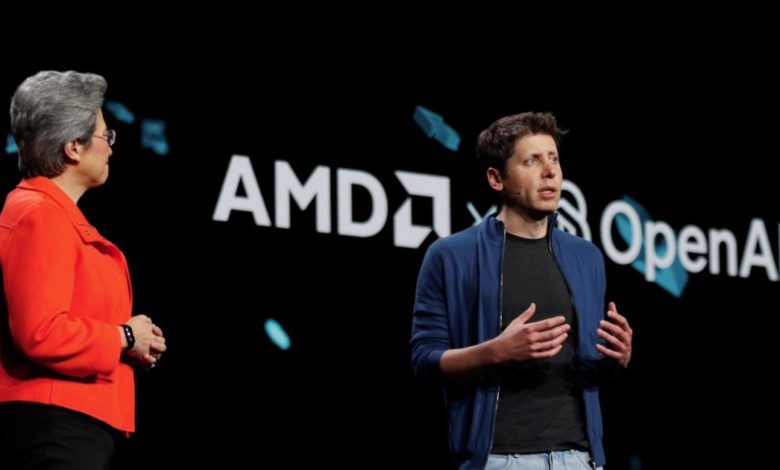
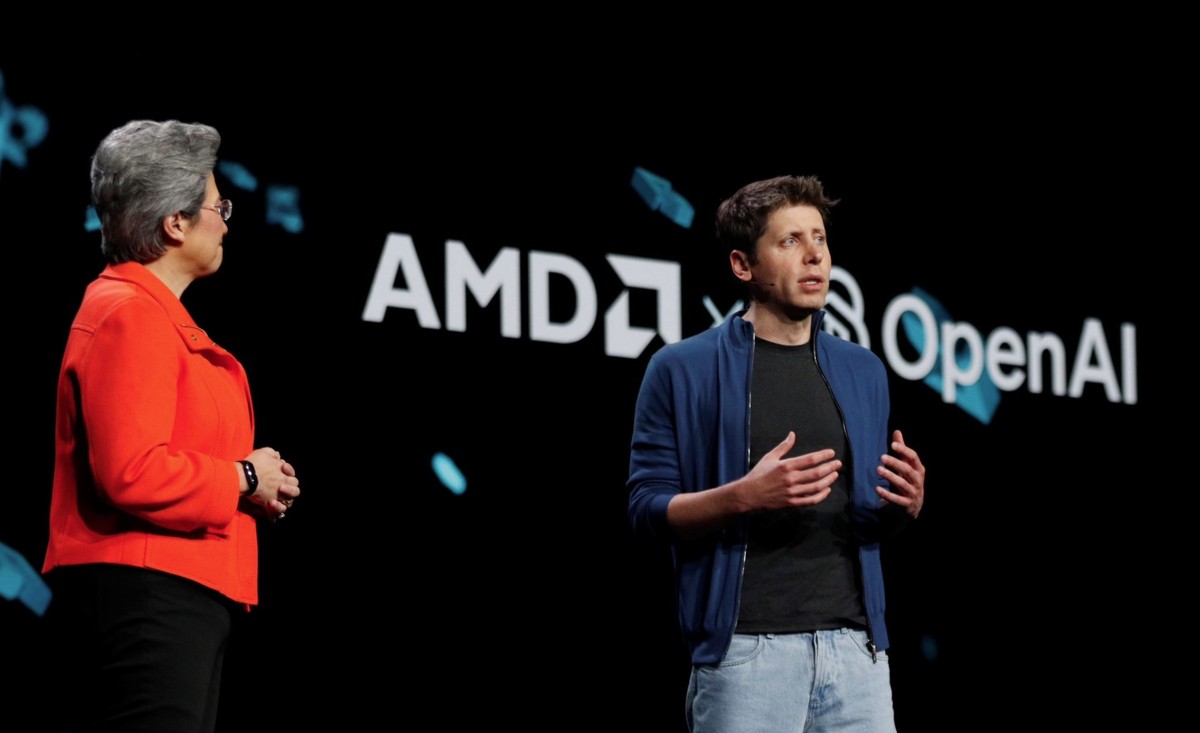
“For the first time we designed every element of the wardrobe as an integrated system,” SU emphasized, explaining that Helios consists not only of 72 GPU Instinct Mi400 systems, but also of the EPYC “Venice” EPYC processors and the “Vulcano” Pencano network cards, fastened to the Open Master. This is how it was created Communication standard enabling free exchange of data between hardware components. “Think about Helios like a server wardrobe that acts like one huge calculation engine,” she added.
Altman himself did not hide his enthusiasm. “When you told me about these parameters for the first time, I thought: there is no way, it sounds completely crazy! It will be something amazing,” he said to SU. Later he emphasized also The growing OpenAi appetite for computing power. “We need a lot of computers, lots of memory and a lot of CPU,” he emphasized. According to Altman, working with AMD on subsequent generations (already Mi450) will speed up the development of AI models capable of long context, which is crucial on the road to Aga (general artificial intelligence).
Read also: AMD MI325X. This little speaking name is a chance for a colossal confusion on the AI market
AMD Helios is to give a new quality
Helios' greatest innovation is the Rack-Scale architecture. The user sees thousands of GPU as a single, addressable resource, which simplifies the training of great artificial intelligence models. AMD declares that the Mi400 system will allow for a 10-fold increase in inference capacity compared to MI300X, with lower energy consumption. To clarify: Inference in AI calculations is a process of using a trained model to generate answers, forecasts or results based on new input data.
In the background, however, there is a war of standards. AMD focuses on an open solution Ualink, while Nvidia is pushing the ownership Nvlink. Lisa Su reminded that “the future AI will not be the work of one company or a closed ecosystem. It will be shaped by the open cooperation of the entire sector.” This is obviously a clear suggestion that AMD's approach is better, because it does not bind companies with one supplier as much as NVIDIA does.
It is worth noting that The Mi400 chip will only go into production in 2026. First, AMD will start with the Mi355X model. This system has seven times higher computing power than its predecessor and generates up to 40 percent. More dollar tokens than competitive NVIDIA Blackwell B100/B200 systems thanks to lower energy consumption. This means that the chip can generate more answers (words or fragments of the text) from the same budget, thanks to greater efficiency and less power consumption.
Andrew Dieckmann, general director of the GPU in AMD, emphasized the cost aspect. “In each dimension there is a significant difference in purchase costs, which we additionally strengthen our performance advantage, which translates into significant, several percent savings” – he said. At current prices of tens of thousands of dollars per chip, this is a real argument for companies building Data Center.
See also: A new generation laptop test is behind us. Starts ai locally – without the internet
AMD rendered Nvidia
AMD claims that Instinct systems work production in seven out of the ten largest AI companies. Oracle Cloud Infrastructure announced a cluster of up to 131,072 Mi355x chips, and the meta uses Mi300X for Llam 3 and 4 inference – and declares the transition to the Mi400. Microsoft serves Copilot services with their help, and Tesla, Xai and Cohere build their own models on them. Therefore, it cannot be said that AMD has a small presence on the AI market.
In previous years, AMD focused on server CPU and chased Intel. Today the goal is the entire AI infrastructure. Within 12 months, the company took over or invested in 25 AI companies-including ZT Systems, whose know-how was the basis for building Helios, and start-ups such as Untether AI or Lamini. “AI systems are becoming extremely complex, which is why full -fledged solutions are really crucial,” SU summed up.
Expenses of technology companies will only exceed $ 300 billion this year.and AMD estimates that the AI accelerator market will reach $ 500 billion. Until 2028, despite this, the manufacturer admits that he still does not know what participation he will be able to break out. Today, Nvidia has over 90 percent. sector for yourself. Anyway, investors remain careful: AMD shares have been practically flat since the beginning of the year, and after the presentation of new systems they fell by 2.2 percent. In the context of the capitalization of AMD to Nvidia, the abyss is also divided, because this first company is valued at $ 192 billion, while Nvidia is almost the most expensive company in the world today, with a valuation of $ 3.5 trillion. (Microsoft is slightly more expensive).
Don't miss: A frenzy for the construction of data centers. The demand is growing, electricity suppliers rub their hands
We are a step closer to Aga
Why are Helios and Mi400 so important for the market? The architecture proposed by AMD allows you to combine hundreds of Petaflts (computing power) into one addressable memory space, which is a condition for training AI models with billions of parameters and a context of millions of tokens – and thus the next stage on the road to artificial general intelligence.
AMD does not dethrone Nvidia overnight, but presenting Helios and Mi400, she appointed a new rivalry vector. Not a single chip, but a whole, open and scalable system. If the announcements are confirmed, and customers such as Opeli or Oracle will keep orders, next year may be the first in which the barrier to entering the data centers AI will really decrease. This can speed up the arrival of the AGA era, as well as significantly improve AMD valuation.
Author: Grzegorz Kubera, Business Insider Polska journalist