Below we publish a fragment of the book “Lost Hegemon. The wasted American chance and Trump's revolution”
Robert Zoellick was a veteran of George Bush Senior's administration. At the turn of the 1980s and 1990s, he served in the State Department as an adviser and trusted collaborator of James Baker, but he was also an envoy of the president himself to meet European allies. Zoellick won a strong position in administration that he was the head of the American delegation, which negotiated with the Soviet Union of the Union of Germany.
When the Democrats took power at the beginning of 1993, and Clinton moved into the White House, Zoellick took care of the advisory, scientific and didactic career. He was one of the most important votes of the right in international issues, and other Republicans willingly scored his opinion. Therefore, when after the 2000 election it turned out that it was Bush – this time Bush Junior – would form a new office, Zoellick became one of the favorites to take an important position. Ultimately, he was involved in the role of a representative for international trade and in this rank he continued the free market policy of Clinton's administration, including supervising the inclusion of China in the World Trade Organization (WTO).
On September 21, 2005, as a deputy secretary of state, Zoellick gave a program speech in which he appealed to China to become a “responsible shareholder” of world order. He claimed that the United States was enjoying cooperation with “confident, peaceful and wealthy” China and that Beijing is in the interest of Beijing with Washington to “shape the future world order”. He recognized that China, which was the fifth economy of the world, and their GDP grew by over 10 percent every year, would become one of the key playmakers in the international arena very quickly. But the longer his speech lasted, the more his tone changed.
You can order the book “Lost Hegemon. Watted Trump's America's Opportunity Opportunity” here!
America dictates China conditions
Zoellick said that the Chinese must realize, “as their actions perceive others”, and their “involvement in cooperation with countries that cause trouble, at best indicates blindness, if not much worse.” Beijing has repeatedly argued that his development is peaceful and has no bad intentions, but Washington was skeptical about such assurances.
That is why Zoellick explained that “uncertainty as to how China will use their power, leaving the United States (…) for greater caution.” America, who spent several times more on reinforcements every year than China, was afraid of “rapid modernization of China and the development of their capabilities” and asked “questions about the goals of this development.”
Shawn Thew / PAP
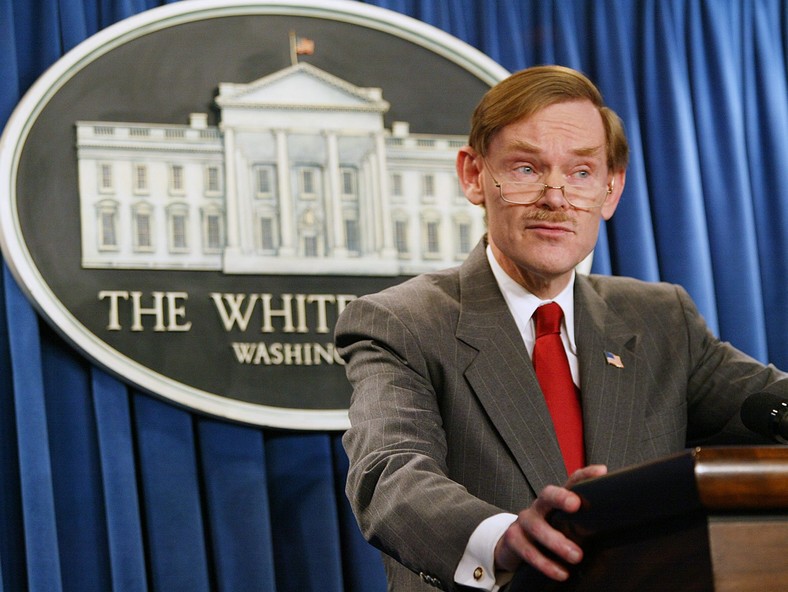
Robert Zoellick in 2003
Zoellick's words were reminiscent of the famous Crowe Memorandum written in 1907, in which the British diplomat Sir Eyre Crowe warned against the growth of Germany and stated that “they were striving [one] To play a much larger and much more dominant role in the international arena than the one that fell in the currently existing system of strength. “
Zoellick saw one solution that could alleviate America's fears: China had to democratize. Thus, he expressed the belief, according to which only the expansion of the zone of democracy and free market economy could secure the interests of America and make the world a place safe for democracy. “A closed political system cannot be a permanent feature of Chinese society,” said Zoellick, clearly directing his words to the authorities in Beijing. Representatives of the American establishment could not imagine that economic liberalization could not bring democratization and political awakening of Chinese society.
Zoellick calculated the reforms that in his opinion China should take to make a “peaceful political transformation” and that “the government could answer to citizens, and could also be settled by them”. In short, the United States predicted the role of “responsible shareholder” for China, but only for democratic and free market China.
Continuation of the material under the video
Was America a “responsible shareholder”?
Zoellick spoke all this over two years after the Americans had a violation of international law with a violation of Iraq with violation of international law. If an external observer would listen to his speech, he would probably do it with some embarrassment or disbelief. First of all, he would ask himself whether the United States may require other countries to become “responsible shareholders” of the world order, since they themselves disregarded the basic principles on which he was based.
Was there not a serious dissonance between Zoellick's admonitions and the policy of America herself, which definitely abused her power, making two invasions to another country in a short time without authorization of the UN Security Council? How reliable in the eyes of other countries were Zoellick's words, since the United States under Bush rejected subsequent international agreements or withdrew from them and tried to freely free from their embarrassing corset? Zoellick claimed that other countries are concerned about Beijing, but he did not think about how great concern in the world aroused the warrior attitude of Bush administration and how serious effects it will have in the future for America herself and her global interests.
Pool / PAP
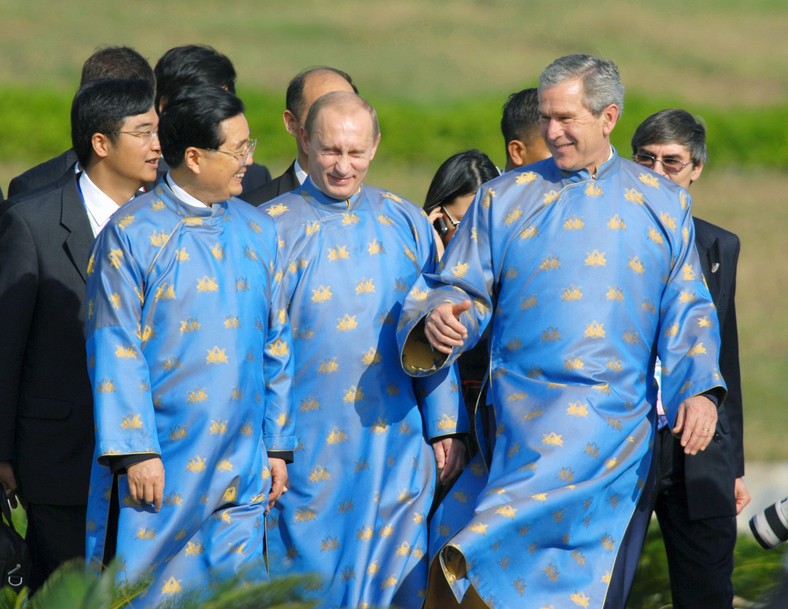
Hu Jintao, Vladimir Putin and George W. Bush in Vietnam, 2006
There is no reason to think that this lack of reflection resulted from Zoellick's bad will. It was rather a manifestation of the American establishment typical of the then – both right -wing and leftist – conviction of the correctness of its own case and the universality of their principles.
Zoellick saw nothing bad in neoconservative assumptions, which after September 11 became the dogmas of almost the entire American political scene: America did not need international legal sanctions to defend the interests of its country; The war against Iraq was a “just war”, and the allegations of any abuse had to be sold as defeteistic and non -patriotic; Other countries should not, however, against America's actions from moral positions, because they were cynical or murdered their citizens. The American establishment spoke in this matter with one voice.
America at the peak of power
Zoellick could proclaim these dogmas with the greater ease and confidence that during the preparation for the attack on Iraq America was at the peak of power. The American economy was almost three times larger than the second in this ranking of Japan. United states' outlays on reinforcements were greater than the total expenses of several more countries. No country of the world could compare with them in terms of technological advancement, quality of universities or the number of patents reported.
America attracted people from around the world who wanted to realize their American dream, and easy credit and money availability allowed Americans to live in the belief that a good run would never end. At the very beginning of the 21st century, a typical representative of the New York or Boston middle class (not to mention the elite of the country) it may seem that the story, like a half -jack, once noted tonbee, it really is something unpleasant, which happens only to other people.
No country could oppose the invasion of Iraq, because it did not have sufficient military or economic power, to force Americans to comply with international law through sanctions. The provisions of the United Nations Card in confrontation with a powerful and determined state were nothing to use force against another country. Nay. The scale of American power and Washington's determination meant that the benefits of working with hegemon even in this situation definitely prevailed over what could be obtained using a strategy of opposition.
Ina / PAP
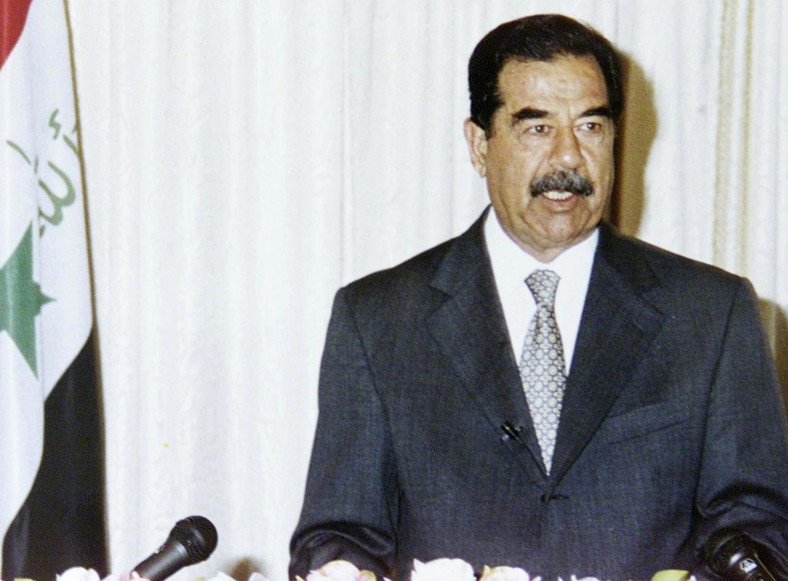
Saddam Hussein in 2002
Saddam Hussein was a brutal dictator. However, the UN Security Council resolution adopted in November 2002 did not allow armed intervention to overthrow it. Attacking Iraq, the Americans actually sent the world news that the right one belongs to who is stronger, more determined and can enforce their will. When Zoellick admonished the Chinese to become a responsible state, his words were the same implied belief that, if necessary, the United States would also be able to cope with Beijing's insubordination.
You can order the book “Lost Hegemon. Watted Trump's America's Opportunity Opportunity” here!
I’m Ashley Davis as an editor, I’m committed to upholding the highest standards of integrity and accuracy in every piece we publish. My work is driven by curiosity, a passion for truth, and a belief that journalism plays a crucial role in shaping public discourse. I strive to tell stories that not only inform but also inspire action and conversation.