June 4 10:40
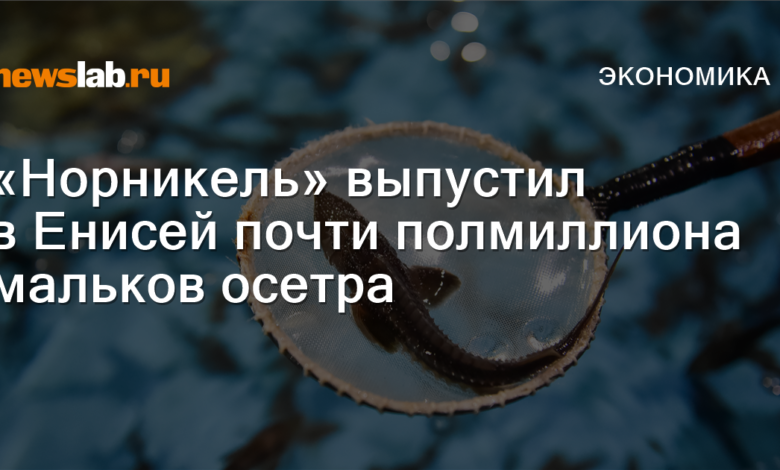
Norkel's subsidiary launched the first Party of Malkov Oaketra in Yenisei in Yenisei.
The Norilsk-Tyimyr Energy Company (NTEK) plans to release 3 million fry. This is the same amount as in the previous two years. The first batch exceeds 460 thousand fry.
The work is carried out as part of an agreement concluded in 2022 between NTEC, the All -Russian Research Institute of Fisheries and Oceanography (VNIRO) and the Yenisei territorial department of the Federal Agency for Rosterbolism. It stipulates the conditions of the largest scientific research of the Taimyr water bodies, as well as the burden of the Yenisei basin and the Norilo-Pipained water system.
For the period up to 2050, the Energy Company plans to release 510 million copies of the young people of valuable species of fish: sturgeon, muksun, Chira, Sig and Nelma in the reservoirs of the Norilo-Peni-River System. Thus, it will be possible to completely restore the condition of aquatic biological resources and maintain them at a level that provides the most stable prey and biological diversity.
“NTEK has been holding large -scale measures for the burdens of the Yenisei for the third year. All plans for the releases of past years are fully implemented. And this year in June we will start our great work. Hundreds of specialists are involved in our joint work with Rosrybolovstvo and Niro, including scientists who conduct the largest fisheries research in recent Russian history, ”said Vladimir Voronkov, head of NTEC projects.
Norilsk Nickel implements a large -scale burial program for which tens of millions of rubles are allocated annually. The company also cooperates with Russian producers of aquaculture, including from the Krasnoyarsk Territory.
In 2023, a study of the condition of aquatic biological resources and their habitat began. The work is being carried out by NIRO, it is designed until 2051. Thus, the program of the study of the Pyasin River basin is an example of scientifically based restoration of fisheries and industrial fishing of a large lake system in the Arctic zone. During the expedition, researchers develop new research methods, theoretical models and technologies for the restoration of aquatic ecosystems, which will further be widely used in the restoration of other water systems of the Arctic.
Links on the topic:
- In the Krasnoyarsk Territory, the court allowed residents to fish on Lake Big
- In Krasnoyarsk, the collapsing shore of the island of Tatyshev will strengthen for 80 million rubles