Trump undermines the foundations in the USA, and Europe rubs its hands. “Let's use it”

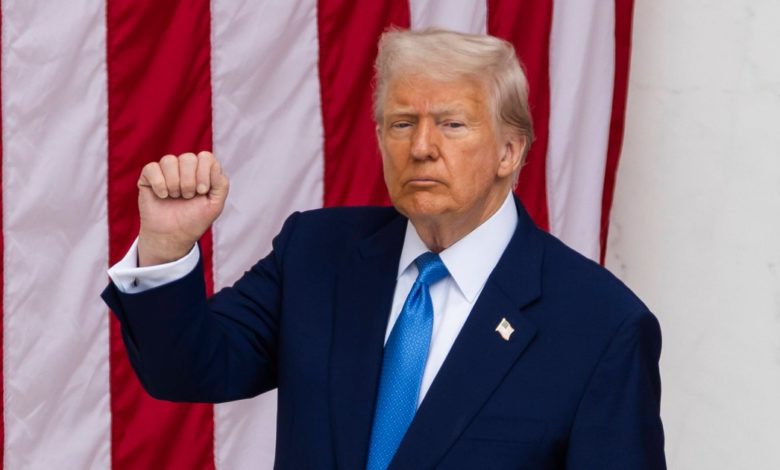
University professors and directors of research centers throughout the continent see the positive sides of the repression of the American president towards American higher education, which include attacks on professors and students, as well as renowned universities from the so -called ivy league, such as Harvard and Columbia, and freezing of billions of dollars of federal funds.
– This is a chance for Europe to start a new enlightenment and establish new partnerships around the world -said Alain-laurent Verbeke, a professor of law at the Belgian research university towards Leuven, who has also lectured on Harvard Law School since 2007.
European universities and leading politicians mobilized in response to Trump's activities in the USA, creating new initiatives aimed at attracting the best foreign talents to Europe by offering generous scholarships and greater academic freedom.
At the beginning of this month, the chairwoman of the European Commission Ursula von der Leyen and President of France Emmanuel Macron announced a plan worth EUR 500 million [2 mld 125 mln zł] Under the name “Choose Europe for science”, which aims to attract foreign scientists to the EU.
– We double the potential amount that scientists moving to Europe from anywhere in the world as part of the relocation fund can apply for – said Maria Leptin, chairwoman of the European Council for Scientific Research (ERC), the EU public authority for scientific and technological research, which cooperates with the Commission on this initiative. – We have to intensify our efforts. And not because of what is happening in the United States, but because we have to do it anyway – she added.
Last month, the Commission announced plans to accelerate visa procedures in order to attract scientists from the USA, and the ministers for EU scientific research met in Brussels on May 23 to discuss ways to increase Europe's competitiveness in the field of science and innovation.
-Let's use this dynamics and this opportunity to attract the most talented and best talents from around the world-said the Commissioner for Start-Punks, Scientific Research and Innovation of Ekaterina Zahariev.
Thanks to the significant strengthening of scientific research and academic development, the EU can increase its economic competitiveness and innovation, and at the same time in a better position to face key challenges, such as climate change and healthcare.
– Scientific research is the foundation of enterprises of the future. By investing in research, we invest in the competitiveness of Europe and the workplace of the future – said French Minister for Scientific Research Philippe Baptiste.
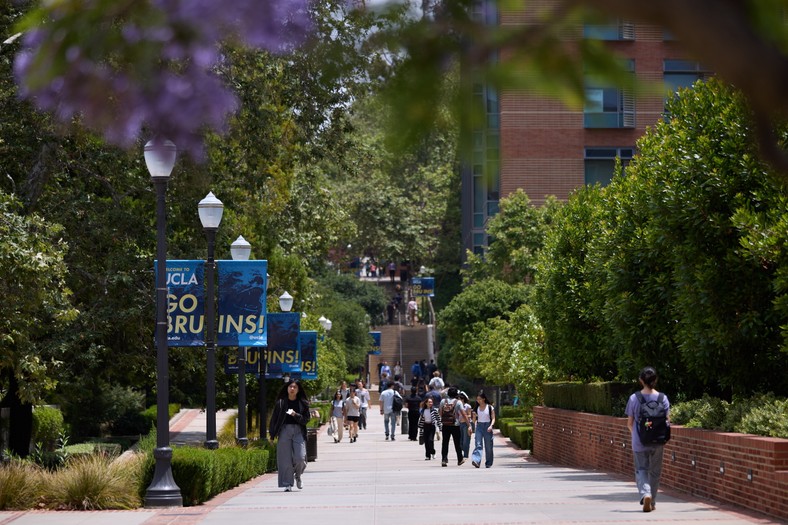
Students at the campus of the University of California in Los Angeles (UCLA) in Los Angeles, USA, 29 May 2025. Trump administration initiated many investigations about universities from the so -called ivy league, including blocked the attempt to withdraw the possibility of accepting foreign students to Harvard
Strengthening efforts
Although Trump gave Europeans a political impulse to increase investments in science and research, experts warn that The EU will have to do much more to strengthen its position and achieve true independence from the United States.
“It would be an illusion that a few additional high -level subsidies are enough,” Leptin from Erbn said.
– The best scientists need good infrastructure and support from research institutions. Young people need good professional perspectives and long -term financing – she added, pointing out that it is mainly EU Member States that should “intensify efforts and increase the attractiveness of research.”
Many European governments have reacted to the possibility of attracting the best talents from the USA, establishing new grants and offering new positions for people from [co najmniej] title of doctor.
Since the start of repression by Trump, the Netherlands, France, Spain, Belgium and Norway have launched targeted initiatives to attract foreign scientists, offering them financing, institutional support and long -term career possibilities in such fields as health, climate and artificial intelligence.
Similarly, European universities, such as Belgian Vrije Universiteit Brussel (Vub) and the French University of Aix-Marseille (AMU), have allocated funds for the recruitment of scientists with the title of Doctor who are “victims of political and ideological interference” in the United States.
Fear and reluctance
Leading European scientists note that their colleagues in the United States have become more and more cautious and full of fears in the face of the repressive policy of Trump, often based on the pretense of combating alleged anti -Semitism and “ideology of vocals” on university campus.
Jan Danckaert, rector of Vub, said that the US scientists began to use anonymous e-mail accounts and encrypted communication platforms to contact international partners.
“It shows that they are very concerned about the way they contact institutions outside the United States,” he said, noting the fears that even a small cooperation in projects that do not like the Trump administration, can be used as a basis for further financing cuts.
Cooperation with colleagues from the USA has become more and more difficult than Trump's second term in January – said Frank Oliver Gloeckner from the Pangaea Environmental Data Center.
– It is a combination of people's fears to lose their jobs and the inability to continue to maintain or provide the same data He explained.
Gloeckner added that some US scientists can not currently participate in video conferences without the consent of the highest level leadership. “For the first time we hear about something like that … and it has changed from day to day,” he said.
European scientists note that the problem of self -censorship is also growing among American researchers.
“They don't want their names to appear in official media, scientific reviews or nowhere else,” said Gloeckner.
Danckaert shared this fear. – Observation of our colleagues in the United States shows that a kind of self -censorship is introduced there – he said. – They are much more cautious in contacts and how to communicate. They always look back.
After Verbeke from Leuven publicly criticized Trump in the European press, several colleagues from Harvard thanked him privately for expressing his opinions, which they were unable to speak.
“I understand professors who don't want to speak, and I respect it, but at the same time I think I have a moral duty to speak,” he said.
Verbeke admitted that this could threaten his chances of getting a visa to the United States or a return to work at Harvard.
“In my heart I am a real transatlantic citizen and I never imagined that one day we would get to the point where the idea of academic freedom will be questioned,” said the German Minister of Research, Technology and Space Dorothee Baer.
– That's why we must now be a safe country, a safe marinade, a safe continent. However, I do not lose hope that the Land of Freedom will one day deserve its name again – she added.